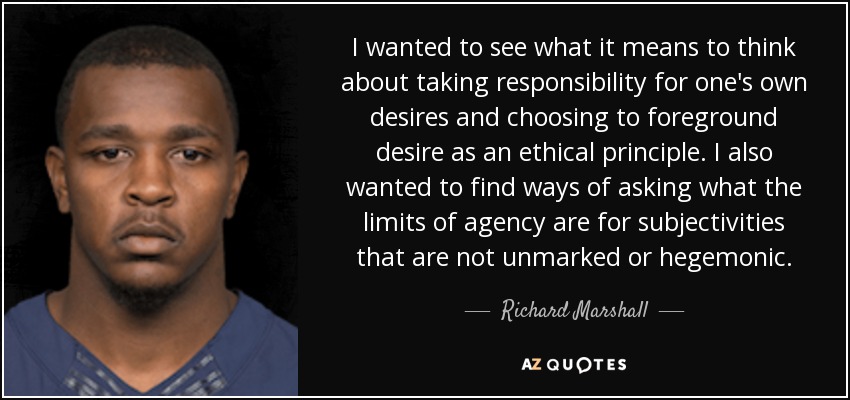
I wanted to see what it means to think about taking responsibility for one's own desires and choosing to foreground desire as an ethical principle. I also wanted to find ways of asking what the limits of agency are for subjectivities that are not unmarked or hegemonic.
Autonomy is the capacity to act on principles that are one's own and one will exercise this capacity by means of a process of rational reflection on these principles. Autonomy is thought to be necessary for attributing political responsibility.
The religious stories, the religious truths, the spiritual principles - obviously, they don't change. But as you get older and you experience more, you recognize the applicability, the profundity, and the fundamental truths of spiritual principles in ways that you couldn't when you simply were living a less dimensional life.
What distinguishes Shambhala is its intention of trying to create a society based upon certain principles. So, Shambhala's focus is not just on the individual, but on society as a whole.
People can be trained in certain principles, but then they actually have to apply them and try them out.
Ultimately, as individuals we each have to ask ourselves to be courageous and apply certain principles.
Fundamentally, Buddhism is for the awakenment and benefit of beings. So, you can't say, "Oh, you can't have it because you're not ready for it." That goes against the fundamental principle.
Buoyant leadership is not a management technique, it's a leadership principle based on the belief that leading isn't presiding, it's taking people on a journey, and on any hero's journey there will be a setback.
There is a dichotomy between people who feel economic principles should order human civilization and people who believe humanitarian principles should order human civilization. That essential disagreement is underlying practically all our world drama.
I am a student of universal spiritual principles, and I read theology and spiritual writings, so my grasp of basic spiritual principles is fairly good.
I won't lay down my principles for any kind of recognition or any kind of position or trying to be more famous. It's just not in me. I'd rather be a man. And then to have all this crazy stuff on my conscience.
Working in theoretical systems can take away the juice. It can also be very beautiful, but when you're trying to satisfy a theoretical principle rather than a sonic reality, then it can become dry.
I knew that the principle objective of my film was to be a sentimental or an emotional study. What I did was kind of like subterfuge.
When I think of civil liberties I think of the founding principles of the country. The freedoms that are in the First Amendment. But also the fundamental right to privacy.
Why I can't stand this phrase about I don't have any permanent enemies, any permanent friends, only permanent interests. I can't stand that. It's a matter of principles. What kind of integrity, what kind of morality do you have?
It's something that people who read my materials have asked me in the past. If you don't have principles - the last chapter of the book ["Win"] is all about winning with principles. It's all about applying words to good things, good people, good efforts. Without that inherent accuracy, then even the best words will still fail.
It has to be simple, but then you deliver them a principle: The simple truth is, as a matter of principle, we cannot spend more than we take in. Something - that changes the tone of the debate.
George W. Bush - who I'm sure that a lot of people, when I say this, will not be happy about it - but Bush had a determination, and had a very clearly defined set of principles. You knew exactly where he stood.
We all know people who say: "It's the principle of the matter" to justify sustaining toxic emotions for years. As they hold onto their anger or hurt, they bleed away their energy reserves, often ending up bitter and depressed.
Nothing can tell us so much about the general lawlessness of humanity as a perfect acquaintance with our own immoderate behavior. If we would think over our own impulses, we would recognize in our own souls the guiding principle of all vices which we reproach in other people; and if it is not in our very actions, it will be present at least in our impulses. There is no malice that self-love will not offer to our spirits so that we may exploit any occasion, and there are few people virtuous enough not to be tempted.
In every science certain things must be accepted as first principles if the subject matter is to be understood; and these first postulates rest upon faith.
The Compound Effect is the principle of reaping huge rewards from a series of small, smart choices
The sickness of indulging desires can be treated, but the sickness of clinging to abstract principles is hard to treat. Obstacles presented by events and objects can be removed, but obstacles presented by social principles are hard to remove.
We must never violate principles. We must never initiate violence. And we should never harm the innocent. But at some point, unless governments back off, we have to stop being nice.
It is better that great peoples should seek out glory, or even vanity, in their deeds, than that they should remain indifferent . For even if they are not incited to act upon virtuous principles, at least there is the saving grace that they will do things they might not have done had not vanity prompted their actions.
Follow AzQuotes on Facebook, Twitter and Google+. Every day we present the best quotes! Improve yourself, find your inspiration, share with friends
or simply: