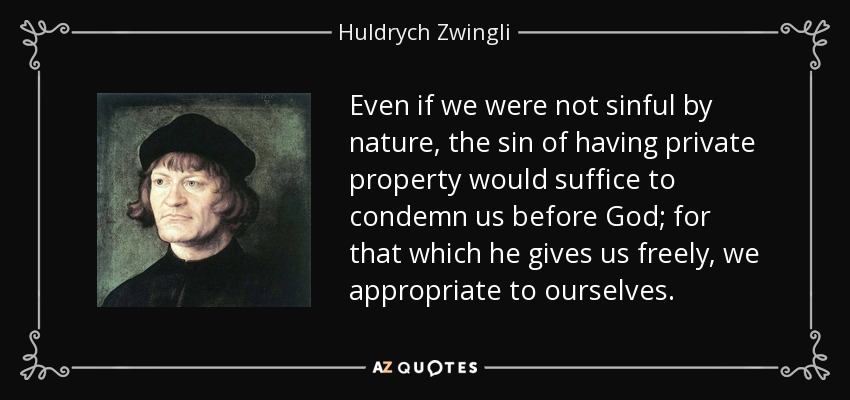
Even if we were not sinful by nature, the sin of having private property would suffice to condemn us before God; for that which he gives us freely, we appropriate to ourselves.
The foundation of any and every civilization, including our own, is private ownership of the means of production. Whoever wishes to criticize modern civilization, therefore, begins with private property.
The idea of private property universal but private, the idea of families free but still families, of domesticity democratic but still domestic, of one man one house - this remains the real vision and magnet of mankind. The world may accept something more official and general, less human and intimate. But the world will be like a broken-hearted woman who makes a humdrum marriage because she may not make a happy one; Socialism may be the world's deliverance, but it is not the world's desire.
The foundations of liberty are private property and the rule of law; this system guarantees the fewest possible forms of injustice, produces the greatest material and cultural progress, most effectively stems violence and provides the greatest respect for human rights. According to this concept of liberalism, freedom is a single, unified concept. Political and economic liberties are as inseparable as the two sides of a medal.
Civil rights, as we may remember, are reducible to three primary heads; the right of personal security; the right of personal liberty; and the right of private property. In a state of slavery, the two last are wholly abolished, the person of the slave being at the absolute disposal of his master; and property, what he is incapable, in that state, either of acquiring, or holding, in his own use. Hence, it will appear how perfectly irreconcilable a state of slavery is to the principles of a democracy, which form the basis and foundation of our government.
My concern over private property is that it no longer fosters individuality. The historic destiny of private property is that it has created a highly corporatized economy, and I have to ask myself why. What is it in the market that led 100 capitalists to dissolve into 10 as a result of rivalry and accumulation, 10 into 3, and I think if the system has its way, those 3 into 1?
A people averse to the institution of private property is without the first elements of freedom
Private property is a necessary institution, at least in a fallen world; men work more and dispute less when goods are private than when they are in common.
Private Property, the Law of Accumulation of Wealth, and the Law of Competition... these are the highest results of human experience, the soil in which society so far has produced the best fruit.
One ideological claim is that private property is theft, that the natural product of the existence of property is evil, and that private ownership therefore should not exist... What those who feel this way don't realize is that property is a notion that has to do with control - that property is a system for the disposal of power. The absence of property almost always means the concentration of power in the state.
The two big mistakes were the belief in a sky god - that there's a man in the sky with 10 things he doesn't want you to do and you'll burn for a long time if you do them - and private property, which I think is at the core of our failure as a species. That's the source of my indignations, my dissatisfactions, however it comes out on the stage. I feel betrayed by the people I'm part of, these creatures, these magnificent creatures.
The great blessing of private property, then, is that people can benefit from their own industry and insulate themselves from the negative effects of others' actions. It is like a set of invisible mirrors that surround individuals, households or firms, reflecting back on them the consequences of their acts. The industrious will reap the benefits of their industry; the frugal the consequences of their frugality; the improvident and the profligate likewise. They receive their due, which is to say they experience justice as a matter of routine.
I have an admiration, even though I'm not likely to do that sort of thing myself, for [Ayn] Roark's behavior when he decided that his design was not being followed - which was a gross violation, by the way, of private property rights, because the building was his.
If men are discharged of reverence for ancient usage, they will treat this world, almost certainly, as if it were their private property, to be consumed for their sensual gratification; and thus they will destroy in their lust for enjoyment the property of future generations, of their own contemporaries, and indeed their very own capital.
The way to maximize production is to maximize the incentives to production. And the way to do that, as the modern world has discovered, is through the system known as capitalism - the system of private property, free markets, and free enterprise.
The protection of private property does more than promote market efficiency; it enhances the level of human freedom in the most intimate and personal parts of our lives.
Economic activity, especially the activity of a market economy, cannot be conducted in an institutional, juridical or political vacuum. On the contrary, it presupposes sure guarantees of individual freedom and private property, as well as a stable currency and efficient public services.
We hold that the ownership of private property is the right and privilege of every American citizen and is one of the foundation stones upon which this nation and its free enterprise system has been built and has prospered. We feel that private property rights and human rights are inseparable and indivisible. Only in those nations that guarantee the right of ownership of private property as basic and sacred under their law is there any recognition of human rights.
The very foundation of private property and free contracting wears away in a nation in which its most vital, most concrete, most meaningful types of private property and free contracting disappear from the moral horizon of the people.
The slave states of Western world are an outgrowth of monopolistic capitalism - an economic system which is opposed to the wide distribution of private property in many hands. Instead, monopolistic capitalism concentrates productive wealth among a few men, allowing the rest to become a vast proletariat.
Monopolistic capitalism is to blame for this; it sunders the right to own property from responsibility that owning property involves. Those who own only a few stocks have no practical control of any industry. They vote by postcard proxy, but they have rarely even seen "their" company. The two elements which ought to be inextricably joined in any true conception of private property - ownership and responsibility - are separated. Those who own do not manage; those who manage; those who manage and work do not control or own.
One of the most extraordinary examples in recent decades [of unitary visions of constitutional enterprise] is found in a book called "Takings"... Epstein makes an extremely clever but stunningly reductionist argument that the whole Constitution is really designed to protect private property... Can a constitution reflecting as diverse an array of visions and aspirations as ours really be reducible to such as sadly single-minded vision as that?
The continued existence of society depends upon private property.
Any material element or resource which, in order to become of use or value to men, requires the application of human knowledge and effort, should be private property-by the right of those who apply the knowledge and effort.
Taxation of private property, or the regulation of such property so as to reduce its value, can become in effect a form of servitude.
Follow AzQuotes on Facebook, Twitter and Google+. Every day we present the best quotes! Improve yourself, find your inspiration, share with friends
or simply: