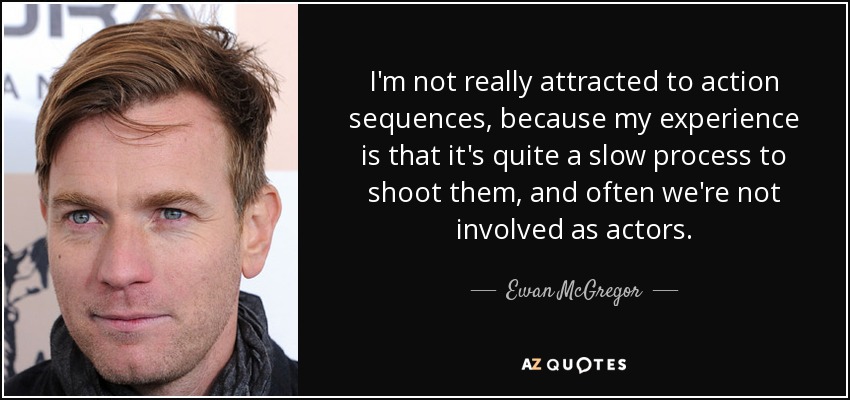
I'm not really attracted to action sequences, because my experience is that it's quite a slow process to shoot them, and often we're not involved as actors.
Just when you think you're hitting your stride someone will shout "cut" and ask you to move your head to the left. It's such an awkward process. You try to make it passionate but it ends up being mechanical.
I have control over every single frame on Blu-ray. If I want a scene bluer, I get that scene bluer. Originally, there was some fluctuation with the prints. If you made a thousand, or a few thousand prints, there is no control over any of that. But now I can make a master using the digital process.
The digital process gives me total control over how I want the film to look. The films look like they did when I was first looking through the viewfinder.
That's the one thing I say about the great British shows. You know, I see it on the series on HBO where the season is shortened to like 12 or 6 or whatever it is. You know there's a reason why there's a quality behind that. Because I think the writers as well as the crew and the cast do get burnt out after doing continuous episodes after and over and it feels like a factory rather than something of a creative process. And we get tapped out. That's just my opinion.
When I was 16, I took the written driving test, just like everybody else did, and I passed it. Then the first time I was behind the wheel of a car, when I was a kid, it kind of freaked me out. I've always been a very anxious student of anything, and so not being able to process things quickly enough, feeling overwhelmed, I just got freaked out and so I just never tried again.
You can't really make something or make a movie and feel all through the process that it's a painful thing. It's not possible to do that.
On the times when I used to make movies that were with a lower budget, nobody was expecting it to be a hit, and nobody was paying attention to what I was doing, and it was a free type of creative process. So, one way to reset myself is to go back to that kind of moviemaking.
I'm in total control. I write the songs, decide what to sing and how to sing. I even control the recording process. But, with a film, there is no control at all.
The normal routine is always the same thing whether it's on a new movie or a new job - there's always a process of getting to know one another. I think part of what makes movies special is that it is a relatively intimate environment and it's pretty short-lived - you get to know one another very quickly.
And those moments that I find mind busting. Meaning like there's a word that I find in a weird place. I love the process of going to the writer and working that out, because that's just basic communication.
You can do everything differently in a novel. Hero narrates the novel; we're in his head. You're hearing all his thought processes and you're hearing him call himself out on his bad behavior. You don't have the benefit of that narrator in a movie. What you see a character do, very often, becomes that much more important because you don't have him editorializing it for you.
I start casting early in the writing process, so I can tailor the script to the gifts of the actors.
And so you try your best. Sometimes you go in with one thing, with one desire and come out with something else. In the case of 'The Aviator' it was to create a Hollywood spectacle, but by about the second or third week of shooting you just want to literally survive it. Because don't forget, I also go through the editing process too, and when the film is released I have to talk about it. So, I take all of that very seriously.
Do I consider myself a part of the casino capitalist process? No I don't. I believe in a society where all people do well.
I think it's important that members of the United States Senate spend time not just on Capitol Hill but making contact with ordinary people and engaging them in the political process.
If you do improvising, it can sometimes end up being a waste of time. And if you do that, it's more or less based on a writing process.
Very thorough in the rehearsal process but more in terms of just understanding the characters, understanding where the actors are at with discovering those characters for themselves, and just setting an overall emotional tone for the piece as opposed to necessarily getting things up on their feet or staging scenes.
If you're going to do a memoir, then it's sort of at this age - in your late sixties or seventies - that you do it. I don't understand people who do memoirs when they're 20. I think most people need a little more time than 20 years to become the person they are. In fact, that process of becoming who you are is still ongoing when you get older, where you go, "Let's see where my next 10 years is going to take me." S
It's sort of an organic process when you're adapting any book, not even just your own. You want to preserve the heart of the story and you want to preserve who the characters are, but film requires a lot of compression.
The experience we all share and the outcomes, which have been remarkable in a way I never could have predicted. Taking unmotivated people - maybe marginally motivated to get on TV and make money - and ending up with a group that values and is changed by the treatment process and wants to share it with other people.
I like drawing. I like to spend the day drawing, the process is important for me. Drawing is a just a pleasure and it's nice to keep it going.
The artwork had very little to do with the thought process, and the writing too, for that matter. What happens, happens, and it happens outside the brain.
Because I'm such a studio guy, I really trust my process. I really believe in myself in the studio.
The long takes process doesn't allow for that many takes. In the past I have shot over 50 takes of different shots. Sometimes you end up using take 64, sometimes take four.
Follow AzQuotes on Facebook, Twitter and Google+. Every day we present the best quotes! Improve yourself, find your inspiration, share with friends
or simply: