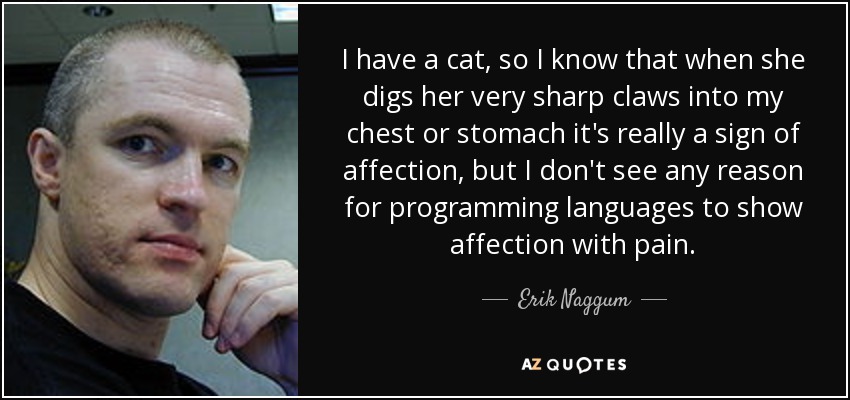
I have a cat, so I know that when she digs her very sharp claws into my chest or stomach it's really a sign of affection, but I don't see any reason for programming languages to show affection with pain.
My particular interest for the past couple of years has been to really think deeply about the big impendence mismatch we have between programming languages, C# in particular, and the database world, like SQL or, for that matter, the XML world, like XQuery and those languages that exist.
If there is ever a science of programming language design, it will probably consist largely of matching languages to the design methods they support.
With .NET once an API is published it's available to all programming languages at the same time.
A programming language that is sort of like Pascal except more like assembly except that it isn't very much like either one, or anything else. It is either the best language available to the art today, or it isn't.
My programming language was solder.
Computer scientists have so far worked on developing powerful programming languages that make it possible to solve the technical problems of computation. Little effort has gone toward devising the languages of interaction.
Job Control Language is the worst programming language ever designed anywhere by anybody for any purpose.
For his major contributions to the analysis of algorithms and the design of programming languages, and in particular for his contributions to the "art of computer programming" through his well-known books in a continuous series by this title.
And C++ programming languages, we own those, have licensed them out multiple times, obviously. We have a lot of royalties coming to us from C++.
The properties of executability and universality associated with programming languages can be combined, in a single language, with the well-known properties of mathematical notation which make it such an effective tool of thought.
Although mathematical notation undoubtedly possesses parsing rules, they are rather loose, sometimes contradictory, and seldom clearly stated. [...] The proliferation of programming languages shows no more uniformity than mathematics. Nevertheless, programming languages do bring a different perspective. [...] Because of their application to a broad range of topics, their strict grammar, and their strict interpretation, programming languages can provide new insights into mathematical notation.
With the computer and programming languages, mathematics has newly-acquired tools, and its notation should be reviewed in the light of them. The computer may, in effect, be used as a patient, precise, and knowledgeable "native speaker" of mathematical notation.
It is the role of the artistic coder to question the coding languages, both through self-reflection and by using them for unintended purposes. These coders introduce multiplicity where none existed and challenge definitions of intent for the entire environment of programming language, machine and system.
Programming languages are like girlfriends: The new one is better because *you* are better.
My favorite programming languages are Lisp and C. However, since around 1992 I have worked mainly on free software activism, which means I am too busy to do much programming. Around 2008 I stopped doing programming projects.
A powerful programming language is more than just a means for instructing a computer to perform tasks. The language also serves as a framework within which we organize our ideas about processes.
The principal lesson of Emacs is that a language for extensions should not be a mere "extension language". It should be a real programming language, designed for writing and maintaining substantial programs. Because people will want to do that!
Most programming languages contain good parts and bad parts. I discovered that I could be better programmer by using only the good parts and avoiding the bad parts.
All of us who attended the meeting - including Microsoft - unanimously agreed that unilaterally extending the Java programming language would hurt compatibility among Java tools and programs, would injure other tools vendors and would damage customers' ability to run a Java-based software product on whatever platform they wished.
Eiffel borrows quite openly from several earlier programming languages and I am sure that if we had found a good language construct in C we would have used it as well.
XML is not a language in the sense of a programming language any more than sketches on a napkin are a language.
I don't know how to stop it, there was never any intent to write a programming language [...] I have absolutely no idea how to write a programming language, I just kept adding the next logical step on the way.
In my daily work, I work on very large, complex, distributed systems built out of many Python modules and packages. The focus is very similar to what you find, for example, in Java and, in general, in systems programming languages.
C++ is in that inconvenient spot where it doesn't help make things simple enough to be truly usable for prototyping or simple GUI programming, and yet isn't the lean system programming language that C is that actively encourages you to use simple and direct constructs.
Follow AzQuotes on Facebook, Twitter and Google+. Every day we present the best quotes! Improve yourself, find your inspiration, share with friends
or simply: