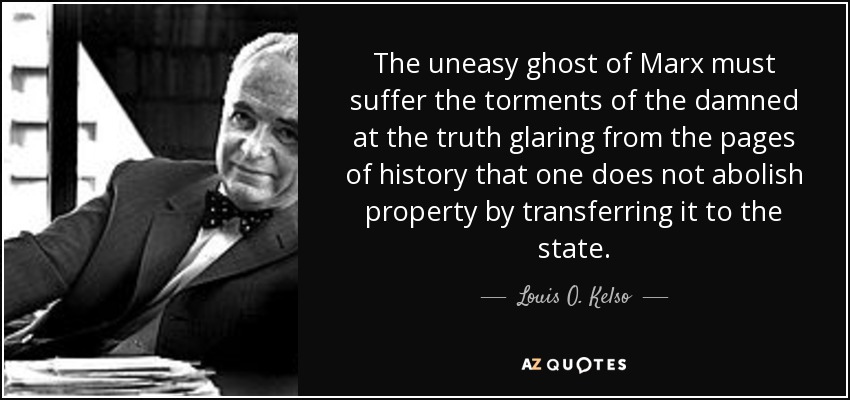
The uneasy ghost of Marx must suffer the torments of the damned at the truth glaring from the pages of history that one does not abolish property by transferring it to the state.
Take Milton Friedman, he sits at his desk pontificating about such bunk as the monetary system being the answer to our problems. The monetary system is a legal contrivance. Property, not money, is real wealth. It's physical, not legal.
Property in everyday life, is the right of control.
A community of small farmers... land property owners, will be the only assurance that the freedom our republic offers will be guaranteed to each and every citizen.
Under the old philosophy which had governed the high Middle Ages things had been everywhere towards a condition of Society in which property was well distributed throughout the community, and thus the family rendered independent.
If we're living in a free country,we should be free to do what we want to do if we're not hurting anyone else or their property. Why should I be incarcerated if I'm doing something that doesn't hurt anyone else?
When incentive to acquire and obtain property is gone, people no longer make efforts to acquire any... Those who infringe upon property rights commit an injustice... If this occurs repeatedly, all incentives to cultural enterprise are destroyed and they cease utterly to make an effort. This leads to destruction and ruin of civilization.
Good character is property. It is the noblest of all possessions.
When capital owners are few, the private-property conduits of necessity create vast savings reservoirs for those few. If there were many owners, the same conduits would broadly irrigate the economy with purchasing power.
Had there been any existent vital and energetic institution left in Society after the Reformation for the use of small property in coordinated form-that is, in combination, so that the average man's holding could be put to useful purpose in company with the holdings of a great number of other men of his own sort, the new evils would not have arisen.
It is clear that the main tenet of socialism, community of goods, must be utterly rejected, since it only injures those whom it would seem meant to benefit, is directly contrary to the natural rights of mankind, and would introduce confusion and disorder into the commonweal. The first and most fundamental principle, therefore, if one would undertake to alleviate the condition of the masses, must be the inviolability of private property.
Conscience is the most sacred of all property; other property depending in part on positive law, the exercise of that, being a natural and unalienable right.
The preceding criticism justifies the following definition of the entire human: human existence as the life of "unmotivated" celebration, celebration in all meaning of the word: laughter, dancing, orgy, the rejection of subordination, and sacrifice that scornfully puts aside any consideration of ends, property, and morality.
The dissolution of society bids fair to become the termination of a career of which property is the end and aim, because such a career contains the elements of self-destruction. Democracy in government, brotherhood in society, equality in rights and privileges, and universal education, foreshadow the next higher plane of society to which experience, intelligence and knowledge are steadily tending.
The growth of property and the desire for its transmission to children was, in reality, the moving power which brought in monogamy to insure legitimate heirs, and to limit their number to the actual progeny of the married pair.
Nine-tenths of the people are at present freeholders... The time is not distant when this country will abound with mechanics and manufacturers who will receive their bread from their employers. Will such men be the secure and faithful guardians of liberty? Give the votes to people who have no property, and they will sell them to the rich who will be able to buy them.
One ideological claim is that private property is theft, that the natural product of the existence of property is evil, and that private ownership therefore should not exist... What those who feel this way don't realize is that property is a notion that has to do with control - that property is a system for the disposal of power. The absence of property almost always means the concentration of power in the state.
Liberalism makes this mistake in regard to private property and Marxism makes it in regard to socialized property... The Marxist illusion is partly derived from a romantic conception of human nature... It assumes that the socialization of property will eliminate human egotism... The development of a managerial class in Russia, combing economic with political power, is an historic refutation of the Marxist theory.
It's long been common practice among many to draw a distinction between "human rights" and "property rights," suggesting that the two are separate and unequal - with "property rights" second to "human rights."
The people of America are a people of property; almost every man is a freeholder.
Rome was in the most dangerous inclination to change on account of the unequal distribution of wealth and property, those of highest rank and greatest spirit having impoverished themselves by shows, entertainments, ambition of offices, and sumptuous buildings, and the riches of the city having thus fallen into the hands of mean and low-born persons. So that there wanted but a slight impetus to set all in motion, it being in the power of every daring man to overturn a sickly commonwealth.
We hold that the ownership of private property is the right and privilege of every American citizen and is one of the foundation stones upon which this nation and its free enterprise system has been built and has prospered. We feel that private property rights and human rights are inseparable and indivisible. Only in those nations that guarantee the right of ownership of private property as basic and sacred under their law is there any recognition of human rights.
Our Founding Fathers well understood that concentrated power is the enemy of liberty and the rights of man. They knew that the American experiment in individual liberty, free enterprise and republican self-government could succeed only if power were widely distributed. And since in any society social and political power flow from economic power, they saw that wealth and property would have to be widely distributed among the people of the country. The truth of this insight is immediately apparent.
Could there be anything resembling a free enterprise economy, if wealth and property were concentrated in the hands of a few, while the great majority owned little more than the shirts on their backs?
To a proprietor of a mine, the silver money is a produce with which he buys what he has occasion for. To all those through whose hands this silver afterwards passes, it is only the price of the produce which they themselves have raised by means of their property in land, their capitals, or their industry. In selling them they in the first place exchange them for money, and afterwards they exchange the money for articles of consumption.
Follow AzQuotes on Facebook, Twitter and Google+. Every day we present the best quotes! Improve yourself, find your inspiration, share with friends
or simply: