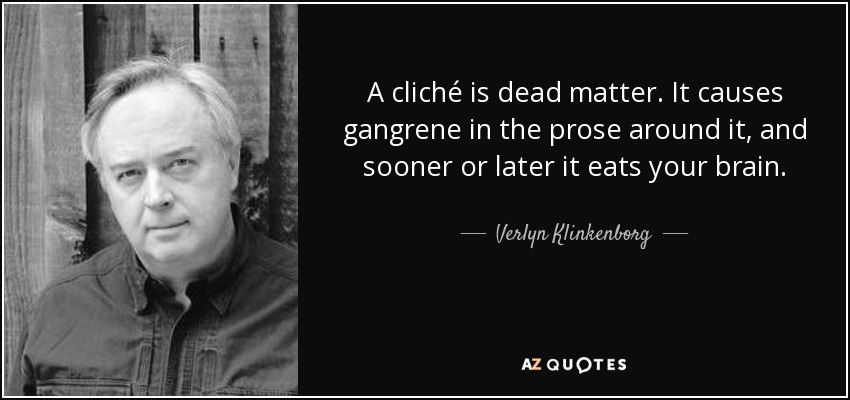
Prose proposes, verse reverses.
Michael Bohn provides a rare opportunity to experience the American sporting scene in the Roaring Twenties. A constant stream of legendary characters marches across these pages. You’ll meet them all: The Babe, The Four Horsemen, The Manassa Manassas Mauler, The Wheaton Iceman, Bill Tilden, Gertrude Ederle, and Grantland Rice, the sportswriter whose purple prose made them all come alive.
I dwell in Possibility A fairer house than Prose More numerous of Windows Superior — for Doors.
. . . you [film critics] always overstress the value of images. You judge films in the first place by their visual impact instead of looking for content. This is a great disservice to the cinema. It is like judging a novel only by the quality of its prose. I was guilty of the same sin when I first started writing for the cinema. . . . Now I feel that only the literary mind can help the movies out of that cul de sac into which they have been driven by mere technicians and artificers.
I've been writing for a long time, since the late '60s. But it hasn't been in the same form. I used to write scripts for television. I wrote for my comedy act. Then I wrote screenplays, and then I started writing New Yorker essays, and then I started writing plays. I didn't start writing prose, really, until the New Yorker essays, but they were comic. I didn't start writing prose, really, until the '90s. In my head, there was a link between everything. One thing led to another.
I'll never be a minimalist. The fact that the prose is more tightly controlled doesn't for a minute mean that it's minimalist. I very much like arcane words and baroque sentence structure.
Writers quite often starve. And I'm mainly just writing critical prose and poetry, that's a formula for starvation.
I love seeing the light go on in aspiring writers' eyes when you point out ways to improve their prose or their story - when they get it.
Probably the best way to describe my writing style is to refer you to "purple prose", which was a tag given to the early mass market magazine writers earning a half cent a word for their fiction. They had to use every adjective, verb and adverb in the English language to add word count to stories in order to feed and support families.
I don't run away from the idea of philosophy as seductive. I want the sentences to be prose but intense prose, to show that, like life, thinking is not linear.
I had real concerns about the relationship between nature and culture and places I wanted to write about... I thought, well, maybe I should try prose. It was a real struggle to begin because, first of all, there were so many words on the page - it was terrifying... Beginning was awful.
I like bringing poetry's focus on figurative language and compression into the essay. Of course, the musical properties of language, the cadence of the sentence, are really important to me in prose.
I grow very impatient with prose writers who don't pay attention to the cadence of the sentence. If you start as a poet, you're wooed by the music of language; you want to put that into your practice.
I'm being explicit about really horrifying experiences in my life, but my hope has always been to be responsible as an artist and to avoid indulging in my misery, or to come off as an exhibitionist. I don't want to make the listener complicit in my vulnerable prose poem of depression, I just want to honor the experience. I'm not the victim here, and I'm not seeking other peoples' sympathy. I don't blame my parents, they did the best they could.
The beauty of prose fiction that I see is simply that in order to create something you need only pay attention to personal exigency.
Writing fiction is an act of imagination and fantasizing, and it's not relating in prose what you've been doing for the last two or three years.
The stories I respect most aren't those with the rich, dense prose, but those which achieve a rich, deep effect with simple little nothing-sentences, lines I won't possibly remember, because they simply functioned, didn't draw attention to themselves, were properly humble.
What I'm constantly striving for in my prose is clarity. So that, ideally, the writing will become so transparent that the reader will forget that the medium of communication is language.
A lot of shows are more script-driven, like a prose script. As an actor, you never see a storyboard.
To my mind, the prose in a non-fiction work that's going to endure has to be of the same quality as the prose in a work of fiction that endures.
You’re trying to take something that can be described in many, many sentences and pages of prose, but you can convert it into a couple lines of poetry and you still get the essence, so it’s that compression. The best code is poetry.
Behind the perfection of a man's style, must lie the passion of a man's soul.
I believe the novella is the perfect form of prose fiction. It is the beautiful daughter of a rambling, bloated ill-shaven giant (but a giant who's a genius on his best days).
If prose can cast a spell, we will listen to it no matter what it's saying. If a narrative uses language in a magical and enlivening way, we will listen to the story. But if the language doesn't cast a spell, we will listen to it only if it is telling us something that actually happened.
The thing about Dickens is you either love him or you hate him and I fell in love with Dickens, I fell in love with his prose style and I decided that I wanted to read the whole Dickens verve during the course of my life.
Follow AzQuotes on Facebook, Twitter and Google+. Every day we present the best quotes! Improve yourself, find your inspiration, share with friends
or simply: