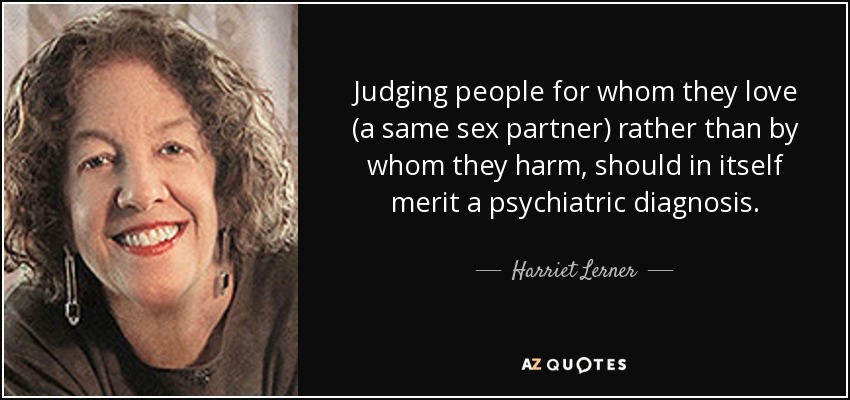
Judging people for whom they love (a same sex partner) rather than by whom they harm, should in itself merit a psychiatric diagnosis.
Yes, I'm very normal, everything is okay, I won't become a psychiatric case.
The similarities between street drug abuse and psychotropic prescription drug use are disturbing. Both types are toxic. Both can cause psychosis, damage the brain and other organs, and even cause death. And neither type of mind-altering drugs, legal or illegal, treats disease. It's important to recognize that the only significant difference between many prescription psychotropic drugs and street drugs such as "speed" and "downers" is that prescription drugs are legal.
Psychiatric services - that is, the attempt to help a person overcome his emotional difficulties in living - are priceless if successful or worthless if they fail.
People go for help, but their lives don't get better because of those [psychiatric] drugs. They get worse. They feel numb and they're told that's a good thing. It's how you degrade a society - by drugging the piss out of it.
When I started writing Tales of the City I was one year away from being a mental illness. It wasn't until 1975 that the American Psychiatric Association took homosexuality off the list of mental illnesses - and in many states, including the state of North Carolina where I grew up, homosexuality was a crime. An arrestable crime. It still is, in many parts of the world.
Clearly this business of treating minds, particularly this big business of treating young minds, has not policed itself, and has no incentive to put a stop to the kinds of fraudulent and unethical practices that are going on.
If someone is starving, excessively exercising or using purging behaviors, then we know they are in a high-risk place for turning on the psychiatric illnesses.
Nearly half a century has passed since Watson proclaimed his manifesto. Today, apart from a few minor reservations, the vast majority of psychologists, both in this country and in America, still follow his lead. The result, as a cynical onlooker might be tempted to say, is that psychology, having first bargained away its soul and then gone out of its mind, seems now, as it faces an untimely end, to have lost all consciousness.
Because my father was a psychiatric nurse, I know my way around the system.
Over the years it [the National Committee for Mental Hygiene] has championed for the promotion of 'mental health' despite the fact that nobody knows what it is or how to do it.
The very term ['mental disease'] is nonsensical, a semantic mistake. The two words cannot go together except metaphorically; you can no more have a mental 'disease' than you can have a purple idea or a wise space". Similarly, there can no more be a "mental illness" than there can be a "moral illness." The words "mental" and "illness" do not go together logically. Mental "illness" does not exist, and neither does mental "health." These terms indicate only approval or disapproval of some aspect of a person's mentality (thinking, emotions, or behavior).
Few legislators who passed these mental health laws realized that (Brock) Chisholm and his associates defined mental illness as a sense of loyalty to a particular nation, a sense of loyalty to a moral code, and strict adherence to concepts of right and wrong. Chisholm has been obsessed for years with the idea that instilling concepts of right and wrong, love of country and morality in children by their parents is the paramount evil.
It is the 'zoomorphic' or 'rattomorphic' fallacy - the expressed or implicit contention that there is no essential difference between rat and man - which makes American psychology so profoundly disturbing.
Treatment Plans and Interventions for Depression and Anxiety Disorders provides clinicians with essential guidelines to treat patients in the era of managed care. Seven psychiatric disorders are described and conceptualized in cognitive-behavioral terms. The authors then provided an unusually clear, reader-friendly description of how to assess and treat each disorder with illustrative case examples, and patient forms and handouts. It should prove very useful for clinicians or clinicians-in-training who want to learn how to conduct short-term treatment through an empirically validated approach.
I don't understand if you get caught in a fight, but take it out on a room, how that implies some psychiatric disorder.
I had a library of maybe 1,000 books in my room in Buenos Aires. I did have the sense that everything there was organised in the right way. You'll probably think I needed serious psychiatric treatment, but there were times when I would not buy a book because I knew it wouldn't fit one of the categories into which I had divided the library.
Viktor Frankl's timeless formula for survival. One of the classic psychiatric texts of our time, Man's Search for Meaning is a meditation on the irreducible gift of one's own counsel in the face of great suffering, as well as a reminder of the responsibility each of us owes in valuing the community of our humanity. There are few wiser, kinder, or more comforting challenges than Frankl's.
Foods of the Gods”) - “After water, cocoa is the single healthiest substance you can put in your mouth. It can easily replace a number of psychiatric drugs for mood, plus it produces the same chemistry in the brain that occurs when we fall in love.
The psychiatric interviewer is supposed to be doing three things: considering what the patient could mean by what he says; considering how he himself can best phrase what he wishes to communicate to the patient; and, at the same time, observing the general pattern of the events being communicated. In addition to that, to make notes which will be of more than evocative value, or come anywhere near being a verbatim record of what is said, in my opinion is beyond the capacity of most human beings.
[it is] a high class kind of subversion, very high class. We're not second story burglars. We go right in the front door.
Men have cried out to me in sincere and despairing appeal: 'Doctor, I cannot go on like this! I have everything to live for! I must stop, but I cannot! You must help me!'...One feels that something more than human power is needed to produce the essential psychic change. Though the aggregate of recoveries resulting from psychiatric effort is considerable, we physicians must admit we have made little impression upon the problem as a whole. Many types do not respond to the ordinary psychological approach.
Yes, I'm an extremist. The Black race here in North America is in extremely bad condition. You show me a Black man who isn't an extremist and I'll show you one who needs psychiatric attention.
Exorcists always need to distinguish demonic possessions from mental or psychiatric disorders, and they use three symptoms to identify people as possessed. First, those people have the ability to see hidden sacred objects, which they always want removed. Second, they have an extraordinary physical strength. And third, they show an aversion to the sacred
The Greeks distinguished between good and bad behavior, language that enhanced or diminished persons. Being intoxicated with scientism, we fail to recognize that the seemingly technical terms used to identify psychiatric illnesses and interventions are simply dyphemisms and euphemisms.
Follow AzQuotes on Facebook, Twitter and Google+. Every day we present the best quotes! Improve yourself, find your inspiration, share with friends
or simply: