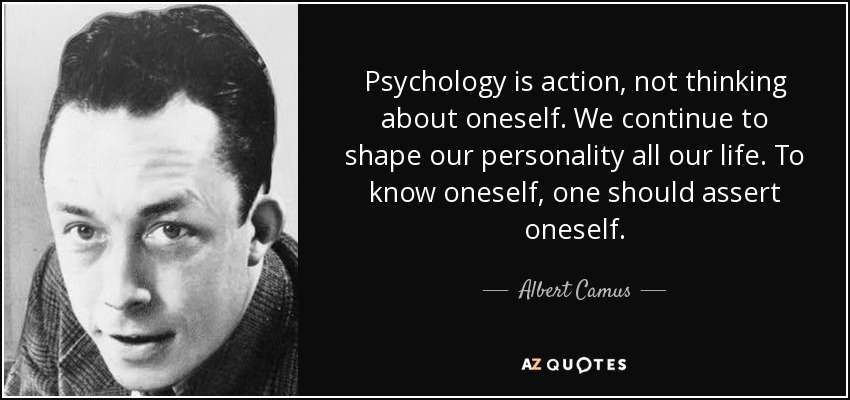
Psychology is action, not thinking about oneself. We continue to shape our personality all our life. To know oneself, one should assert oneself.
In the West the whole Western tradition of religion and psychology propounds, preaches, persuades people to have strong egos - because unless you have a strong ego, how can you survive? Life is a struggle; if you are egoless you will be destroyed. Then who will resist? Who will fight? Who will compete? And life is a continuous competition. Western psychology says: Attain to the ego, be strong in it.
Radical acceptance rests on letting go of the illusion of control and a willingness to notice and accept things as they are right now, without judging.
Happiness cannot be attained by wanting to be happy - it must come as the unintended consequence of working for a goal greater than oneself.
Some find that very optimistic people have benign illusions about themselves. These people may think they have more control, or more skill, than they actually do. Others have found that optimistic people have a good handle on reality. The jury is still out.
The good life is best construed as a matrix that includes happiness, occasional sadness, a sense of purpose, playfulness, and psychological flexibility, as well autonomy, mastery, and belonging.
You don't have to be the best at something. You just have to be the most determined.
"Life is unfair" "The goalposts will move" and above all: "other people matter"
Purposeful action is thus the goal of all that is truly educative.
By activating an expansive, tolerant, and creative mindset, positive feelings maximize the social, intellectual, and physical benefits that will accrue.
When I am in New York, I want to be in Europe, and when I am in Europe, I want to be in New York.
The universe stands aside for those people who know where they are going.
The Fundamentalist Religions simply seem to offer more hope for a brighter future than do the more liberal, humanistic ones.
The key to the understanding of the character of the conscious lies in the region of the unconscious.
Child psychology and animal psychology are of relatively slight importance, as compared with the sciences which deal with the corresponding physiological problems of ontogeny and phylogeny.
Experimental psychology itself has, it is true, now and again suffered relapse into a metaphysical treatment of its problems.
Hence, wherever we meet with vital phenomena that present the two aspects, physical and psychical there naturally arises a question as to the relations in which these aspects stand to each other.
I gleaned more practical psychology and psychiatry from the Bible, than from all other books!
I think that in order to achieve progress in the study of language and human cognitive faculties in general it is necessary first to establish 'psychic distance' from the 'mental facts' to which Köhler referred, and then to explore the possibilities for developing explanatory theories... We must recognize that even the most familiar phenomena require explanation and that we have no privileged access to the underlying mechanisms, no more so than in physiology or physics.
If we wish to imitate the physical sciences, we must not imitate them in their contemporary, most developed form; we must imitate them in their historical youth, when their state of development was comparable to our own at the present time. Otherwise we should behave like boys who try to copy the imposing manners of full-grown men without understanding their raison d' être, also without seeing that in development one cannot jump over intermediate and preliminary phases.
In the course of normal speaking the inhibitory function of the will is continuously directed to bringing the course of ideas and the articulatory movements into harmony with each other. If the expressive movement which which follows the idea is retarded through mechanical causes, as is the case in writing ... such anticipations make their appearance with particular ease.
It is easier to understand mankind in general than any individual man.
Many psychologists ... thought by turning their attention to their own consciousness to be able to explain what happened when we were thnking. Or they sought to attain the same end by asking another person a question, by means of which certain processes of thought would be excited, and then by questioning the person about the introspection he had made. It is obvious ... that nothing can be discovered in such experiments.
Not one idiot in a thousand has been entirely refractory to treatment, not one in a hundred has not been made more happy and healthy; more than thirty per cent have been taught to conform to social and moral law, and rendered capable of order, of good feeling, and of working like the third of a man; more than forty per cent have become capable of the ordinary transactions of life under friendly control, of understanding moral and social abstractions, of working like two-thirds of a man.
Now the word-symbols of conceptual ideas have passed so long from hand to hand in the service of the understanding, that they have gradually lost all such fanciful reference.
Follow AzQuotes on Facebook, Twitter and Google+. Every day we present the best quotes! Improve yourself, find your inspiration, share with friends
or simply: