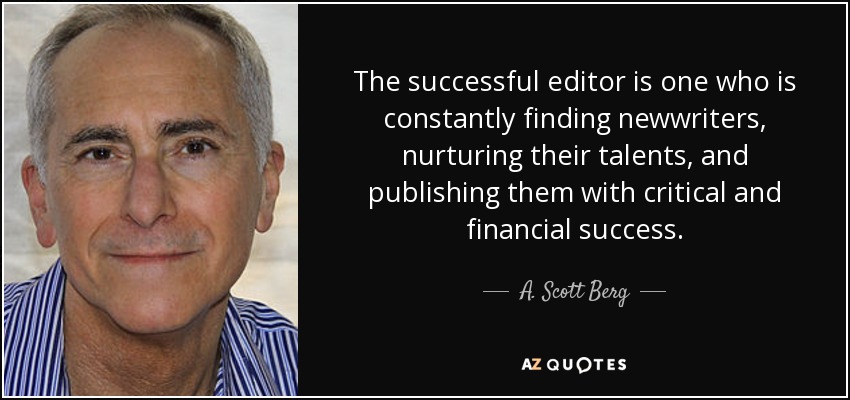
The successful editor is one who is constantly finding newwriters, nurturing their talents, and publishing them with critical and financial success.
Publishing is no longer simply a matter of picking worthy manuscripts and putting them on offer. It is now as important to market books properly, to work with the bookstore chains to getterms, co-op advertising, and the like. The difficulty is that publishers who can market are most often not the publishers with worthy lists.
My father, Benjamin Shiller, told me not to believe in authorities or celebrities - that society tends to imagine them as superhuman. It's good advice. People are snowed by celebrities all the time. In academia people have this idea of achieving stardom - publishing in the best journals, being at the best university, writing on the hot topic everyone else is writing about. But that's what my father told me not to do. He taught me that you have to pursue things that sound right to you.
The music publishing I own is fabulous recording.
The strange thing is, we never owned our own publishing; it was always getting bought and sold.
I'm referred to, I see, as 'the biggest banker in modern publishing'. Now there's a line that needed the celebrated Guardian proof-reading.
There's always a tricky issue when you get into stolen material or pornography. The laws for online publishing the same as for print-based publishing, where if you're hosting certain types of things and somebody notifies you about that.
My idea of that[idea of career] is constantly changing. I mostly just throw it out to the universe and I can't really do much after that. I've never taken the steps to be "successful": I've never had a manager or signed to a publishing house. I've talked to people about it but I've never followed through because it gives me the creeps.
Bloggers and other flavors of lone wolf are publishing heart-wrenching photo-essays from the front line of the recovery effort. Newspapers and TV networks? They're writing about the temperature of the water in some part (they don't specify which) of some damaged reactor, illustrating it with video screen grabs of machinery they don't understand enough to explain.
Still, I kept writing. I had no guarantee that I would someday win awards for writing. Heavens, the only person during that time who seemed to think I could write something worth publishing was my loyal husband. But I always remembered the professor from graduate school who urged me to write and who recommended me for that first writing assignment in 1964. When I protested to Sara Little that I didn't want to add another mediocre writer to the world, she gently reminded me that if I didn't dare mediocrity, I would never write anything at all.
Okay, are you really 'experimenting'? How do you know if you're really experimenting? You're working on it methodically and you're publishing the results! It's not an experiment if you don't publish the results in some verifiable and falsifiable form, okay?
My publishing deal is out of Nashville, my management is split between Nashville and Texas, but we are also getting to play eight other states as well as Canada and Europe this year. I don't want to pigeon-hole myself. When people ask me if I'm Texas or Nashville, I tell them I am just Cody Johnson.
One observer commenting on security analysts over forty stated: "They know too many things that are no longer true." As long as I am "on stage", publishing a regular record and assuming responsibility for management of what amounts to virtually 100% of the net worth of many partners, I will never be able to put sustained effort into any non-BPL activity. If I am going to participate publicly. I can't help being competitive. I know I don't want to be totally occupied with out-pacing an investment rabbit all my life. The only way to slow down is to stop.
They [academy writing programs] have no concept that the world has changed, that publishing has changed, that filmmaking has changed, and if you're not constantly looking at your education model and adjusting for the change, you'll find yourself teaching antiquity. Like all of these programs that won't accept students who are writing genre fiction - what an institutional ego!
It's interesting to me that really one of the first things she [Eleanor Roosevelt]did as First Lady was to collect her father's letters and publish a book called The Letters of My Father, essentially, hunting big game, The Letters of Elliott Roosevelt. And it really was an act of redemption, really one of her first acts of redemption as she entered the White House. She was going to redeem her father's honor. And publishing his letters, reconnecting with her childhood really fortified her to go on into the difficult White House years.
In some cases, people are silent; they're being complacent. But we're also seeing people speak out against some of these raids, these arrests. So for example, the Townhouse Gallery - the outreach director gave an interview to Ahram Online, which is a semi-official news agency here. And he sort of dismissed it, played it down. But the publisher from the publishing house - the Merit Publishing House, which was raided - he said this won't scare us; we will continue to dream of a free country, a country with social justice, and this won't silence us.
I started publishing my comic while I was still living with my parents.
I've been really fortunate to have Bridge Records interested in publishing my music for the past 25 years. Most of my music is available in their catalog.
I was in the second year of my PhD when I first had the idea - I'd recently started working as a translator, which meant firstly that I was hearing about amazing-sounding books from other translators, and also that I was getting enough of an insider's view of the publishing industry to be aware of all the implicit biases that made it so difficult for these books to ever get published, especially if they weren't from European languages (harder to discover, editors can't read the original, lack of funding programmes, authors who don't speak English).
Plus, publishing's inherent conservatism, means that what little did get through was weighted towards the commercial end of the scale, which is not the kind of writing that excites me.
And to improve access to the UK publishing industry - I'm hoping to set up an internship or work experience for someone from a low-income background, as soon as we have the funds. While we don't have the funds, we won't have an intern.
Not only are unpaid internships exploitative, they're one of the main forces keeping publishing in this country a primary white middle-class industry, which has a direct knock-on effect on what gets published and how.
Hwang Jung-eun is one of the brightest stars of the new South Korean generation - she's Han Kang's favourite, and the novel we're publishing scooped the prestigious Bookseller's Award, for critically-acclaimed fiction that also has a wide popular appeal. She stands out for her focus on social minorities - her protagonists are slum inhabitants, trans women, orphans - and for the way she melds this hard-edged social critique with obliquely fantastical elements and offbeat dialogue.
I started publishing stories in small magazines early on, but after seven or eight or nine years you feel like you need a little more than that to show for your efforts.
When I started publishing, I got offers to write for big magazines. But I would always say, "Well, it's not that I don't want to write for these big magazines, but you can't edit it."
Follow AzQuotes on Facebook, Twitter and Google+. Every day we present the best quotes! Improve yourself, find your inspiration, share with friends
or simply: