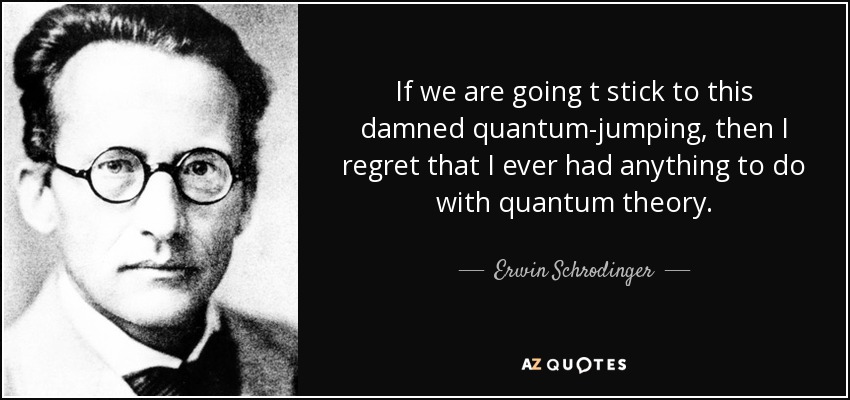
If we are going t stick to this damned quantum-jumping, then I regret that I ever had anything to do with quantum theory.
Human rights are an aspect of natural law, a consequence of the way the universe works, as solid and as real as photons or the concept of pi. The idea of self- ownership is the equivalent of Pythagoras' theorem, of evolution by natural selection, of general relativity, and of quantum theory. Before humankind discovered any of these, it suffered, to varying degrees, in misery and ignorance.
Bell's theorem...proves that quantum theory requires connections that appear to resemble telepathic communication.
For the most part, quantum theory has been of little practical value in my life.
Scientific realism in classical (i.e. pre-quantum) physics has remained compatible with the naive realism of everyday thinking on the whole; whereas it has proven impossible to find any consistent way to visualize the world underlying quantum theory in terms of our pictures in the everyday world. The general conclusion is that in quantum theory naive realism, although necessary at the level of observations, fails at the microscopic level.
If all this damned quantum jumping were really here to stay, I should be sorry, I should be sorry I ever got involved with quantum theory.
By 2100, our destiny is to become like the gods we once worshipped and feared. But our tools will not be magic wands and potions but the science of computers, nanotechnology, artificial intelligence, biotechnology, and most of all, the quantum theory.
I did my masters in elementary particles. But the foundations of elementary particles is quantum theory and there were too many conceptual problems around quantum theory that I couldn't live with. So I decided I was going to work on the foundations of quantum theory. That's what I did my Ph.D on.
The words are strung together, with their own special grammar-the laws of quantum theory-to form sentences, which are molecules. Soon we have books, entire libraries, made out of molecular "sentences." The universe is like a library in which the words are atoms. Just look at what has been written with these hundred words! Our own bodies are books in that library, specified by the organization of molecules-but the universe and literature are organizations of identical, interchangeable objects; they are information systems.
Quantum mechanics, that brilliantly successful flagship theory of modern science, is deeply mysterious and hard to understand. Eastern mystics have always been deeply mysterious and hard to understand. Therefore, Eastern mystics must have been talking about quantum theory all along.
Quantum theory thus reveals a basic oneness of the universe. It shows that we cannot decompose the world into independently existing smallest units. As we penetrate into matter, nature does not show us any isolated "building blocks," but rather appears as a complicated web of relations between the various parts of the whole. These relations always include the observer in an essential way. The human observer constitute the final link in the chain of observational processes, and the properties of any atomic object can be understood only in terms of the object's interaction with the observer.
Classical physics has been superseded by quantum theory: quantum theory is verified by experiments. Experiments must be described in terms of classical physics.
On quantum theory I use up more brain grease (rough translation of German idiom) than on relativity.
There's far more truth in the Book of Genesis than in the quantum theory.
There may be rhetoric about the socially constructed nature of Western science, but wherever it matters, there is no alternative. There are no specifically Hindu or Taoist designs for mobile phones, faxes or televisions. There are no satellites based on feminist alternatives to quantum theory. Even that great public sceptic about the value of science, Prince Charles, never flies a helicopter burning homeopathically diluted petrol, that is, water with only a memory of benzine molecules, maintained by a schedule derived from reading tea leaves, and navigated by a crystal ball.
The mathematical framework of quantum theory has passed countless successful tests and is now universally accepted as a consistent and accurate description of all atomic phenomena. The verbal interpretation, on the other hand - i.e., the metaphysics of quantum theory - is on far less solid ground. In fact, in more than forty years physicists have not been able to provide a clear metaphysical model.
Quantum theory was split up into dialects. Different people describe the same experiences in remarkably different languages. This is confusing even to physicists.
By far the most important consequence of the conceptual revolution brought about in physics by relativity and quantum theory lies not in such details as that meter sticks shorten when they move or that simultaneous position and momentum have no meaning, but in the insight that we had not been using our minds properly and that it is important to find out how to do so.
A successful unification of quantum theory and relativity would necessarily be a theory of the universe as a whole. It would tell us, as Aristotle and Newton did before, what space and time are, what the cosmos is, what things are made of, and what kind of laws those things obey. Such a theory will bring about a radical shift - a revolution - in our understanding of what nature is. It must also have wide repercussions, and will likely bring about, or contribute to, a shift in our understanding of ourselves and our relationship to the rest of the universe.
A person who wasn't outraged on first hearing about quantum theory didn't understand what had been said.
The great revelation of the quantum theory was that features of discreteness were discovered in the Book of Nature, in a context in which anything other than continuity seemed to be absurd according to the views held until then.
The incomplete knowledge of a system must be an essential part of every formulation in quantum theory. Quantum theoretical laws must be of a statistical kind. To give an example: we know that the radium atom emits alpha-radiation. Quantum theory can give us an indication of the probability that the alpha-particle will leave the nucleus in unit time, but it cannot predict at what precise point in time the emission will occur, for this is uncertain in principle.
Niels Bohr brainwashed a whole generation of theorists into thinking that the job (interpreting quantum theory) was done 50 years ago.
Science may be weird and incomprehensible--more weird and less comprehensible than any theology--but science works. It gets results. It can fly you to Saturn, slingshotting you around Venus and Jupiter on the way. We may not understand quantum theory (heaven knows, I don't), but a theory that predicts the real world to ten decimal places cannot in any straightforward sense be wrong.
You believe in the God who plays dice, and I in complete law and order in a world that objectively exists, and which I, in a wildly speculative way, am trying to capture. ... Even the great initial success of the quantum theory does not make me believe in the fundamental dice-game, although I am well aware that our younger colleagues interpret this as a consequence of senility. No doubt the day will come when we will see whose instinctive attitude was the correct one.
Follow AzQuotes on Facebook, Twitter and Google+. Every day we present the best quotes! Improve yourself, find your inspiration, share with friends
or simply: