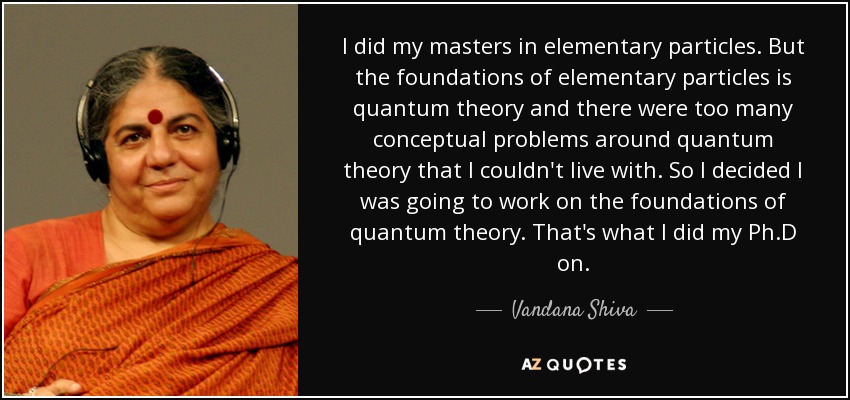
I did my masters in elementary particles. But the foundations of elementary particles is quantum theory and there were too many conceptual problems around quantum theory that I couldn't live with. So I decided I was going to work on the foundations of quantum theory. That's what I did my Ph.D on.
For example, the idea that objects have properties out there in fixed ways is an incorrect idea about the world. Properties are created through relationships and processes. They are not inherent in electrons or photons or quanta any more than they are inherent in soil or trees or people. So my critique of reductionistic science is a critique that I have inherited from my scientific training. But it has been deepened by my experiences as an ecologist, in seeing the ecological destruction taking place today.
I'm really fascinated by the parallels between quantum theory and the teachings of some of these ancient texts. So many of the things that quantum physicists are talking about today, like non-locality and the observer effect, are things the yogis have been saying for thousands of years.
Christians assert that because there is fundamental weirdness at the quantum level of the very very small one must pretend to know things one does not know, aka have faith.
No theory of reality compatible with quantum theory can require spatially separate events to be independent.
Quantum mechanics is confusing and consciousness is confusing, so maybe they're the same.
I've always been fascinated by quantum physics and the possibility of alternate realities.
Ever since I was a kid, I've had an enormous interest in the sciences - everything from quantum physics to anthropology.
For many years quantum physics had been giving indications that there are levels of reality other than the material level.
Quantum Mechanics and General Relativity are both accepted as scientific fact even though they're mutually exclusive. Albert Einstein spent the second half of his life searching for a unifying truth that would reconcile the two.
In Einstein's theory of relativity the observer is a man who sets out in quest of truth armed with a measuring-rod. In quantum theory he sets out with a sieve.
There is a responsibility on all companies to look at the quantum of pay and the relationship between the top and the bottom.
There can never be two or more equivalent electrons in an atom, for which in a strong field the values of all the quantum numbers n, k1, k2 and m are the same. If an electron is present, for which these quantum numbers (in an external field) have definite values, then this state is 'occupied.'
To me quantum computation is a new and deeper and better way to understand the laws of physics, and hence understanding physical reality as a whole.
The most important application of quantum computing in the future is likely to be a computer simulation of quantum systems, because that's an application where we know for sure that quantum systems in general cannot be efficiently simulated on a classical computer.
Unfortunately, unless we're focused on building up our courage, which gives us our self-confidence and all that we need to make quantum change in our lives, the voice of fear will always take the lead inside our minds.
If I say [electrons] behave like particles I give the wrong impression; also if I say they behave like waves. They behave in their own inimitable way, which technically could be called a quantum mechanical way. They behave in a way that is like nothing that you have seen before.
Quantum physics is a bit of a passion of mine. It's extraordinary. There's a branch of mathematics that is based on lunacy, and that's wonderful.
At the head of these new discoveries and insights comes the establishment of the facts that electricity is composed of discrete particles of equal size, or quanta, and that light is an electromagnetic wave motion.
By recognizing that the chemical atom is composed of single separable electric quanta, humanity has taken a great step forward in the investigation of the natural world.
For under certain conditions the chemical atoms emit light waves of a specific length or oscillation frequency - their familiar characteristic spectra - and these can come in the form of electromagnetic waves only from accelerated electric quanta.
In my view the structure of the whole atom was that of an individual, with all its parts interconnected, and the emission of a spectral line appeared to me to be the result of the coherence and co-operation of several electric quanta.
There's a lot of things I nerd out over. Quantum Mechanics. I also love Dungeons and Dragons. I want to be an astronaut.
In the future, maybe quantum mechanics will teach us something equally chilling about exactly how we exist from moment to moment of what we like to think of as time.
Einstein and the Quantum is delightful to read, with numerous historical details that were new to me and cham1ing vignettes of Einstein and his colleagues. By avoiding mathematics, Stone makes his book accessible to general readers, but even physicists who are well versed in Einstein and his physics are likely to find new insights into the most remarkable mind of the modern era.
Follow AzQuotes on Facebook, Twitter and Google+. Every day we present the best quotes! Improve yourself, find your inspiration, share with friends
or simply: