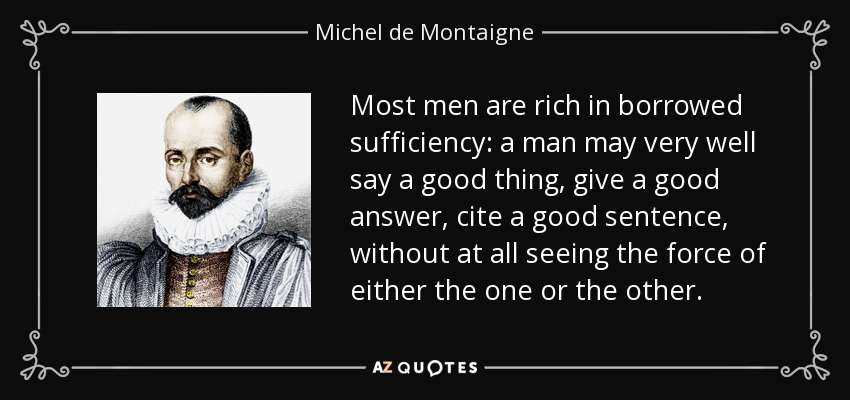
Most men are rich in borrowed sufficiency: a man may very well say a good thing, give a good answer, cite a good sentence, without at all seeing the force of either the one or the other.
It is always the same: women bedeck themselves with jewels and furs, and men with wit and quotations.
Next to the semi-colon, quotation marks seem to be the chief butts of reformatory ardor.
Whatever we may say against collections, which present authors in a disjointed form, they nevertheless bring about many excellent results. We are not always so composed, so full of wisdom, that we are able to take in at once the whole scope of a work according to its merits. Do we not mark in a book passages which seem to have a direct reference to ourselves? Young people especially, who have failed in acquiring a complete cultivation of mind, are roused in a praiseworthy way by brilliant passages.
As by some might be saide of me: that here I have but gathered a nosegay of strange floures, and have put nothing of mine unto it, but the thred to binde them. Certes, I have given unto publike opinion, that these borrowed ornaments accompany me; but I meane not they should cover or hide me.
My quarrel with him is, that his works contain nothing worth quoting; and a book that furnishes no quotations, is me judice, no book,—it is a plaything.
The surest way to make a monkey of a man is to quote him. That remark in itself wouldn’t make any sense if quoted as it stands. The average man ought to be allowed a quotation of no less than three sentences, one to make his statement and two to explain what he meant. Ralph Waldo Emerson was about the only one who could stand having his utterances broken up into sentence quotations, and every once in a while even he doesn’t sound so sensible in short snatches.
The best aphorisms are.... portable wisdom, the quintessential extracts of thought and feeling. They furnish the largest amount of intellectual stimulus and nutriment in the smallest compass. About every weak point in human nature, or vicious spot in human life, there is deposited a crystallization of warning and protective proverbs.
Indeed a good quotation hardly ever comes amiss. It is a pleasing break in the thread of a speech or writing, allowing the speaker or writer to retire for an instant while another and greater makes himself heard. And this calling-up of the deathless dead implies also a community of mind with them, which the reader will not grudge the author lest he should seem to deny it to himself.
Not everything that can be extracted appears in anthologies of quotations, in commonplace books, or on the back of Celestial Seasonings boxes. Only certain sorts of extracts become quotations.
Some lines are born quotations, some are made quotations, and some have "quotation" thrust upon them.
Anatole France frankly advised, "When a thing has been said and said well, have no scruple. Take it and copy it." Yes, indeed, but do more. Copy many well-said things. Pierce them together. Assimilate them. Make the process of reading them a way to form the mind and shape the soul. As anthologies can never be complete, we will never exhaust the ways quotations can enrich our lives.
A single gnomic line can come to resonate with centuries of subsequent wisdom.
Unless created as freestanding works, quotations resemble "found" art. They are analogous, say, to a piece of driftwood identified as formally interesting enough to be displayed in an art museum or to a weapon moved from an anthropological to an artistic display.... The presenter of found art, whether material or verbal, has become a sort of artist. He has not made the object, but he has made it as art.
I wonder if "an" ever occurs before "haughty" except in a quotation, or whether you can make anything sound like a quotation by adding a word like "goeth"?
The attribution of a speaker is in fact a part of the quotation. Some statements simply are better if a certain famous person said them.
Reframing an extract as a quotation constitutes a kind of coauthorship. With no change in wording, the cited passage becomes different. I imagine that the thrill of making an anthology includes the opportunity to become such a coauthor.
We sometimes think of quotations as extracts from larger texts, but some quotations originated complete unto themselves.
A knowledge of general literature is one of the evidences of an enlightened mind; and to give an apt quotation at a fitting time, proves that the mind is stored with sentential lore that can always be used to great advantage by its possessor.
A wise word is not a substitute for a piece of herring.
The teachings of elegant sayings Should be collected when one can. For the supreme gift of words of wisdom, Any price will be paid.
I feel a reassuring oneness with other people when I find that even my most intimate, anguished, socially inadmissible emotions and desires are known to others.... Kindred souls—indeed, my selves otherwise costumed—turn up in books in the most unexpected places. Discovering them is one of the great rewards of a liberal education. If I quote liberally, it is not to show off book learning, which at my stage of life can only invite ridicule, but rather to bathe in this kinship of strangers.
The quotation-business is booming. No subdivision of the culture seems too narrow to have a quotation book of its own.... It would be an understatement to say that these books lean on one another. To compare them is to stroll through a glorious jungle of incestuous mutual plagiarism.
Clichés are static, the emotion behind them long spent. If you are tempted to use them, here is a saying of my mother’s: Fang pi bu-cho, cho pi bu-fang. Basically that translates to: "Loud farts don’t stink, and the really smelly ones don’t make a sound." In other words: When you’re full of beans, you just blow a lot of hot air. If you want to have a real impact, be deadly but silent. Oh, also recognize the difference between a bad cliché and a good quotation. My mother’s saying is a good quotation. You should use it often.
Aphorisms are essentially an aristocratic genre of writing. The aphorist does not argue or explain, he asserts; and implicit in his assertion is a conviction that he is wiser and more intelligent than his readers.
Follow AzQuotes on Facebook, Twitter and Google+. Every day we present the best quotes! Improve yourself, find your inspiration, share with friends
or simply: