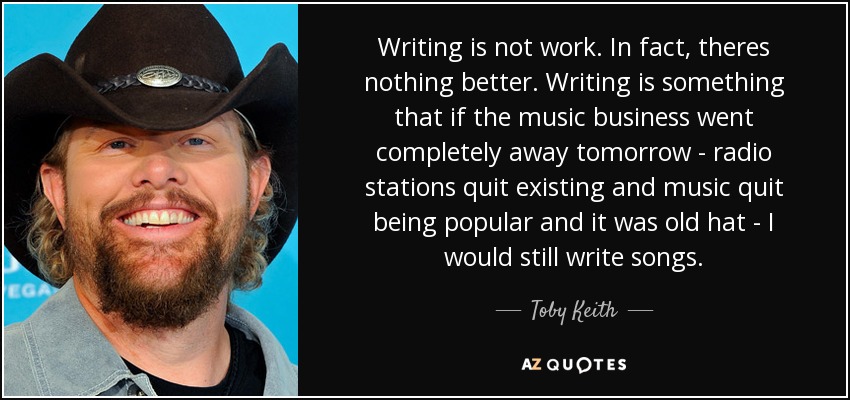
Writing is not work. In fact, theres nothing better. Writing is something that if the music business went completely away tomorrow - radio stations quit existing and music quit being popular and it was old hat - I would still write songs.
Middle age is when you get in the car and immediately change the radio station.
The radio station was playing Tchaikovsky's Swan Lake, a sure sign that things were much worse than they appeared.
I have listened to college radio quite a lot. I never went to college, so actually the college radio station is sort of like the closest I got to some kind of college experience.
Because of the control of the media by corporate wealth, the discovery of truth depends on an alternative media, such as small radio stations, networks, programs. Also, alternative newspapers, which exist all over the country. Also, cable TV programs, which are not dependent on commercial advertising. Also, the internet, which can reach millions of people by-passing the conventional media.
I have known Tavis Smiley since the 1980s, when we both worked at the same radio station in Los Angeles. He is smart, and he is a gentleman who has accorded me great respect both on and off the air.
Mother Earth needs us to keep our covenant. We will do this in courts, we will do this on our radio station, and we will commit to our descendants to work hard to protect this land and water for them. Whether you have feet, wings, fins, or roots, we are all in it together.
I didn't know that there were any radio stations in Nova Scotia.
Usually it's lyric first, but sometimes it's melody. And I carry a hand-held recorder everywhere I go so I can just hum or whistle a melody if one hits me. Sometimes it's both simultaneously - lyric and melody at the same time - those are a little confusing to me, but sometimes it comes in that form. I just feel like I have my own little radio station and sometimes the static clears and something beams in from out there.
I have been singing since I was two years old, my parents tell me, and started to write songs when I was fifteen. Eventually, my friends and my parents knew that this was something I liked to do. They also knew I had a dream of making my own album. They have always been encouraging me to do something about it, and so I did. So I went to a local radio station in Tromsø, and there I got to record a couple of songs.
Politically I also don't believe anymore that we can only have one voice to a story, it's like having one radio station to represent a country. You want the politics of any complicated situation to be complicated in a book of fiction or nonfiction.
Why is it when you turn on the TV you see ads for telephone companies, and when you turn on the radio you hear ads for TV shows, and when you get put on hold on the phone you hear a radio station?
People don't like the music that's out now, that's on their radio stations, and they want to hear something different, but they're just the audience. You know, people will keep the TV on even if a show is on that they hate - because, unfortunately, they've been programmed to do that. [But] they are really looking for something that's gonna speak to the world that they're living in. That's what people are looking for, but they're not finding it.
I first got interested in music as a toddler by my childhood babysitter, Rosetta Atkins. She taught me how to sing by imitating the voices on the gospel radio station she listened to - both men and women's voices.
There is no question that the US market is the hardest to break into. I believe that the reason for this primarily has to do with the fact that the majority of the most powerful radio stations in the US are owned by Clear Channel. They are massive and have the ability to break artists worldwide. For the most part, they are dealing directly with the major labels in the US, with whom they have had long relationships. If you are an artist that is not being pushed by Clear Channel radio in the US, your chances of becoming a household name are slim.
In Europe, radio stations are owned by a variety of different entities, so there is less uniformity on radio programming and more opportunity for artists to get radio play and break overseas.
I sent a lot of the e-mails out to venues and tried to get shows and tried to get people interested in it. It can be a tough thing, because you know these people at venues are getting e-mails like that every day, but I think just my experience in working in running a radio station.
The music I was always attracted to and the shows I was really into like, you know, those weekend Don Kirshner shows, "Midnight Special," those shows, I remember watching those and the music was just on; it was the greatest radio stations.
My latest theory is that it's - well, I describe it as, like, being in an apartment with kind of thin walls. And in the apartment next door, they've got a radio tuned constantly on - tuned to a really cool radio station. It's on all the time. And you can just hear it coming through the wall all the time.
And then, one day, they program a new tune, and it really catches your ear, you know, because you can be doing the washing up or something, you know, in your apartment and suddenly you go, whoa, what are they playing in there? And you run to the wall, but it's finished - but the song's finished. You only heard enough of it just the pique your interest. And you never know when they're going to play it again, of course, like a normal radio station.
Worst music ever sells millions. The worst music with the shittiest lyrics. The fact is that they pay radio stations to put it on the radio, then you've heard it a million times when you're driving from your shitty job to your shitty house. It's indoctrination, it's sad.
If I weren't playing baseball, I would be a radio or sports broadcaster. In college at South Carolina I did some stuff with the radio station and really liked it.
Every time I meet people working in radio, I'm a little embarrassed. It's all pre-programmed, rigidly formatted stuff. Time and time again, when I talk to jocks, they say how jealous they are of the freedom we have on WKRP. I sometimes have to explain to them that it's not a real radio station.
Kurt (Cobain) was a fan of my standup, which was pretty weird. I know when people hear that, it's kind of like finding out that Jimi Hendrix really liked Buddy Hackett, but he interviewed me at a college radio station before they broke and did Bleach. And then, like, about two years later, I was opening for Nirvana at these huge sports arenas.
All my life I've worked and I was so lucky to go from a radio station in Washington to the Dodgers and of course, it never stopped. For me to suddenly put the key in the ignition and turn the engine off, it's kind of a frightening thought. I put the key in and left it there, God willing, for another year.
Follow AzQuotes on Facebook, Twitter and Google+. Every day we present the best quotes! Improve yourself, find your inspiration, share with friends
or simply: