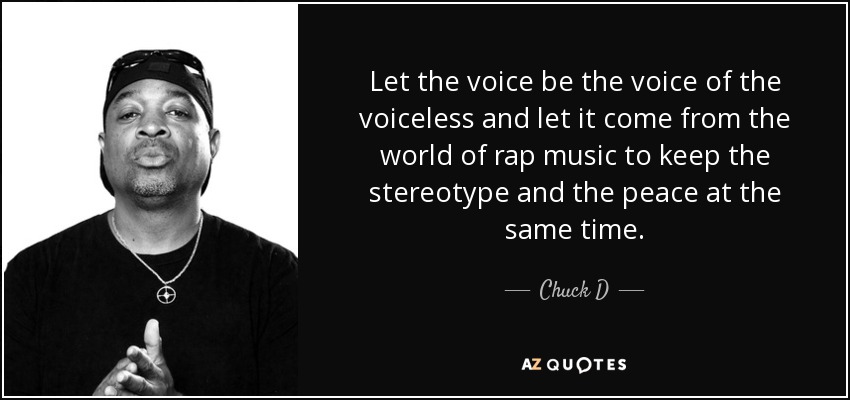
Let the voice be the voice of the voiceless and let it come from the world of rap music to keep the stereotype and the peace at the same time.
There's always tons of crap music people are trying to sell us - [it's] the same way with publishers and galleries.
I just make [music] for the people that always enjoyed hearing from me. I make it for people that enjoy the energy of rap music or a good rhyme. I do it for the people I see everyday, not the Hollywood ass people, the normal people.
I love pop music just as much as I like rap music, or ill-ass hip-hop music, or rock music.
Do you see how Jerry Heller made it work? That is how he combined what we did to make the rap music into mass music. That's exactly how it happened.
What we're doing now, is to try to eradicate the limited notion of how people are interacting with each other through hyper-racialized ideas. A lot of it deal with, as an example, genre. If I ask you to visualize a trap musician or a hip-hop musician, you'll see one thing. If I say visualize a western classical musician, you'll see a very different thing. A lot of how music is disseminated to us is hyper-racialized. It's not something that we think about all the time, but if you take a minute to look back, it's why you get this argument when there's a white rapper.
To me, that's the biggest problem with hip-hop today is the fact that everyone believes that all of hip-hop is rap music, and that, when you say "hip-hop," it's synonymous with rap. That when you say "hip-hop," you should be thinking about breakdancing, graffiti art, or MCing - which is the proper name for rap - DJing, beat-boxing, language, fashion, knowledge, trade. You should be thinking about a culture when you say, "hip-hop.".
I think that all journalists, specifically print journalists, have a responsibility to educate the public. When you handle a culture's intellectual property, like journalists do, you have a responsibility not to tear it down, but to raise it up. The depiction of rap and of hip-hop culture in the media is one that needs more of a responsible approach from journalists. We need more 30-year-old journalists. We need more journalists who have children, who have families and wives or husbands, those kinds of journalists. And then you'll get a different depiction of hip-hop and rap music.
The power of the voice in rap is about the expression of truth, rather than the expression of some kind of artifice. Landays, they're about love and pleasure and oppression and levels of oppression within a family. And because of that, I think rap music is probably closely related.
I didn't have to sell my soul for money. I didn't have to go through trap music; I could just help Ye write songs and get money from it. So I knew when I put my album out I could just be myself. Not saying I won't do a trap beat or rap over one, but that's just not what makes me. That's not all of CyHi.
I hate rap music, which to me sounds like a bunch of angry men shouting, possibly because the person who was supposed to provide them with a melody never showed up.
Rap music is really good when you're traumatized.
Rap music is just computerised crap. I listen to Top of the Pops and after three songs I feel like killing someone.
I like rap music. But bragging about being rich to poor people is really offensive. I want to hear a rap song about buying a Cy Twombly painting or dating a museum curator. I want to hear about that kind of rich.
I think rap music has made more money on dance music than dance music has made on dance music. Just a thought.
Rap music and rap records used to always be like this: we get one or two shots to a piece cause it was a singles marketplace and when the major record companies saw that it could also handle the sales of the albums then they started to force everybody to expand their topics from 1 to about 10 and you gotta deliver 12 songs, so a lot of times if you took a person who wasn't really developed, and the diversity of trying say 12 different things, you know the companies were like "Cool! Say the same thing 12 different ways."
With rap music, there are billions and billions of samples that are uncleared that people have never been bothered about on an underground level.
I always did poetry, and [rap music is] pretty much hip-hop melody with poems.
If we were to see Western landay poems, we'd see them out of disenfranchised populations, maybe out of the legacy of slavery. Spirituals, rap music - that would be the space we'd find American landays in.
They had all this talent, and they had no instruments. So they started rap music. They rhymed on their own. They made their own sounds and their own movements.
You never want to look like an old fart doing young rap music.
I grew up in the Bronx. I'm into rap music.
They don't want to see rap music. They don't want to see the Beastie Boys. They don't care what we're doing. They want one thing and one thing only: that's to see Madonna come on stage.
No, I can't do rap music...
I don't have any sympathy for the subject matter, [but] I have great respect for rap artists. In fact, not for the rap artists, but the people who make the music over which they rap. Rap music - the music itself is incredible - but [the people that make the music] are hardly ever credited.
Follow AzQuotes on Facebook, Twitter and Google+. Every day we present the best quotes! Improve yourself, find your inspiration, share with friends
or simply: