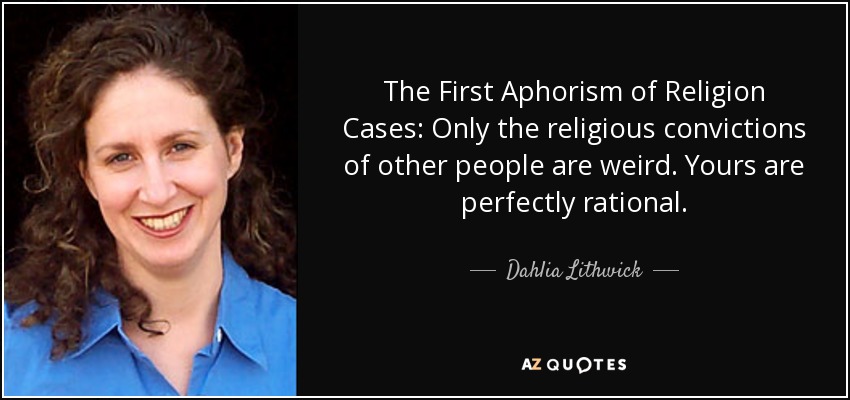
The First Aphorism of Religion Cases: Only the religious convictions of other people are weird. Yours are perfectly rational.
But to proceed; as in order and place, so also in matter of her Creation, Woman far excells Man. things receive their value from the matter they are made of, and the excellent skill of their maker: Pots of common clay must not contend with China-dishes, nor pewter utensils vye dignity with those of silver.... Woman was not composed of any inanimate or vile dirt, but of a more refined and purified substance, enlivened and actuated by a Rational Soul, whose operations speak it a beam, or bright ray of Divinity.
A person's behavior is rational if it is in his best interests, given his information
What counts now are the value-less facts, the material and the rational. All else is regarded with condescension as being of only sentimental value.
Since ancient times, the left side has stood for the side of the unconscious or the unknown; the right side, by contrast, has represented the side of consciousness or wakefulness. Through the late twentieth century, the movement of the Left limited themselves to a materialist understanding of reality- exemplified by Marxism- demanding social justice and economic equality but not the restoration of intuition and the recognition of the hidden, qualitative dimensions of being suppressed by the mental-rational consciousness, narrowly focused on the quantifiable.
The prevailing tendency to regard all the marked distinctions of human character as innate, and in the main indelible, and to ignore the irresistible proofs that by far the greater part of those differences, whether between individuals, races, or sexes are such as not only might but naturally would be produced by differences in circumstances, is one of the chief hinderances to the rational treatment of great social questions, and one of the greatest stumbling blocks to human improvement.
Jurors have found, again and again, and at critical moments, according to what is their sense of the rational and just. If their sense of justice has gone one way, and the case another, they have found "against the evidence," ... the English common law rests upon a bargain between the Law and the people: The jury box is where the people come into the court: The judge watches them and the people watch back. A jury is the place where the bargain is struck. The jury attends in judgment, not only upon the accused, but also upon the justice and the humanity of the Law.
Magic is another word that makes people uneasy, so I use it deliberately, because words they are comfortable with, the words that sound acceptable, rational, scientific, and intellectually sound, are comfortable precisely because they are the language of estrangement.
Okay, look at it this way: if the evening news has a very high probability of being accurate, then it's highly improbable that they would inaccurately report the numbers chosen in the lottery. That counterbalances any improbability in the choosing of those numbers, so you're quite rational to believe in this highly improbable event.
The belief that value judgments are not subject, in the last analysis, to rational control, encourages the inclination to make irresponsible assertions regarding right and wrong or good and bad. One evades discussion of serious issues by the simple device of passing them off as value problems, whereas, to say the least, many of these conflicts arose out of man's very agreement regarding values.
Well, it's possible to be mentally ill and rational.
Historians are presumed to be unable to "do psychology," which is "mystical" anyway, so they are forced to accept the most "rational" explanations... "and it is on these that history is built.
My position is to listen to my constituents, learn from the best information available and ultimately make sound, rational decisions that are going to be beneficial to the people of the 8th Congressional District.
The core of the Marxist critique of capitalism is that although the individual capitalist is rational (as liberals assume), the capitalist system itself is irrational.
They [human beings] are unwilling to gamble that God made those people who are skilled at rational argumentation uniquely virtuous. They protect themselves and others from cleverness by obscuring their preferences.
Put the money into schools. Rational ones that train young minds to think, to demand that persons in authority show the evidence for the ideas they push. Do that, and we won't need to provide a world for the Sacred Brethren who, given the opportunity, would run everyone else off the planet.
The necessary precondition for the birth of science as we know it is, it would seem, the diffusion through society of the belief that the universe is both rational and contingent. Such a belief is the presupposition of modern science and cannot by any conceivable argument be a product of science. One has to ask: Upon what is this belief founded?
You cannot expect any rational thought from a religious man. He is like a rocking log in water.
Man is a conscious, rational thinker and a supra-conscious creator genius.
A system of philosophy, or metaphysics, is a union of a world view and a life view in one harmonious, complete, integral conception. In so far as any man strives to attain, by rational inquiry, a consistent and comprehensive view of life and reality, he is a metaphysician.
Investors, monarchies, and parliamentarians devised methods to control the processes of wealth accumulation and the power that came with it, but the ideology behind gold fever mobilized settlers to cross the Atlantic to an unknown fate. Subjugating entire societies and civilizations, enslaving whole countries, and slaughtering people village by village did not seem too high a price to pay, nor did it appear inhumane. The systems of colonization were modern and rational, but its ideological basis was madness.
Margaret Miles offers a stunning treatment of human experience, coaxing humans to leave dualisms behind and embrace our intelligent bodies. In a foundational text, she draws on the arts, philosophy and theology, and her experience as a hospice volunteer to explore concrete alternatives to privileging the rational mind. Her erudition, wisdom, and graceful writing are compelling proof of the intelligent body.
Hope and optimism are different. Optimism tends to be based on the notion that there's enough evidence out there to believe things are gonna be better, much more rational, deeply secular, whereas hope looks at the evidence and says, "It doesn't look good at all. Doesn't look good at all. Gonna go beyond the evidence to create new possibilities based on visions that become contagious to allow people to engage in heroic actions always against the odds, no guarantee whatsoever." That's hope. I'm a prisoner of hope, though. Gonna die a prisoner of hope.
Teller contended, not implausibly, that hydrogen bombs keep the peace, or at least prevent thermonuclear war, because the consequences of warfare between nuclear powers are now too dangerous. We haven't had a nuclear war yet, have we? But all such arguments assume that the nuclear-armed nations are and always will be, without exception, rational actors, and that bouts of anger and revenge and madness will never overtake their leaders (or military and secret police officers in charge of nuclear weapons). In the century of Hitler and Stalin, this seems ingenuous.
Rational people have better things to do than grant unwarranted credibility to every half-assed delusion.
Follow AzQuotes on Facebook, Twitter and Google+. Every day we present the best quotes! Improve yourself, find your inspiration, share with friends
or simply: