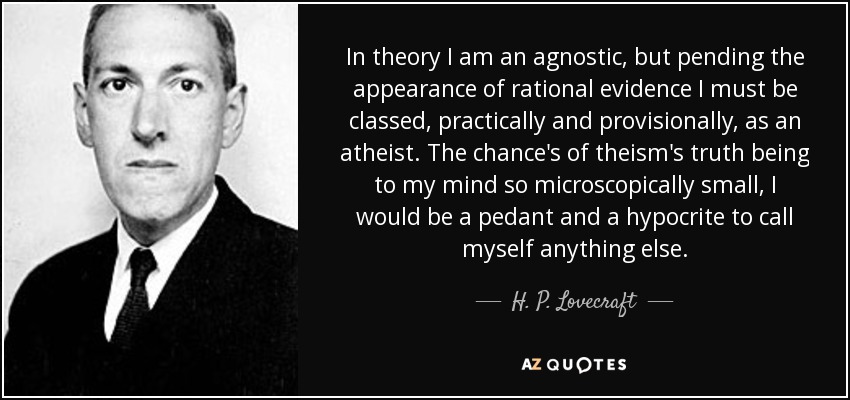
In theory I am an agnostic, but pending the appearance of rational evidence I must be classed, practically and provisionally, as an atheist. The chance's of theism's truth being to my mind so microscopically small, I would be a pedant and a hypocrite to call myself anything else.
Psychologist Nathaniel Branden speaks of a benevolent sense of life possible to those with rational, productive values, vividly contrasted with the coercive parasitic group-culture of mystics and altruists we live in, where people all around you seem a burdensome annoyance, a threat to your survival. Having been told from childhood that life is a zero-sum game in which you owe everything to others, at some level you worry all the time that someday the bastards will collect. And collect they do, every April 15th. Why do you think they call it collectivism?
Most writers I know move back and forth between the rational and the intuitive, though there are some who approach writing very rationally, and others who claim not to think their work through.
Do I wish that things were more orderly in Washington and rational and people listened to the best arguments and compromised and operated in a more thoughtful and organized fashion? Absolutely. But when you look at history that's been the exception rather than the norm.
I would like people to pay attention to the idea of rational empathy, and that as a society, we are walking down a path that's well-trodden throughout history.
Every single human civilization has failed over time, and my belief is that it's due to a lack of rational empathy, of understanding that if you don't have equality in your society, the conflicts you breed (whether internally or externally) will eventually cause its collapse.
The world is not a rational place.
From a rational standpoint, it might be expected that man should be far more willing to express financial confidence in his skills rather than risking his earnings on the mindless meanderings of chance. Experience, however, has strongly indicated the reverse proposition to hold true.
The difference in sex does not hinder the ability of being strong on the levels of thinking, giving, having a strong willpower and the ability to take the right decision and the right position after studying all options, once the circumstances that favor creativity and rational thinking are available.
It would be a mistake to believe that one could come to any substantive understanding of politics by discussing abstractly the good, the right, the true, or the rational in complete abstraction from the way in which these items figure in the motivationally active parts of the human psyche, and particularly in abstraction from the way in which they impinge, even if indirectly, on human action.
I'm quite a rational person. I'm not very superstitious, but I really do enjoy horror as a genre.
Life, to be worthy of a rational being, must be always in progression; we must always purpose to do more or better than in time past.
Few fears are rational.
Unlike rational thought, intuition cannot be 'taught' or even turned on. In fact, it is impossible to find or manipulate this intuitive consciousness using our rational mind—any more than we can grasp our own hand or see our own eye.
Zen is based on the recognition of two incompatible types of thought: rational and intuitive.
A mutual fund can do for you what you would do for yourself if you had sufficient time, training, and money to diversify, plus the temperament to stand back from your money and make rational decisions.
Yet the people, and even the clergy, incapable of forming any rational judgment of the business of peace and war, presumed to arraign the policy of Stilicho, who so often vanquished, so often surrounded, and so often dismissed the implacable enemy of the republic. The first moment of the public safety is devoted to gratitude and joy; but the second is diligently occupied by envy and calumny.
The United States is strongly committed to the IPCC process of international cooperation on global climate change. We consider it vital that the community of nations be drawn together in an orderly, disciplined, rational way to review the history of our global environment, to assess the potential for future climate change, and to develop effective programs. The state of the science, the social and economic impacts, and the appropriate strategies all are crucial components to a global resolution. The stakes here are very high; the consequences, very significant.
I used to refer to my drug use as putting the monster in the box. I wanted to be less, so I took more - simple as that. Anyway, I eventually decided that the reason Dr. Stone had told me I was hypomanic was that he wanted to put me on medication instead of actually treating me. So I did the only rational thing I could do in the face of such as insult - I stopped talking to Stone, flew back to New York, and married Paul Simon a week later.
There also appears to be another element in the soul, which, though irrational, yet in a manner participates in rational principle.
The soul has two parts, one rational and the other irrational. Let us now similarly divide the rational part, and let it be assumed that there are two rational faculties, one whereby we contemplate those things whose first principles are invariable, and one whereby we contemplate those things which admit of variation.
These two rational faculties may be designated the Scientific Faculty and the Calculative Faculty respectively; since calculation is the same as deliberation, and deliberation is never exercised about things that are invariable, so that the Calculative Faculty is a separate part of the rational half of the soul.
In bad or corrupted natures the body will often appear to rule over the soul, because they are in an evil and unnatural condition. At all events we may firstly observe in living creatures both a despotical and a constitutional rule; for the soul rules the body with a despotical rule, whereas the intellect rules the appetites with a constitutional and royal rule. And it is clear that the rule of the soul over the body, and of the mind and the rational element over the passionate, is natural and expedient; whereas the equality of the two or the rule of the inferior is always hurtful.
In [the soul] one part naturally rules, and the other is subject, and the virtue of the ruler we maintain to be different from that of the subject; the one being the virtue of the rational, and the other of the irrational part. Now, it is obvious that the same principle applies generally, and therefore almost all things rule and are ruled according to nature.
Now the soul of man is divided into two parts, one of which has a rational principle in itself, and the other, not having a rational principle in itself, is able to obey such a principle. And we call a man in any way good because he has the virtues of these two parts.
Follow AzQuotes on Facebook, Twitter and Google+. Every day we present the best quotes! Improve yourself, find your inspiration, share with friends
or simply: