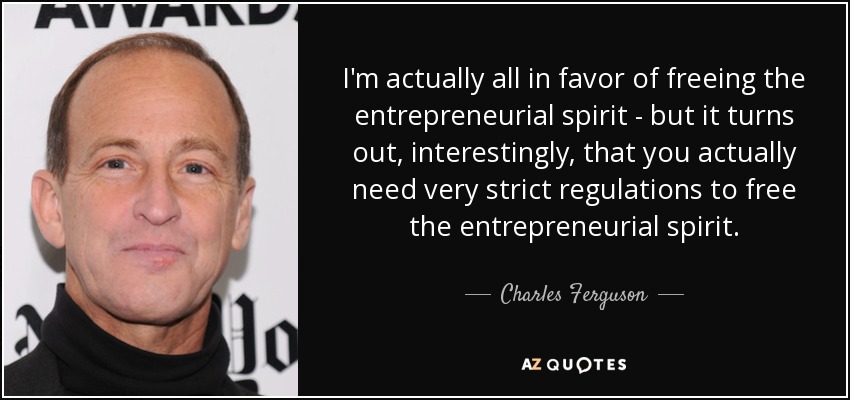
I'm actually all in favor of freeing the entrepreneurial spirit - but it turns out, interestingly, that you actually need very strict regulations to free the entrepreneurial spirit.
It is ridiculous to believe that Greece might be taking in one million migrants, registering them, then giving refuge to those who have a right to asylum and sending everyone back that does not. Greece is not doing that. We can blame the Greeks for that, but at the same time we should change the Dublin Regulation. When we insist on this unrealistic procedure, it means nothing more than that we are defending Dublin while renouncing Schengen.
Now that I'm afraid was institutionalized, and the great thing about the Canadian content regulations is that it broke that open. I mean it broke it open because people were faced with no choice, but to really start listening to these records and find the ones that they could play. It didn't take long for Canadian radio to go "Wow! We're not going broke doing this, it's not killing us, the audience isn't complaining."
I was in charge of price controls in World War II and had a ceiling on overall prices. Everybody who was subject to general maximum price regulation wanted an exception and went to Congress to persuade a Congressman, or a group of people on the Hill, that I was being a menace to their industry.
The institutions are working better now, the banks are much more functional. At this time, 1997, there were no mobile phones! It's a whole different thing now with mobile phones: technology has created a form of regulation, because people can actually talk to each other a lot more.
Sprite really does taste different everywhere! That's like a fact. Because of certain regulations, you can only put so many sugars.
I've been regulated my whole life. We have progressive taxes. It's not a free-market free-for-all. I completely understand that society has a perfectly legitimate right to put in structures and regulations and rules that make it fairer, better, cleaner.
Prescriptive regulations, such as telling electric utilities what kinds of coal to burn or what kinds of scrubbers to install on their smokestacks, were not only intrusive, they were also grossly inefficient.
In L.A., I called every scrap yard and surplus place that was listed, about 50 or 60 places, and only at one of them did the owner get intrigued and let me go around the yard to find stuff. Because the insurance regulations are such that you can't go into the places anymore.
The banks, because of mismanagement, because of huge risk taking, are now in very vulnerable positions. We can expect that we're gonna have to do more to shore up the financial system. We also are gonna have to make sure that we set up financial regulations so that not only does this never happen again, but you start having some sort of - trust in how the credit markets work again.
I think there is some overreach in the sense that the EPA now says: if Congress doesn't pass greenhouse emissions regulations or testing, we'll simply do it on our own. I think that's an arrogance of a regulatory body run amok.
The first thing I'd do [as a president] is de-regulate about 90-percent of the things that they've got regulation on, OK, including duck hunting. We're way over-regulated on everything.
There has to be some more regulation. But our kids have this incredible buffet of they can work in genomics, they can work in pre-omics, or they can work in robotics, or they can work in this, or they can work in that. And within the next five years there will be entirely new industries that come out of nowhere that kids are working in that would have been inconceivable when they started college. Not when we started college.
I don't think the idea of requiring these to be only sold to people who have already own the bonds, in other words, this naked position that the Germans have recently put into their financial regulation and has been discussed here. I don't think that makes any sense.
I think we're fooling ourselves if we think that regulators are going to be able to outsmart the bankers. So, the task of designing regulatory reform is trying to make more or less foolproof regulation and that's one of the advantages of the systemic category.
In any socialist government, they must destroy all alliances other than your alliance to the government, and they want the government to become your God. That for you to totally depend upon government. So we become slaves to government, through taxation, through regulation, through all kinds of restrictions, that makes us not free anymore.
If you have a regulation that's going to save hundreds of thousands of lives annually and not cost very much, that sounds like a very good idea.
And so in 1975, the grizzly bear was put on, as I said - on the endangered species list as threatened. And new measures were taken, for instance, bear-proofing garbage, creating new regulations to - essentially to try and keep people and people's food away from the bears, let the bears adjust to eating the abundant wild food that's available in Yellowstone and allow them to be more wild, to be independent of humans as sources of foods for the good of both sides. And that has been quite successful.
Paul Keating told us before we were elected that you can do deals with [Rupert] Murdoch without saying you were doing a deal. Did we do that kind of thing? Maybe. But from around about the turn of the century, I felt strongly that we had to do something about media ownership and self-regulation. Tony [Blair] disagreed.
Leaving [from EU] will allow us to return real democratic control to important areas of national life; from international trade, the right to work and live in Britain to business regulation.
That's the problem with the financial sector. Banks and the financial sector live in the short run, not the long run. In principle the government is supposed to make regulations that help the economy over time. But once it's taken over by the financial sector, the government lives in the short run too.
Complex rules restricting our labour markets are not some naturally occurring phenomenon. Just as excessive regulation is not some external plague that's been visited on our businesses.
Whether interpreting the Constitution or filling in the blanks of a law or a regulation, every word of the court's opinion can widen or narrow our rights as Americans and either protect us or leave us more vulnerable to any winds that blow.
Judges are not members of Congress, they're not state legislators, governors, nor presidents. Their job is not to pass laws, implement regulations, nor to make policy.
More taxes, more regulation, more Washington domination, more debt. Those things are not the future for America. They will never work.
Follow AzQuotes on Facebook, Twitter and Google+. Every day we present the best quotes! Improve yourself, find your inspiration, share with friends
or simply: