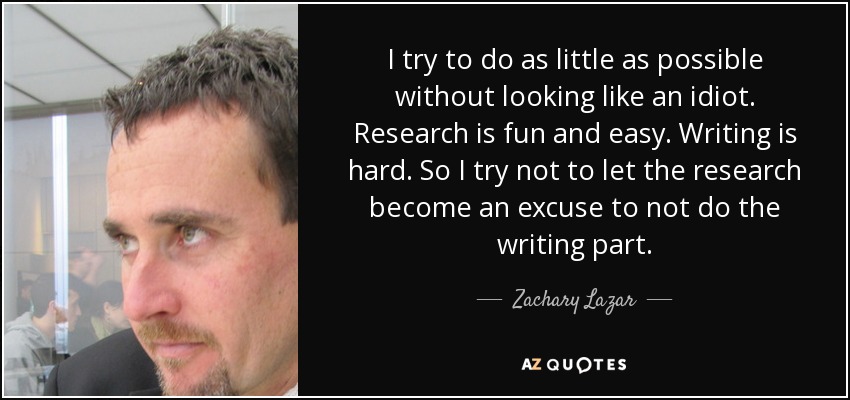
I try to do as little as possible without looking like an idiot. Research is fun and easy. Writing is hard. So I try not to let the research become an excuse to not do the writing part.
With the historical fictions, I was already doing so much research, and so much of the stories was anchored by historical truth that the move to nonfiction didn't feel all that dramatic - just another half-step to the right.
I've had investigations of my lab because people didn't like what I had to say. And when you have investigations and you're doing research, you're shut down for a while. You have to start all over again. So that's one area where I paid a high price.
You start doing your research and realizing that the fertility rate for women drops considerably. And you're like, "Oh my God, now I want to get pregnant, and now it's a crazy time where I might not be able to get pregnant because I'm getting older and my eggs are aging and my uterus isn't as fertile as it used to be and my loins are not where they used to be."
Many Chinese entrepreneurs are now donating for education; others support foundations in health care and research. None of us wants to be the richest guy in the cemetery.
I'd done all my research and seen that Booker and Gadson had worked with giant folks and little peanuts, too. That just showed me that they're musicians. They're not just interested in doing the big ones, they're interested in doing stuff that - pardon the expression - gives them a boner. I'm like that, too. I don't want to just do easy stuff. I want to keep myself freaked out all the time. Hence the title of the record, I Like To Keep Myself in Pain.
When I began research, I read the writings of the Sonderkommandos. They are not well known, but these prisoners wrote from the middle of hell from Auschwitz, to let the world know what happened. The texts were buried beneath the ground and found after the liberation of the concentration camps.
I began to firmly change my mind when I saw how young Egyptians used Facebook, for example, to begin to coalesce their social justice movement in their country. And a good Iranian friend of mine showed me how also in Iran, till the government shut it down, much was communicated via social media. So I'm not against. I use the internet regularly to do research. It's great but you have to use your discernment, especially if researching content.
I also did a great amount of writing while doing research. It gave me the opportunity to meet and talk to people other than family, but also to explore my own memory deeper by comparing it to the memories of others who were in my home town during, for example, the political transition from socialism to a nationalistic "democracy" or during the bombings.
It is a bit more challenging for the simple fact that now the stories I am writing are relying more on my imagination than on facts, more on research than on memory; so it is basically a slower writing process, more reading, more exploring. On the other hand, this approach is a little bit relieving too, since many times while writing [How the Soldieer Repairs the Gramophone] I felt too close and equal to my character.
I had a visceral connection to the period [of Korean War]. By visceral I suppose I mean emotional. But every fiction requires so much that is not that so I did a lot of other research and a lot of thinking, a lot of struggling there.
The hidden village was something we found when we went to research in China we climbed a mountain in the Sichuan province where the panda sanctuary is based, and we climbed to this beautiful, mist-covered, almost primordial place and when we turned these corners these moss covered old buildings would come into view, revealing themselves and it was so beautiful and so unlike anything we'd seen that we literally took those moments and put them into the film [Kung Fu Panda 3].
We teach what we have to learn. It's been an extraordinary journey that I couldn't have done with not only the research participants but the community, the tribe that we've built of people who are also on this journey.
It's a practice for me every day, sometimes every hour of every day. It is an absolute practice. When I went into the research, I really thought that there are authentic people and inauthentic people, period. What I found is, there people who practice authenticity and people who don't. The people who practice authenticity work their ass off at it.
Maybe, through the stories I share about my life and others and the medical research that has been dedicated to the world of positive psychology, they'll relate to the power of a positive perspective and change the world one person at a time. Pipe dream, of course, but I love the thought of being given the chance to inspire!
I like to do my research, get in the right mental state for the person I'll be portraying. A lot of time, it's just incorporating a lot of what that person would be into, into my daily routine.
HIV/AIDS from converted from a lethal disease into a chronic disease because basic scientists' fundamental research was done that illuminated aspects of that virus and allowed the generation of therapies like antiretroviral therapies. And so now HIV/AIDS is not a lethal disease, it is a chronic disease.
Hepatitis C was a devastating disease but because fundamental research was done in hepatitis C, it is now curable. It is now absolutely curable with new medications. So this is transformative.
I think there's a lack of understanding which is partly our fault as scientists and physicians in not communicating well enough with the public. But there's a lack of understanding of how important biomedical research is.
The director of the institute where I was working apologized about these young, enthusiastic researchers when the World Bank visited because he was afraid the institute would lose the World Bank consultancies.I went back home and started the Research Foundation for Science, Technology, and Ecologyan extremely elaborate name for the tiny institute that I started in my mothers cow shed. My parents handed over family resources and said, Put them to public purpose. Thats how I survived.
Fortunately I had a great intern who did a lot of the research on Andy's prices, which of course are phenomenal, but getting them straight - you know, he's reached this $100million plateau that only a handful of other artists have reached, which puts him in the company of Cezanne, Klimt, Picasso, and such.
Most of them benefit businesses, things like research and development tax credits. But people will also benefit, too, from things like - the earned income tax credit and the child tax credit have been made permanent. They predominantly help lower-income families.
One of the places where research is needed is all the sensory problems. And you get sensory problems not just with autism, but with dyslexia, learning problems, ADHD, attention deficit, you know, things like sound sensitivity, problems with fluorescent lighting.
Jesse Owen was bigger than a black hero, he was an American hero. For me, I looked at it from that perspective. Through my research, I obviously learned a lot, much of which made me sad, upset, disappointed and even angry, regarding what Jesse had to go through. Not only was he a black man in America during an age of high racial tension and segregation, but he was also living in the middle of the Great Depression - it was very difficult times for him and his family.
I'm not actually sure if guilt is an emotion. In fact, that was - at the very beginning of this process, we realized, man, we really don't know very much about this subject so we better do some research. And we started looking around online.
Follow AzQuotes on Facebook, Twitter and Google+. Every day we present the best quotes! Improve yourself, find your inspiration, share with friends
or simply: