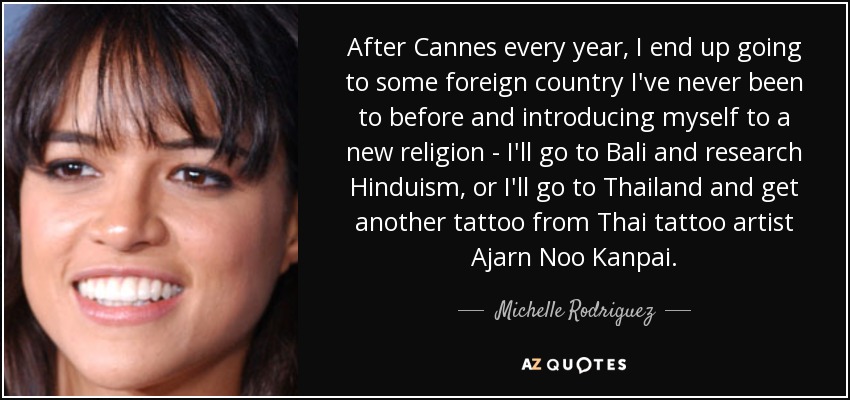
After Cannes every year, I end up going to some foreign country I've never been to before and introducing myself to a new religion - I'll go to Bali and research Hinduism, or I'll go to Thailand and get another tattoo from Thai tattoo artist Ajarn Noo Kanpai.
I often use the iPhone as an example of how governments shape markets, because what makes the iPhone ‘smart’ and not stupid is what you can do with it. And yes, everything you can do with an iPhone was government-funded. From the Internet that allows you to surf the Web, to GPS that lets you use Google Maps, to touch screen display and even the SIRI voice activated system - all of these things were funded by Uncle Sam through the Defense Advanced Research Projects Agency (DARPA), NASA, the Navy, and even the CIA!
In my day, everything came from my belly button and seat of the pants. Today, everything is done from research.
Recently, results of the Human Genome Project have shattered one of Science's fundamental core beliefs, the concept of genetic determinism. We have been led to believe that our genes determine the character of our lives, yet new research surprisingly reveals that it is the character of our lives that controls our genes. Rather than being victims of our heredity, we are actually masters of our genome.
A surprising feature of herbal research is that it is seldom the rare, exotic, and beautiful plant that proves the most interesting; more often it is some common, familiar, and despised weed that is discovered to have undreamed-of virtues.
For memetics to be a reasonable research programme, it should be the case that copying, and differential success in causing the multiplication of copies, overwhelmingly plays the major role in shaping all or at least most of the contents of culture. Evolved domain-specific psychological dispositions, if there are any, should be at most a relatively minor factor that could be considered part of background conditions.
In 1989 I came to New York to go to the School of Visual Arts. Then, after two years, I switched over to the New School for Social Research and did cultural anthropology in the graduate school there.
The impression I got during the research and interview process was that they are trying to own the disease and therefore own the cause which can ultimately be more profitable for some corporations and fund-raising groups.
By sort of combining the research of a lot of smart people, I came up with an equation for dread [dread=uncontrollability+unfamiliarity+imaginability+suffering+scale of destruction+unfairness]. The dread equation is a simplification, but it's a way to explain why we fear something so much when it is so unlikely. Part of it is the lack of control. That's why we're more scared of plane crashes than car crashes even though we know rationally which is more dangerous.
Just go to an auto show, and you'll see all the signs of sexual arousal in the men: shiny eyes, tremors, sex flush. An acute example of the need for professional sex research.
If Holocaust happened, then those who bear the responsibility for it have to be punished, and not the Palestinians. Why isn't research into a deed that occurred 60 years ago permitted? After all, other historical occurrences, some of which lie several thousand years in the past, are open to research, and even the governments support this.
The roots of the Palestinian conflict must be sought in history. The Holocaust and Palestine are directly connected with one another. And if the Holocaust actually occurred, then you should permit impartial groups from the whole world to research this. Why do you restrict the research to a certain group? Of course, I don't mean you, but rather the European governments.
There is no reason why an extraphysical general principle is necessarily to be avoided, since such principles could conceivably serve as useful working hypotheses. For the history of scientific research is full of examples in which it was very fruitful indeed to assume that certain objects or elements might be real, long before any procedures were known which would permit them to be observed directly.
I could not write my books without the library's help. Even with the ease of Internet research, I find books to be indispensable when I am writing. ... Books make me laugh, cry, and think. They give me insight into history, and into the lives of people in other cultures. They help me make important decisions, and they provide endless entertainment. Hooray for libraries!
I never really do much research before signing a film. It is just the script and character that I concentrate on.
We worked and worked, didn't get anywhere. That's how you know you're doing research.
The biggest challenge in the research process is to let go, to stop, to say enough, and then to reduce all of that beloved labor down to a few succinct paragraphs that shape the background to your narrative. I love research - that's all the fun, especially in the field. To write, however, is to suffer, and my pieces usually come in thousands of words over the assigned length. That's a serious flaw in my writing process - shaping and disciplining the footlockers of material one has so happily gathered.
My very clear vision for the ideal Roomba is one you never see and you never touch. Our research priorities are explicitly focused on the Roomba of the future that will deliver on the promise of automatically cleaning your floor.
I did no research on The Best Man. That was something that came out from my own head.
We allowed ourselves to become particularly interested in research into the appearance of intermediate products of sugar decomposition during cell-free fermentation.
My research suggests that when people get rebuffed they become frustrated and angry, but they would do better to become curious about the reason for the rejection. I also found that people assume that others are like them, operating under the same knowledge, beliefs, constraints and priorities. This mirror assumption makes it easier to speculate about why others act in the way they do, but sometimes the mirror assumption is wrong.
I will work and fight for stem cell research.
There are major writers who have written books [based on my research]. If one looks carefully at the copyright page, you'll see my name. Writers of the stature of Mailer and even bigger. All over the world.
Oral history is a research method. It is a way of conducting long, highly detailed interviews with people about their life experiences, often in multiple interview sessions. Oral history allows the person being interviewed to use their own language to talk about events in their life and the method is used by researchers in different fields like history, anthropology and sociology.
My book, Oral History: Understanding Qualitative Research is about how researchers use this method and how to write up their oral history projects so that audiences can read them. It's important that researchers have many different tools available to study people's lives and the cultures we live in. I think oral history is a most needed and uniquely important strategy.
Follow AzQuotes on Facebook, Twitter and Google+. Every day we present the best quotes! Improve yourself, find your inspiration, share with friends
or simply: