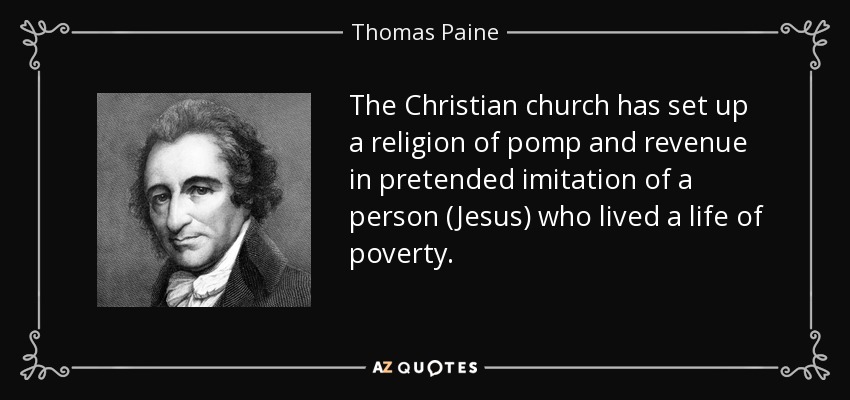
The Christian church has set up a religion of pomp and revenue in pretended imitation of a person (Jesus) who lived a life of poverty.
Even before 2007, this half of a small island was the richest football country on earth. In 2005-2006 the Premiership's total revenue was about £1.4bn, 40 per cent more than its nearest rival, Italy's Serie A. That was before take-off. Now foreign television channels are sending so much cash that the Premiership is expected to take in nearly £1.8bn this season. Even the team that finishes bottom of the table (Wigan might be a good bet) will get £26.8m from TV. That's more than all of Argentine or Belgian football put together.
Every effort therefore must be made to perpetuate prosperity. And, since that is to the advantage of the rich as well as the poor, all that accrues from the revenues should be collected into a single fund and distributed in block grants to those in need, if possible in lump sums large enough for the acquisition of a small piece of land, but if not, enough to start a business, or work in agriculture. And if that cannot be done for all, the distribution might be by tribes or some other division each in turn.
I come back to the same thing: We've got the greatest pipeline in the company's history in the next 12 months, and we've had the most amazing financial results possible over the last five years, and we're predicting being back at double-digit revenue growth in fiscal year '06.
Zealous groups threaten to infringe civil liberties when they seek government support to impose their own religious views on nonadherents. This has taken many forms, including attempts to introduce organized prayer in public schools, to outlaw birth control and abortion, and to use public tax revenues to finance religious schools.
The move to tax Internet sales, clothed as a 'fairness' issue, is the typical 'wolf-in-sheep's-clothing' ploy so often used by governments unwilling to cut expenditures to match revenues. It matters not whether its proponents have a 'D' or an 'R' after their name. It is a tax increase in either case.
What usually works: Simple sells. When you have to get out an encyclopedia and an Excel sheet to show somebody how much they make on a stream that comes by way of ad revenue, it gets a little complicated.
I came up with this idea to create an app. And the premise of the app is this: every problem in the bar business goes away when there's sales. You increase revenue and you solve every problem. It's when the revenues are low that [the business] doesn't work. So I wanted to put together an app that focused on top-line revenue, guest experience, and business management in a more organized way.
The key question facing those of us working in the media (old and new) is whether we embrace and adapt to the radical changes brought about by the Internet or pretend that we can somehow hop into a journalistic Way Back Machine and return to a past that no longer exists and can't be resurrected. There is no question that, as the industry moves forward and we figure out the new rules of the road, there will be - and needs to be - a great deal of experimentation with new revenue models.
Maria Sharapova is her own empire. She herself personally makes more in revenue than the entire WTA tour.
A visit to the hood through a record, or through a video, or through a film, is a lot safer than actually visiting the people in real life. It became a business model. It became a revenue engine that, you know, you can get to the hood without ever going there.
Concerning our possibilities on the international financial markets, the sanctions are severely harming Russia. But the biggest harm is currently caused by the decline of the prices for energy. We suffer dangerous revenue losses in our export of oil and gas, which we can partly compensate for elsewhere. But the whole thing also has a positive side: if you earn so many petrodollars - as we once did - that you can buy anything abroad, this slows down developments in your own country.
They [leaders in Western Europe] do not misuse financial instruments, financial injections, but, first of all, seek structural change. This is urgent for our economy as well, maybe even more urgent bearing in mind the problem that we cannot yet deal with, namely the prevalence of the oil and gas sector in the Russian Federation and, as a result, dependence on revenue from oil and gas.
When the ruble is weaker, it is easier to sell, to produce here for a cheap ruble and sell for an expensive dollar, get revenue in dollars and then exchange it for rubles and get a bigger income. This is simple.
Finally, we will have at our disposal additional revenues from unleashing American energy. The Institute for Energy Research cites a short run figure of as much as $36 billion annually from increased energy production, tremendous amounts of money.
Legalized gambling cost taxpayers $3 for every $1 in state revenue to government
27 percent to 55 percent of casino revenues come from problem or pathological gamblers
Today, as a result of a miraculous set of circumstances, Iran is going to get between $50 to $55 billion in oil revenue, which is unheard of in the history of the revolution.
In a world where authenticity increasingly is in focus, consumers are seeking more than brands who focuses on revenue - consumers want to support brands with a purpose - one that justifies an emotional engagement.
Donald Trump is going to go farther than other presidents have gone in terms of making us more dependent on ourselves energy-wise, and to create billions of dollars in revenue, millions of jobs, some people project, over time.
While advocates of legalized gambling say it brings in revenues needed for education and other uses, it actually has led to higher taxes, loss of jobs, economic disruption of non-gambling businesses, increased crime and higher social-welfare costs
If gambling were banned, those social costs would drop, tax revenues from consumer goods would increase, and money would be pumped into the productive economic sector
When the economy's shrinking, providing jobs, spending on things like infrastructure can actually increase revenue and drive down debt. And then, there's going to be a time at which point debt has to be taken care of.
Print works! It works as a business proposition - our print readers [of the Mother Jones] not only provide revenue in the form of subs and ads, but they are a core part of our donor community; 10 percent give us a donation on top of their subscription; that's about the same rate as NPR gets from its listeners.
When you are incubating new ideas, "Don't put all your eggs in one basket" is very good advice. But when you are seeking to transform your enterprise's portfolio by scaling a fledgling business to material size - say ten percent of total enterprise revenue - then it is imperative that you make that the singular focus of everyone in the enterprise for the two to three year period it is likely to require to reach its tipping point. Expecting to do two such scaling efforts in parallel is simply folly, yet that is what the "eggs/basket" idea is often used to justify.
Follow AzQuotes on Facebook, Twitter and Google+. Every day we present the best quotes! Improve yourself, find your inspiration, share with friends
or simply: