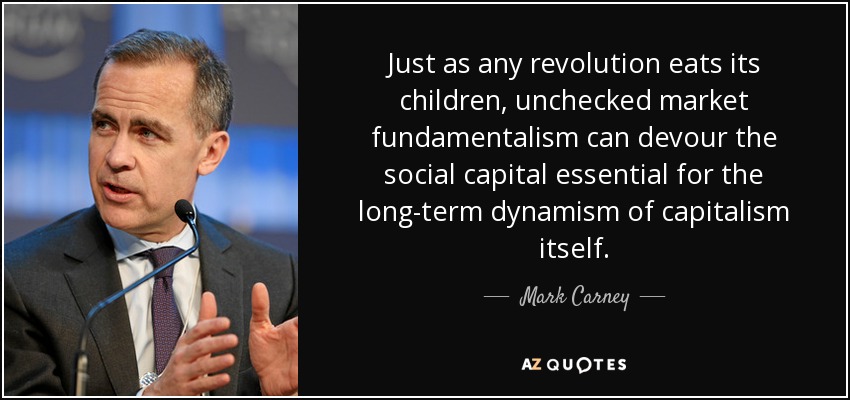
Just as any revolution eats its children, unchecked market fundamentalism can devour the social capital essential for the long-term dynamism of capitalism itself.
We believe that this time of transition will make for a more dynamic Revolution Church, and will help us focus and expand our scope and mission.
The link between literacy and revolutions is a well-known historical phenomenon. The three great revolutions of modern European history -- the English, the French and the Russian -- all took place in societies where the rate of literacy was approaching 50 per cent. Literacy had a profound effect on the peasant mind and community. It promotes abstract thought and enables the peasant to master new skills and technologies, Which in turn helps him to accept the concept of progress that fuels change in the modern world.
Let us be today's Christians. Let us not take fright at the boldness of today's church. With Christ's light let us illuminate even the most hideous caverns of the human person: torture, jail, plunder, want, chronic illness. The oppressed must be saved, not with a revolutionary salvation, in mere human fashion, but with the holy revolution of the Son of Man, who dies on the cross to cleanse God's image, which is soiled in today's humanity, a humanity so enslaved, so selfish, so sinful.
Imperialism has layed its body over the world, the head in Eastern Asia, the heart in the Middle East, its arteries reaching Africa and Latin America. Wherever you strike it, you damage it, and you serve the World Revolution.
The purpose of every industrial revolution is to make craft and skills obsolete, and thereby make people interchangeable and cheap.
Carla Hesse has given us an astonishing new look at women's struggle for independent expression and moral autonomy during the French Revolution and afterward. Denied the political and civil rights of men, literary women plunged into the expanded world of publication, answering the men's philosophical treatises with provocative novels about women's choices and chances. Lively and learned, The Other Enlightenment links women from Madame de Stael to Simone de Beauvoir in an alternate and daring path to the modern.
People often criticize my films for being pessimistic; there are certainly many reasons for being pessimistic but I don’t see my films that way. They’re founded in the belief that revolution doesn’t belong on the cinema screen but outside in the world. Never mind if a film ends pessimistically but exposes certain mechanisms clearly enough to show people how they work and the ultimate effect is not pessimistic. My goal is to reveal such mechanisms in a way that makes people realize the necessity of changing their own reality.
It is a question of building which is at the root of the social unrest of today: architecture or revolution.
Our revolution's main mission is to pave the way for the reappearance of the Twelfth Imam, the Mahdi.
The mercy of the West has been social revolution; the mercy of the East has been individual insight into the basic self/void.
We believe that we live in the 'age of information,' that there has been an information 'explosion,' an information 'revolution.' While in a certain narrow sense this is the case, in many important ways just the opposite is true. We also live at a moment of deep ignorance, when vital knowledge that humans have always possessed about who we are and where we live seems beyond our reach. An Unenlightenment. An age of missing information.
Legitimate revolution must be led by, made by those who have been most oppressed: black, brown, yellow, red, and white women-with men relating to that the best they can.
We had no revolutions to fear, nor fatigues to undergo; all our adventures were by the fireside, and all our migrations from the blue bed to the brown.
The sustainability revolution will, hopefully, be the third major social and economic turning point in human history, following the Neolithic Revolution - moving from hunter-gathering to farming - and the Industrial Revolution
The feminist revolution had to be fought because women quite simply were stopped at a state of evolution far short of their human capacity.
Some of my ancestors fought in the American Revolution. A few more wore red coats, a few wore blue coats, and the rest wore no coats at all. We never did figure out who won that war.
All revolutions have failed? Perhaps. But rebellion for good cause is self- justifying -- a good in itself. Rebellion transforms slaves into human beings, if only for an hour.
Three words remain that can yet stir the blood of man: the word 'rebellion'; the word 'revolt'; the word 'revolution'.
There never was a good war or a bad revolution.
England has never enjoyed a genuine social revolution. Maybe that's what's wrong with that dear, tepid, vapid, insipid, stuffy, little country.
It is almost never when a state of things is the most detestable that it is smashed, but when, beginning to improve, it permits men to breathe, to reflect, to communicate their thoughts with each other, and to gauge by what they already have the extent of their rights and their grievances. The weight, although less heavy, seems then all the more unbearable.
It can never be too often repeated, that the time for fixing every essential right on a legal basis is while our rulers are honest, and ourselves united.
The refusal of King George to allow the colonies to operate an honest money system, which freed the ordinary man from clutches of the money manipulators was probably the prime cause of the revolution.
We had quitters during the Revolution too...we called them 'Kentuckians.'
Follow AzQuotes on Facebook, Twitter and Google+. Every day we present the best quotes! Improve yourself, find your inspiration, share with friends
or simply: