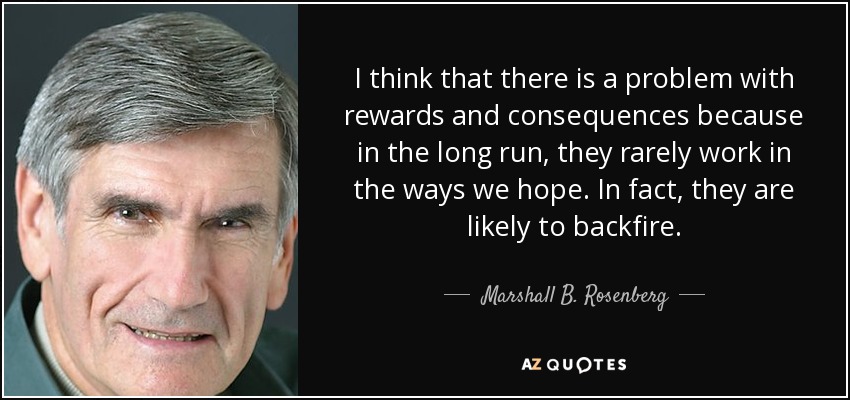
I think that there is a problem with rewards and consequences because in the long run, they rarely work in the ways we hope. In fact, they are likely to backfire.
For me the best thing about winning an award is when the people cheer for your win. When you can see that the people are really happy that you are winning something, that's the most reward thing in the world.
This was the great clarity of being beyond emotion, after the reward of having felt everything one could feel.
A morality that holds need as a claim, holds emptiness-non-existence-as its standard of value; it rewards an absence, a defect: weakness, inability, incompetence, suffering, disease, disaster, the lack, the fault, the flaw-the zero.
If there existed only one man or woman who did not love the Saviour, and if that person lived among the wilds of Siberia, and if it were necessary that all the millions of believers on the face of the earth should journey there, and every one of them plead with him to come to Jesus before he could be converted, it would be well worth all the zeal, labour, and expense. If we had to preach to thousands year after year, and never rescued but one soul, that one soul would be full reward for all our labour, for a soul is of countless price.
Laughter, ridicule, opposition, persecution, are often the only reward which Christ's followers get from the world.
Just practice good, do good for others, without thinking of making yourself known so that you may gain reward. Really bring benefit to others, gaining nothing for yourself. This is the primary requisite for breaking free of attachments to the Self.
Firm and patient optimism always yields its rewards.
In most cases, no matter what it is, if you measure it and reward it, people will try to excel at it
When I knew I couldn't suffer another moment of pain, and tears fell on my bloody bindings, my mother spoke softly into my ear, encouraging me to go one more hour, one more day, one more week, reminding me of the rewards I would have if I carried on a little longer. In this way, she taught me how to endure — not just the physical trials of footbinding and childbearing but the more torturous pain of the heart, mind, and soul.
Rather, to change a habit, you must keep the old cue, and deliver the old reward, but insert a new routine.
Then one day, we’ll put the reward in the old place, and put in the rat, and, by golloy, the old habit will rememerge right away. habits never really disappear. They’re encoded into the sturctures of our brain, and that’s a huge advantage for us, because it would be awful if we had to relearn how to drive after every vacation. The problem is that your brain can’t tell the difference between bad and good habits, and so if you have a bad one, it’s always lurking there, waiting for the right cues and rewards.
However, to modify a habit, you must decide to change it. You must consiously accept the hard work of identifying the cues and rewards that drive the habits' routines, and find alternatives. You must know you have control and be self-conscious enough to use it -- and every chapter in this book is devoted to illustrating a different aspect of why that control is real.
What we know from lab studies is that it's never too late to break a habit. Habits are malleable throughout your entire life. But we also know that the best way to change a habit is to understand its structure - that once you tell people about the cue and the reward and you force them to recognize what those factors are in a behavior, it becomes much, much easier to change.
If I were to speak of war, it would not be to show you the glories of conquering armies but the mischief and misery they strew in their tracks; and how, while they marched on with tread of iron and plumes proudly tossing in the breeze, some one must follow closely in their steps, crouching to the earth, toiling in the rain and darkness, shelterless themselves, with no thought of pride or glory, fame or praise, or reward; hearts breaking with pity, faces bathed in tears and hands in blood. This is the side which history never shows.
Should one be shallow enough to view existence as a system of rewards and punishments, one soon learns that we pay as dearly for our triumphs as we do for our defeats.
In life, there's the beginning and the end. The beginning don't matter. The end don't matter. All that matters is what you do in between – whether you're prepared to do what it takes to make change. There has to be physical and material sacrifice. When all the dust settles and we're getting ready to play down for the ninth inning, the greatest reward is to know that you did your job when you were here on the planet.
It takes a great deal of courage and independence to decide to design your own image instead of the one that society rewards, but it gets easier as you go along.
In the annals of science fiction, where dystopias rule the imaginative roost, Star Trek stood nearly alone in telling us that our future would be better than our past, that our common problems would be solved, that we, as a species, were fundamentally good, and that the universe would reward us for our goodness.
All that I do and suffer is but the way to the reward, and not the deserving thereof.
Every event has a purpose and every setback its lesson. I have realized that failure, whether of the personal, professional or even spiritual kind, is essential to personal expansion. It brings inner growth and a whole host of psychic rewards. Never regret your past. Rather, embrace it as the teacher that it is.
The painter who is content with the praise of the world for what does not satisfy himself, is not an artist, but an artisan; for though his reward be only praise, his pay is that of a mechanic.
I've always sought to express a tension in form and meaning in order to achieve a veracity. I have come to the conclusion that the art world has to join us, women artists, not we join it. When women are in leadership roles and gain rewards and recognition, then perhaps 'we' (women and men) can all work together in art world actions.
A beautiful literary collection that tells of today's country doctor, somewhat removed from our romantic black-bag image of days gone by, but still fulfilling an essential need in caring for spread-out populations. At times, with today's advances in technology, medicine in rural America looks very like it does in America's cities, but the variety of practices is enormous. The Country Doctor Revisited captures the trials and tribulations of medicine, but also the satisfaction and the extraordinary rewards that come to those who embrace such a practice.
Because men believe not in Providence, therefore they do so greedily scrape and hoard. They do not believe in any reward for charity, therefore they will part with nothing.
Follow AzQuotes on Facebook, Twitter and Google+. Every day we present the best quotes! Improve yourself, find your inspiration, share with friends
or simply: