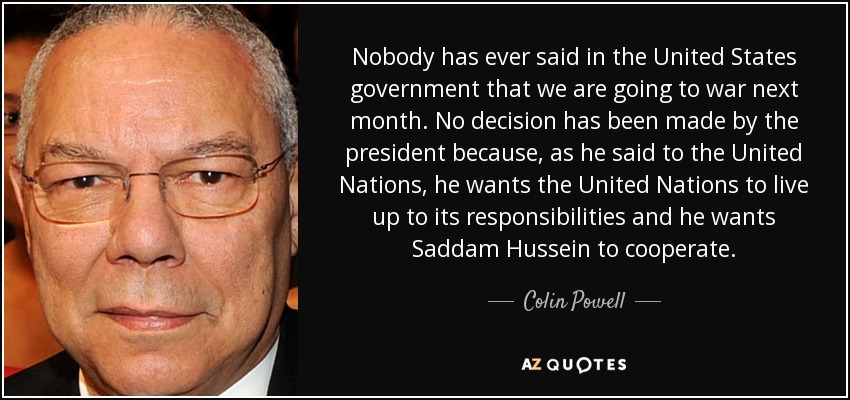
Nobody has ever said in the United States government that we are going to war next month. No decision has been made by the president because, as he said to the United Nations, he wants the United Nations to live up to its responsibilities and he wants Saddam Hussein to cooperate.
We now believe it is appropriate for Saddam Hussein to be forced to change, either by the threat of war, and therefore that compels him to cooperate. If he cooperates, then the basis of changed regime policy has shifted because his regime has, in fact, changed its policy to one of cooperation. So if he cooperates, then that is different than if he does not cooperate.
It remains our policy to change the regime until such time as the regime changes itself. So far, we cannot be sure that he is cooperating or he [Saddam Hussein] is acting in a way that could give us comfort, or should give the international community comfort, that he is giving up his weapons of mass destruction. He continues to give us statements that suggest he is not in possession of weapons of mass destruction when we know he is.
The burden is on Saddam Hussein. And our policy, our national policy - not the UN policy but our national policy - is that the regime should be changed until such time as he demonstrates that it is not necessary to change the regime because the regime has changed itself.
It is not our place to decide who should lead the Iraqi people. If Saddam [Hussein] leaves or has to be forced out of power and a new regime brought in, a new leadership brought in, I am confident it will be some combination of people inside the country and outside the country.
I wish that after the war against Saddam Hussein we had been more effective at rebuilding Iraq quickly. I think had we done it from the provinces, in, rather than from Baghdad, out, we might have been more successful.
Saddam Hussein had nerve gas and used it against his own people, he had used chemical weapons against the Iranians and he almost had a nuclear bomb in 1981 and in 1991. And he had been caught with anthrax in 1995 by the UN inspections after denying that he had it.
I think we've, again, got to be extremely careful; otherwise we'll misunderstand what's going on in Iraq and in Syria today. Of course, you can't say that those of us who removed Saddam in 2003 bear no responsibility for the situation in 2015.
Most Iraqis, even if they hated Saddam and suffered, say life was much better under him than it was under the occupation and what's going on today.
The Sunni Arabs began to realize that they had made a huge mistake by not voting in the election of 2005 and by not being part of the new Iraq. They had reasons for this: They were effected by the disestablishment of the military and by de-Baathification (the dismantling of Saddam Hussein's party) in winter 2007-2007. They increasingly recognized that their future lay in being part of the solution rather than a continuing part of the problem.
It was right to overthrow Saddam Hussein. It was the regime itself that was a threat. I think in hindsight, what I would have done is turn authority back over to Iraqis much more quickly and say: "Your country, you figure out how to run it."
I still think the world is better off and safer without Saddam Hussein.
Abu Ghraib, as bad as it was, can't be compared to what Saddam was doing to people.
Does anybody really believe that Iraq is going to be a wonderful democracy where people are going to run down to the voting box and gently put in their ballot and the winner is happily going to step up to lead the county? C'mon. Two minutes after we leave, there's going to be a revolution, and the meanest, toughest, smartest, most vicious guy will take over. And he'll have weapons of mass destruction, which Saddam didn't have.
As Americans, we want peace - we work and sacrifice for peace. But there can be no peace if our security depends on the will and whims of a ruthless and aggressive dictator. I'm not willing to stake one American life on trusting Saddam Hussein.
But in terms of Saddam Hussein being there, let's remember that his country is divided, in effect. He does not control the northern part of his country. We are able to keep arms from him. His military forces have not been rebuilt.
In fact, five years ago, after Saddam ejected the UN inspectors, John McCain and I gave up on containment and introduced the Iraqi Liberation Act, which, when it became law, made a change of regime in Baghdad official US policy. You might therefore say that, when it comes to Iraq, President Bush is just enforcing the McCain-Lieberman policy.
US worse off than before Saddam because US lost credibility.
Every Iraqi would I know would rather have Saddam back... I mean like... that does not even take rocket science.
Follow AzQuotes on Facebook, Twitter and Google+. Every day we present the best quotes! Improve yourself, find your inspiration, share with friends
or simply: