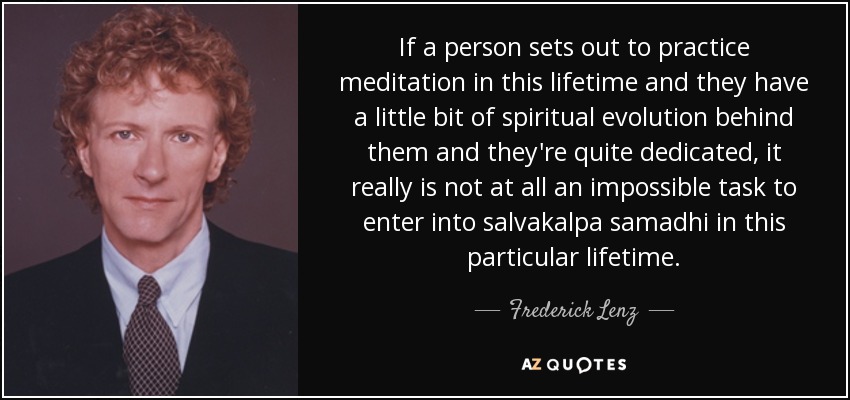
If a person sets out to practice meditation in this lifetime and they have a little bit of spiritual evolution behind them and they're quite dedicated, it really is not at all an impossible task to enter into salvakalpa samadhi in this particular lifetime.
Nirvikalpa samadhi is another matter. I don't feel that's really up to us. That happens at a certain time when our being has gone through countless changes and refinements.
The advanced education in Tantra obviously has to do with the entrance into samadhi, the negation of the self. That is what the path of negation means, not the negation of life, but the negation of anything that is not enlightenment.
Nirvikalpa samadhi is a state of no mind, beyond the ten thousand states of mind, where there is nothing but perfection, where the self no longer exists...the ego dissolves into immortality.
Nirvikalpa Samadhi means you are sitting in meditation and you go beyond the planes of light to nirvana. Then you come back and here you are "back in the saddle again".
Sahaja samadhi means that you have just gone back and forth so many times that there is no back and forth. All you see is enlightenment in this world and the other side. There is no other side anymore. It means that you are wakeful.
To be fixated on Sahaja Samadhi is to be fixated. To be fixated on the idea of being not fixated is fixation too. All these ideas and definitions about enlightenment become silly.
You can call it tathata, suchness. 'Suchness' is a Buddhist way of expressing that there is something in you which always remains in its intrinsic nature, never changing. It always remains in its selfsame essence, eternally so. That is your real nature. That which changes is not you, that is mind. That which does not change in you is buddha-mind. You can call it no-mind, you can call it samadhi, satori. It depends upon you; you can give it whatsoever name you want. You can call it christ-consciousness.
Buddhas can take you to the boundary line of meditation and samadhi. That is the only difference between meditation and samadhi. If your mind has become utterly quiet and silent, but only the master is there, then it is meditation. If your mind has become so quiet that even the master has disappeared, it is samadhi. The last barrier is going to be the master. He will take you out of the world, but one day you will have to leave him too. And the real master will always keep you alert that you have to leave him one day, at the final stage.
So let it be a criterion if you follow the path of awareness, let love be the criterion. When your awareness suddenly blooms into love, know perfectly well that awareness has happened, SAMADHI has been achieved. If you follow the path of love, then let awareness function as a criterion, as a touchstone. When suddenly, from nowhere, at the very center of your love. a flame of awareness starts arising, know perfectly well... rejoice! You have come home.
When our mind works freely without any hindrance, and is at liberty to 'come' or to 'go', we attain Samadhi of Prajna, or liberation. Such a state is called the function of 'thoughtlessness'. But to refrain from thinking of anything, so that all thoughts are suppressed, is to be Dharma-ridden, and this is an erroneous view.
The yoga of discrimination is only practiced once you have started to go into Samadhi.
It is only in Samadhi that you'll begin to get an inkling of who you are; and finally, it is only in nirvana that this perfect truth will become clear.
Satori is a brief flash. Suddenly the light breaks through. For a short timeless time we experience eternity in its unmanifest form. It's comparable to salvikalpa samadhi.
The final battles are the samskaras of good karma. They prevent Samadhi. Naturally for a religious person the avoidance is intensive. They are so hung up on good karma and on method.
I first went into samadhi when I was 19. I was meditating in the mountains and had been meditating on a daily basis for several years. Suddenly there was no time or space or life or death or myself or the Universe. I was absorbed in light.
Samadhi is the highest octave spiritual light. Not the best, but the highest octave.
When I enter into nirvikalpa samadhi, most can see this light, or feel it. This light creates very powerful, steady spiritual transformation. The reason you are here is to sit in this light.
Reality is perfect light. It frees you from the limitations of this world, from the ugliness, from the unhappiness of limited perception.
When the world stops, time stops.
When time stops, matter stops.
Present is the reality. The past is finished, and the future doesn't exist. When the Kundalini rises She elongates those thoughts and establishes in the center where there is complete thoughtless awareness. And spiritually you grow in that thoughtless awareness which in Sanskrit we call as Nirvichaar Samadhi.
That's why their realization is not integrated and complete, and they must go through many, many lifetimes very often before that acceptance will take place.
Nirvikalpa samadhi is another matter. In order to enter into nirvikalpa samadhi, you must have a great deal of humility.
When you eneter into samadhi and seek to make that magical walk between salvikalpa and nirvikalpa samadhi, it's necessary to focus your awareness not on being or nonbeing.
Follow AzQuotes on Facebook, Twitter and Google+. Every day we present the best quotes! Improve yourself, find your inspiration, share with friends
or simply: