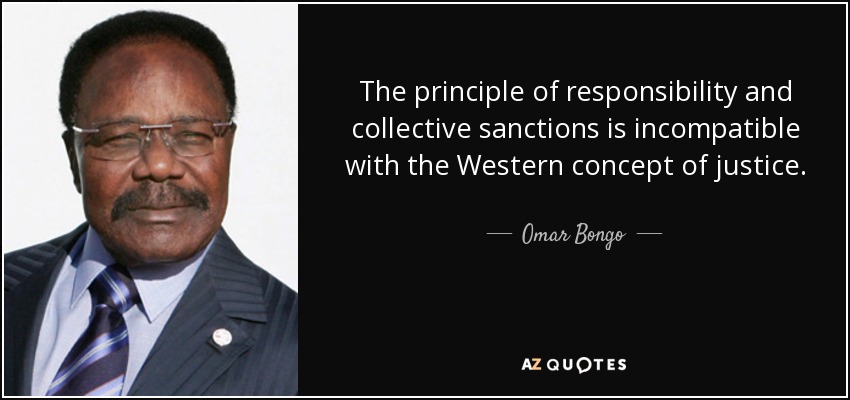
The principle of responsibility and collective sanctions is incompatible with the Western concept of justice.
The serious crimes by the Sudanese government and the government-supported militias must be met with serious consequences. We must work for tough international economic sanctions on the Sudanese government.
In dealing with those nations that break rules and laws, I believe that we must develop alternatives to violence that are tough enough to actually change behavior -- for if we want a lasting peace, then the words of the international community must mean something. Those regimes that break the rules must be held accountable. Sanctions must exact a real price. Intransigence must be met with increased pressure -- and such pressure exists only when the world stands together as one.
US intelligence agencies will only use such data to meet specific security requirements: counterintelligence, counterterrorism, counterproliferation, cybersecurity, force protection for our troops and allies, and combating transnational crime, including sanctions evasion.
Happiness is the only sanction of life; where happiness fails, existence remains a mad and lamentable experiment.
You look at the Middle East, you started the Iran deal, that's another beauty where you have a country that was ready to fall, I mean, they were doing so badly. They were choking on the sanctions. And now they're going to be actually probably a major power at some point pretty soon, the way they're going.
Attempts to enforce by legal sanctions, acts obnoxious to so great a proportion of Citizens, tend to enervate the laws in general, and to slacken the bands of Society. If it be difficult to execute any law which is not generally deemed necessary or salutary, what must be the case, where it is deemed invalid and dangerous? And what may be the effect of so striking an example of impotency in the Government, on its general authority?
The disesteem into which moralists have fallen is due at bottom to their failure to see that in an age like this one the function of the moralist is not to exhort men to be good but to elucidate what the good is. The problem of sanctions is secondary.
I'm worried about the world because there's chaos in the Middle East, and I think the Iranian deal [to lift sanctions] is going to continue the Shia-Sunni battles, the Persian-Arab battles.
Existentialism is about being a saint without God; being your own hero, without all the sanction and support of religion or society.
I have never solicited nor received money from Iraq for our campaign against war and sanctions. I have never seen a barrel of oil, never owned one, never bought one, never sold one.
All who think cannot but see there is a sanction like that of religion which binds us in partnership in the serious work of the world.
In fact, soon after that [South African sanctions], I was going on an official visit to the UK and Margaret Thatcher instructed every minister to clear the decks of any outstanding matters between us - Australia and the Brits. And she went out of her way to make sure that that was as successful a visit as it possibly could be.
People talk about smart sanctions and crippling sanctions. Ive never seen smart sanctions, and crippling sanctions cripple everyone, including innocent civilians, and make the government more popular.
Reason has never really directed social reality, but now reason has been so thoroughly purged of any specific trend or preference that it has finally renounced even the task of passing judgment on man's actions and way of life. Reason has turned them over for ultimate sanction to the conflicting interests to which our world actually seems abandoned.
I support a very active programme on disarmament and arms control for Iraq, and of course every other country in the world... That does not require economic sanctions...I think we've got to take the risk and give up economic sanctions while hanging on to the disarmament programme and allow the Iraqis to get on with rebuilding their country.
I believe that no one should be executed, guilty or innocent. There are appropriate sanctions that protect society and punish wrongdoers without forcing us to stoop to the level of the least among us at his or her worst moment.
Geneticists believe that anthropologists have decided what a race is. Ethnologists assume that their classifications embody principles which genetic science has proved correct. Politicians believe that their prejudices have the sanction of genetic laws and the findings of physical anthropology to sustain them.
We [ with Brian Mulroney and Rajiv Gandhi] went to the meeting in Canada [the 1987 Vancouver CHOGM] and I said to them there that sanctions weren't working; they were just being busted. And it did seem to me that one way that we could bring the apartheid regime down would be if we did mount an effective investment sanction.
I think we have to reflect on a treaty change that would permit more than surveillance, with recommendations and appropriate sanctions. When recommendations are not followed and sanctions prove ineffective, European institutions should have the capacity to impose the necessary decisions on a particular country.
Military action is never the first thing that you jump to. You always look at other possibilities, including economic sanctions, tightening the screws.
Peace is never long preserved by weight of metal or by an armament race. Peace can be made tranquil and secure only by understanding and agreement fortified by sanctions. We must embrace international cooperation or international disintegration. Science has taught us how to put the atom to work. But to make it work for good instead of for evil lies in the domain dealing with the principles of human dignity. We are now facing a problem more of ethics than of physics.
It seems fair to say that while the moral standards of the nineteenth century persisted almost unchanged into the twentieth, moral practices changed sharply, and that though the standards of the nineteenth century persisted the institutions that had sustained them and the sanctions that had enforced them lost influence and authority.
We live in a free society, and freedom means freedom for everybody. We shouldn't be able to choose and say, 'You get to live free and you don't.' That means people should be free to enter into any kind of relationship they want to enter into. Like Joe (Lieberman), I'm also wrestling with the extent to which there ought to be legal sanction of those relationships. I think we ought to do everything we can to tolerate and accommodate whatever kind of relationships people want to enter into.
The human psyche has two great sicknesses: the urge to carry vendetta across generations, and the tendency to fasten group labels on people rather than see them as individuals. Abrahamic religion gives strong sanction to both-and mixes explosively with both. Only the willfully blind could fail to implicate the divisive force of religion in most, if not all, of the violent enmities in the world today.
Follow AzQuotes on Facebook, Twitter and Google+. Every day we present the best quotes! Improve yourself, find your inspiration, share with friends
or simply: