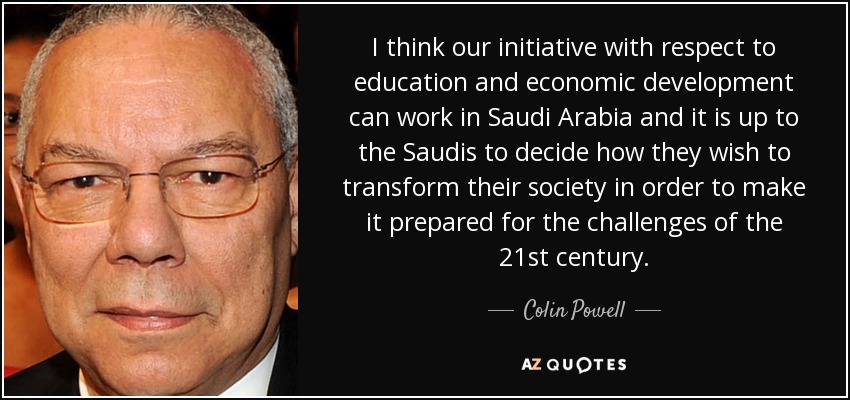
I think our initiative with respect to education and economic development can work in Saudi Arabia and it is up to the Saudis to decide how they wish to transform their society in order to make it prepared for the challenges of the 21st century.
I'm very careful not to isolate Israel on this but to make this part of a transformed foreign policy where we apply the same standards across the board. So it's not just Israel. It's also Saudi Arabia, it's also Egypt. It's where there are massive and systemic violations of human rights and international law.
Likewise to Saudi Arabia, where we just were selling another billion dollars worth of weapons, and we're not only selling the weapons but we are complicit in the war effort in Yemen where there are also incredible atrocities and war crimes being committed.
I've been to Egypt, Lebanon, Saudi Arabia, and Kuwait for brief visits at conferences, and they are very interesting countries.
I am the Saudi Arabia of unhappiness. I have so many reserves of misery that you wouldn't understand. I actually think that's part of why I connect with Canadians. I think they understand grinding misery underneath.
Saudi women like makeup. And I'm OK with that. If that's what you want to make you feel good, go for it.
Washington still refuses to provide evidence to support the claims in 1990 that a huge Iraqi military build-up on the Saudi border justified war.
It is no secret that many Islamic movements in the Middle East tend to be authoritarian, and some of the so-called 'Islamic regimes' such as Saudi Arabia, Iran - and the worst case was the Taliban in Afghanistan - they are pretty authoritarian. No doubt about that.
I am told that the Saudis have organized 34 countries who want to join in the battle against terrorism.
When you had the World Trade Center go, people were put into planes that were friends, family, girlfriends, and they were put into planes and they were sent back, for the most part, to Saudi Arabia. I would be very, very firm with families. Frankly, that will make people think because they may not care much about their lives, but they do care, believe it or not, about their families' lives.
I think that if you believe in regime change, you're mistaken. In 2013, we put 600 tons of weapons - us, Saudi Arabia, and Qatar - into the war against [Bashar] Assad. By pushing Assad back, we did create a safe space.
In terms of Iran and in terms of Saudi Arabia, of course they hate each other. That's no great secret. But John Kerry, who is I think doing a very good job, has tried to at least get these people in the room together because both of them are being threatened by ISIS.
Saudi Arabia has said that if the US-led coalition against Daesh is prepared to engage in ground operations, we will be prepared to participate with special forces. The Russians say their objective is to defeat Daesh, too. If the deployment of ground troops helps in the fight against Daesh, why is that World War III?
After the revolution of 1979, Iran embarked on a policy of sectarianism. Iran began a policy of expanding its revolution, of interfering with the affairs of its neighbors, a policy of assassinating diplomats and of attacking embassies. Iran is responsible for a number of terrorist attacks in the Kingdom, it is responsible for smuggling explosives and drugs into Saudi Arabia. And Iran is responsible for setting up sectarian militias in Iraq, Pakistan, Afghanistan and Yemen, whose objective is to destabilize those countries.
If you do not learn English in this country, you cannot get anywhere. We are in America. We are not in Mexico, we are not in China, we are not in Saudi Arabia - we speak English in this country! And what bilingual education does, is keep them from learning English, so they are doomed to be second-class citizens.
Oil now, as a result of the Saudi production, is priced so low that there are not going to be new fracking investments made. A lot of companies that have gone into fracking are heavily debt-leveraged, and are beginning to default on their loans. The next wave of defaults that banks are talking about is probably going to be in the fracking industry. When the costs of production are so much more than they can end up getting for the oil, they just stop producing and stop paying their loans.
I understand that and I have had very candid discussions with Saudi leaders in the past. I respect their culture and their heritage and their traditions, but I think that they now, as they move forward, will have to start examining these traditions and these practices to see whether or not change is appropriate.
Some countries, like Saudi Arabia, where the population growth is very high, whereby you don't have the mortgage low yet. Still the demand outstrips supply by much.
You know, in Saudi Arabia, there is a body of 40 people - 34 people exactly, that once the succession comes, they will meet and they will elect a king in there.
Saud bin Abd al-Aziz was the moon-faced, shortsighted, bespectacled son of the old founder of Saudi Arabia, who'd always been his father's protege but had never quite lived up to everything that his father had.
If I look at the really important questions in [Middle East] region, I see Iran, where there is a strong desire for a freer society and where people are repressed by a small group of ayatollahs. I see Syria, where we can see a similar desire of the people to be free. These two countries fund Hezbollah and other terrorist organizations and are hurting our efforts in Afghanistan and have been extremely harmful in Iraq. Then I also see large, important countries such as Egypt and Saudi Arabia.
The King had been a good friend of the government and the people of South Africa and we all mourn his passing with our brothers and sisters in Saudi Arabia.
We don't supply a hundred billion dollars worth of weapons to the war criminals in Saudi Arabia nor do we supply eight million dollars a day to the Israeli army that is also violating international law and human rights.
We have an even worse situation in Syria, where the United States' allies are actually supporting people who are violently opposed to the United States, who are dangerous, radical Islamist fanatics. I mean, where is the logic of that? When are we going to call the Saudis on the support of intolerant, bigoted, fanatical types of Islam? When are we going to call this ally?
If you were following the [Barack] Obama campaign back then, closely, you could see it had become very close to banking interests. So I think you can't properly understand Hillary Clinton's foreign policy without understanding Saudi Arabia.
Follow AzQuotes on Facebook, Twitter and Google+. Every day we present the best quotes! Improve yourself, find your inspiration, share with friends
or simply: