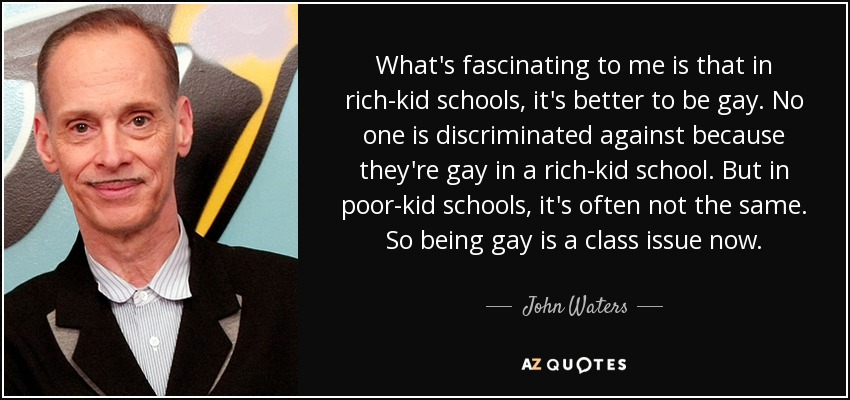
What's fascinating to me is that in rich-kid schools, it's better to be gay. No one is discriminated against because they're gay in a rich-kid school. But in poor-kid schools, it's often not the same. So being gay is a class issue now.
I was inspired by, when I was in college, seeing some incredible speakers come to my school: Michael Eric Dyson, Spike Lee, Nikki Giovanni, and other poets and writers. I always loved that experience: going and sitting in an auditorium and listening to their opinions.
We need to create jobs for 300,000 youth graduating from high school in the next three years. We need to produce growth so we can have an economic system that can turn our natural wealth into a productive system. We need services, because poverty reduction cannot take place without effective citizenship.
We work with tweens. Middle school grades. That's a key time in a young person's literary history. That's the time when they're still open to reading, but there are other things that are starting to interest them that can pull them out of their reading habits. It's a critical time to make the reading habits stick, but at the same time it's not pulling teeth to try to get them to read in the first place.
The one thing that always sticks out to me was how reading to young people - even if they're not that young, even if they're too cool for school, middle schoolers - what a profound act of love it is.
In the south of India, they educated girls. Three things came together in southern India that are unbelievably coincidental. There, the local Maharajas believed in education for everybody. The Syrian Catholic Church built schools for boys and girls. And then the Communist party, which took over politics for a period of time, had very strong social policies that benefited women. As a result, girls got into school. It was the first part of the country where towns could claim to be 100 percent literate. And so there, you're going to have a sex ratio at birth that's normal.
The fact is that we wouldn't have found out about Manzanar except in our story-telling because it was really never told in the American history books when we attended school. So we were very, very lucky to have that part of history told.
The point of life that I'm currently at is a 'me right now' type of attitude. I am 37 years-old, my son is in college and my daughter is in high school. I'm becoming okay with me. I can't live life as an artist or person being someone that someone else has tried to mold me into. I'm not going to put on a dress that's two sizes too small. I'm custom making my own clothes so that they'll never fit anyone else if you know what I mean.
I do find it extraordinary that men are so prepared to pay for your dinner here. That simply never happens in England. When I first got together with Len, I couldn't understand why it seemed like he was always trying to get into my side of the car. He was holding the door open for me! I don't know what you teach American men in school here, but you have to keep it up, because it's extremely charming.
Business schools need to help students learn how to thrive under pressure. To understand themselves and their psychological vulnerability that might inhibit their ability to be effective in roles that involve ongoing complexity and duress. Preparation is essential.
I was 16 years old, attending boarding school, and I loved Pride and Prejudice. From the opening pages, I loved it. And I will say in my class, not one but two boys told me that I reminded them of Lizzy Bennet. I didn't realize it at the time but this was the nicest thing that any male would ever say to me. This was as good as it got.
Somehow, in the novel format, I don't really like to do upfront, ideological discussion. In my heart, literature remains a poetic and ambiguous medium. On the other hand, I trained as a documentary filmmaker in film school, so my films very much reflect reality and socio-political problems. They're less subtle I would say.
I think everyone should understand history of segregation the same way we had to go to school and read about George Washington. I believe this generation should know their history and they should know that the struggle's not over yet. For instance, you can't get the cover of a magazine if your skin is too dark.
Growing up, you're told there are things you're not capable of doing because you're a girl. That perception's starting to change and it's amazing. It's important that we continue to share the message with other young women. If they grow up in a household or go to a school where they're told that they can't do certain things, it's important that they hear from someone that it is possible to do whatever they want with their lives.
Very few people know that there is a whole school of historians that have existed in the United States from the 1940s and the early '50s that were revisionists. They were attacking the whole basis of the history of the Cold War. People like D.F. Fleming, William Appleman Williams.
I grew up in uptown Jamaica; I went to a rich school. I was raised by my mother and my stepfather; they made sure education came before anything. I had a good childhood, grew up spending time with my bigger brothers and sisters. My people are good people. I was exposed to a lot of different kinds of people and culture.
I wouldn't recommend it, because art school is a funny business. Yes, if you can find a situation where they'll give you money to live at the school and do whatever you want and pay for all your materials, if you're a painter or maybe a filmmaker, do it. But acting should be the most fun thing in the world; you're surrounded by other people who are as obsessed with Anton Chekhov as you are.
I don't go to parties even when I'm invited. I've always been an 80-year-old woman inside. I remember going to my first school dance petrified. I just wanted to leave. Like, This is cool, but I'm ready to go home now.
The business schools could do a better job teaching face-to-face management, the actual work of organizing and helping along the efforts of others in the organization. The more quantitative disciplines have gotten more attention, often more research dollars. Areas like organizational science or, even mushier, leadership have had more trouble settling on what it's important to teach, and how. It's rather like strategy itself, which as I argue in the book, has had trouble through most of its history figuring out how to incorporate people, their motivation and ability, into its calculations.
We do have to learn poetry at school. Poetry is interesting to me, particularly Chinese poetry. It's like an ancient form of song. There's five sentences, seven sentences - they're very different from English poetry. Chinese poetry is much more rigorous. You can only use this many words, and they will form some kind of rhythm so people can actually sing it. To me, poetry is quite abstract but also quite beautiful.
I was fortunate to be at that school in an era in which encounters between students and teachers were encouraged; there were a number of teachers who lived on campus, and they'd regularly invite students over for dinner on the weekends. I hope it's still like that: being treated seriously by an adult you admire is a great gift. Children, like adults, want respect - but it's only when you're older that you realize how few people actually extend it.
When I started teaching, I would get miffed if a student asked me to write him or her a recommendation for law school - I'd feel like that's not what we were doing in the course. But now I see that person as someone who might be gainfully employed. I bring in a lot of people to speak to my classes, and I've gotten to the point where I've expanded the type of guests I invite to include people both inside and outside of the traditional publishing world.
My schooling was very conservative. I went to Trinity School, and then to the Hill School, which is a boarding school, then to Yale. My parents got divorced in that period, and I realized I didn't have a life anymore. I was the only child, so a three-person family breaks apart. I ended up very conformist, very scared, very lonely. I couldn't go on with Yale, just couldn't do it. I'd been doing too much of that for too long. I didn't know what I wanted, but I knew what I didn't want, which was to go to Wall Street and join the crowd there.
I don't think I'm more politically-based as much as socially-based. My grandmother died on February 29th, and she kept all of my magazine and newspaper scraps, every interview. I've been in the newspapers since I was about 15 - not for rapping, but for real substantive stuff I was doing in the community, organizing around gang violence in the schools. So I had already made my grandma proud before I was on TV. I've always been who I am.
Business school graduates from the best schools earn large salaries and frequently rise to positions of great power. It would be nice if they used that power to truly make the world a better place - which entails more than just maximizing their own organization's profits and their own economic well-being.
Follow AzQuotes on Facebook, Twitter and Google+. Every day we present the best quotes! Improve yourself, find your inspiration, share with friends
or simply: