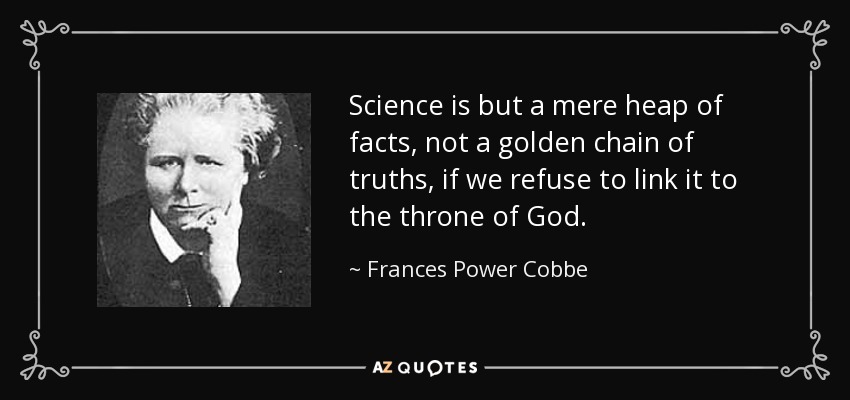
Science is but a mere heap of facts, not a golden chain of truths, if we refuse to link it to the throne of God.
A mere inference or theory must give way to a truth revealed; but a scientific truth must be maintained, however contradictory it may appear to the most cherished doctrines of religion.
Truths physical have an origin as divine as truths religious.
Science and art are the handmaids of religion.
My thesis is that what we call 'science' is differentiated from the older myths not by being something distinct from a myth, but by being accompanied by a second-order tradition-that of critically discussing the myth. ... In a certain sense, science is myth-making just as religion is.
It's a common perception that science and religion are mutually exclusive. But there are many scientists who would consider themselves to be spiritual people. Not only that, but in the case of climate change - a scientific issue with strong moral implications and difficult decisions to be made - it's essential to connect the science to our values. And for many of us, our values come from our faith.
Religion belongs to the realm that is inviolable before the law of causation and therefore closed to science.
Without poetry our science will appear incomplete, and most of what now passes with us for religion and philosophy will be replaced by poetry.
poetry has been able to function quite directly as human interpretation of the raw, loose universe. It is a mixture, if you will, of journalism and metaphysics, or of science and religion.
The way in which science and religion by and large complement each other is becoming ever clearer, as are the natures of the various points of tension between them and some possible resolutions of those tensions.
The true contrast between science and religion is that science unites the world and makes it possible for people of widely differing backgrounds to work together and to cooperate. Religion, on the other hand, by its very claim to know “The Truth” through “revelation,” is inherently divisive and a creator of separatism and hostility.
There is no conflict between science and religion. Conflict only arises from an incomplete knowledge of either science or religion, or both.
There is some conflict between religion and science in my world, but that's nothing new. Science, at its root, is a rational discipline. Religion, on the other hand, is fundamentally trans-rational. Both of them attempt to solve problems, but since their methodology is vastly different, they can't help but come into conflict.
To claim that science and religion pose different questions to the world is not to suggest that if the bones of Jesus were discovered in Palestine, the pope should get himself down to the dole queue as fast as possible. It is rather to claim that while faith, rather like love, must involve factual knowledge, it is not reducible to it.
When you realize that no one really knows what they are doing and that everyone is doing the best they can according to their own level of consciousness, life gets a lot easier. Skeptical scrutiny is the means, in both science and religion, by which deep thoughts can be winnowed from deep nonsense.
The difference between religion and science is the difference between thoughtless certainty and thoughtful doubt.
I work in the field of art, and you know how during a period of Marxist ideology, fewer people are inclined to believe in the power of the culture as a whole: they believe in the revolutionary potential of economics, class struggle theory.. ..Therefore it's time to show that art means the power of creativity, and it's time to define art in a larger way, to include science and religion too..(1973
A dreaded society is not a civilized society. The most progressive and powerful society in the civilized sense, is a society which has recognized its ethos, and come to terms with the past and the present, with religion and science. With modernism and mysticism, with materialism and spirituality; a society free of tension, a society rich in culture. Such a society cannot come with hocus-pocus formulas and with fraud. It has to flow from the depth of a divine search.
The antagonism between science and religion, about which we hear so much, appears to me to be purely factitiousfabricated, on the one hand, by short-sighted religious people who confound a certain branch of science, theology, with religion; and, on the other, by equally short-sighted scientific people who forget that science takes for its province only that which is susceptible of clear intellectual comprehension; and that, outside the boundaries of that province, they must be content with imagination, with hope, and with ignorance
My deeply held belief is that if a god of anything like the traditional sort exists, our curiosity and intelligence are provided by such a god. We would be unappreciative of those gifts (as well as unable to take such a course of action) if we suppressed our passion to explore the universe and ourselves. On the other hand, if such a traditional god does not exist, our curiosity and our intelligence are the essential tools for managing our survival. In either case, the enterprise of knowledge is consistent with both science and religion, and is essential for the welfare of the human species.
Science and religion are two windows that people look through, trying to understand the big universe outside, trying to understand why we are here. The two windows give different views, but they look out at the same universe. Both views are one-sided, neither is complete. Both leave out essential features of the real world. And both are worthy of respect.
There are (or is) indeed no contradiction between science and religion, the fields of which are different, and which, far from mutually fighting and persecute, must, on the contrary, complete each other.
The very idea that there is some kind of conflict between science and religion is completely mistaken. Science is a method for investigating experience... Religion is the fundamental, necessary internalization of our system of more permanent values.
Someone with a fresh mind, one not conditioned by upbringing and environment, would doubtless look at science and the powerful reductionism that it inspires as overwhelmingly the better mode of understanding the world, and would doubtless scorn religion as sentimental wishful thinking. Would not that same uncluttered mind also see the attempts to reconcile science and religion by disparaging the reduction of the complex to the simple as attempts guided by muddle-headed sentiment and intellectually dishonest emotion?
I need the binocular approach of science and religion if I am to do any sort of justice to the deep and rich reality of the world in which we live.
Follow AzQuotes on Facebook, Twitter and Google+. Every day we present the best quotes! Improve yourself, find your inspiration, share with friends
or simply: