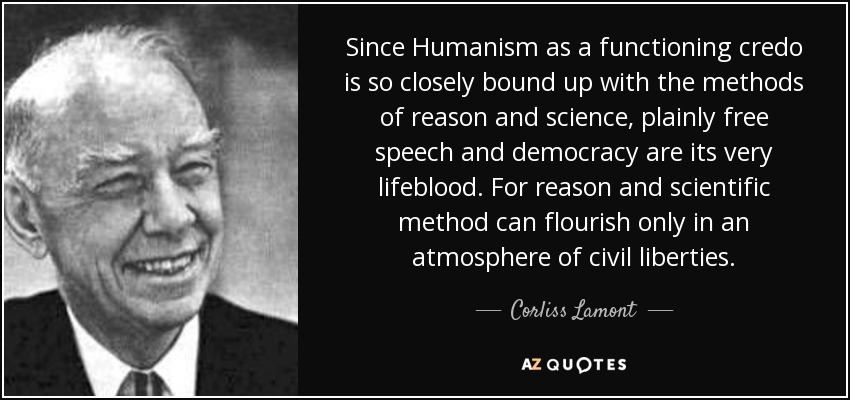
Since Humanism as a functioning credo is so closely bound up with the methods of reason and science, plainly free speech and democracy are its very lifeblood. For reason and scientific method can flourish only in an atmosphere of civil liberties.
We live in a world shaped by the ambiguous legacy of the Enlightenment...[it] enlarged the scope of human freedom, prepared our minds for the scientific method, made man the measure of all things, and placed individual consent front and center on the political stage.
Some people read business books looking for confirmation. I read them in search of disquiet. Confirmation is cheap, easy and ineffective. Restlessness and the scientific method, on the other hand, create a culture of testing and inquiry that can't help but push you forward.
If science is an unfinished project, the next stage will be about reconnecting and integrating the rigor of scientific method with the richness of direct experience to produce a science that will serve to connect us to one another, ourselves and the world.
But it seems to me equally obvious that the orderliness is not all-pervasive. There are streaks of order to be found among the chaos, and the nature of scientific method is to seek these out and to stick to them when found and to reject or neglect the chaos. It is obvious that we have succeeded in finding some order in nature, but this fact in itself does not prove anything farther.
Statistics is the branch of scientific method which deals with the data obtained by counting or measuring the properties of populations of natural phenomena.
It is necessary to guard ourselves from thinking that the practice of the scientific method enlarges the powers of the human mind. Nothing is more flatly contradicted by experience than the belief that a man distinguished in one or even more departments of science, is more likely to think sensibly about ordinary affairs than anyone else.
And you get Thomas Paine, who's the least religious Founding Father saying, you've got to teach creation science in the classroom. Scientific method demands that.
The method of science is tried and true. It is not perfect, it's just the best we have. And to abandon it, with its skeptical protocols, is the pathway to a dark age.
There is no scientific proof that only scientific proofs are good proofs; no way to prove by the scientific method that the scientific method is the only valid method.
A television advertisement must illustrate the scientific method to substantiate any claim.... That is why stains are lifted, ring-around-the-collar is removed, paper towels become soaked, excess stomach acid is absorbed, and headaches go away-all during the commercial.
The invention of the scientific method and science is, I'm sure we'll all agree, the most powerful intellectual idea, the most powerful framework for thinking and investigating and understanding and challenging the world around us that there is, and it rests on the premise that any idea is there to be attacked. If it withstands the attack then it lives to fight another day and if it doesn't withstand the attack then down it goes. Religion doesn't seem to work like that.
The scientific method ... is nothing but the exclusion of subjective opinions as far as possible, by the devising of experiments where observation can give objective answers, yes or no, to questions whether events are causally connected.
Today's liberal intellectuals, who pride themselves on scientific method and being “broadminded”, are the most narrow-minded, self-righteous and hate-filled bigots in the history of humanity. No primitive tribe worshipping with its witch-doctor was ever more vicious in its hatred and suppression of heretics than today's Marxist intellectuals, anti-racists and liberals.
I simply go with what works. And what works is the healthy skepticism embodied in the scientific method. Believe me, if the Bible had ever been shown to be a rich source of scientific answers and enlightenment, we would be mining it daily for cosmic discovery.
My parents were not scientists. They knew almost nothing about science. But in introducing me simultaneously to skepticism and to wonder, they taught me the two uneasily cohabiting modes of thought that are central to the scientific method.
Science, at its core, is simply a method of practical logic that tests hypotheses against experience. Scientism, by contrast, is the worldview and value system that insists that the questions the scientific method can answer are the most important questions human beings can ask, and that the picture of the world yielded by science is a better approximation to reality than any other.
The poets and philosophers before me discovered the unconscious; what I discovered was the scientific method by which the unconscious can be studied.
The purpose of scientific method is to select a single truth from among many hypothetical truths. That, more than anything else, is what science is all about. But historically science has done exactly the opposite. Through multiplication upon multiplication of facts, information, theories and hypotheses, it is science itself that is leading mankind from single absolute truths to multiple indeterminate, relative ones.
We have to learn how scientists arrive at decisions. Once you use the scientific method, it doesn't mean that your decisions will be perfect. They'll be far more accurate than just opinions.
I conclude that, while it is true that science cannot decide questions of value, that is because they cannot be intellectually decided at all, and lie outside the realm of truth and falsehood. Whatever knowledge is attainable, must be attained by scientific methods; and what science cannot discover, mankind cannot know.
I am convinced that the act of thinking logically cannot possibly be natural to the human mind. If it were, then mathematics would be everybody's easiest course at school and our species would not have taken several millennia to figure out the scientific method.
A Resource-Based Economy is in the application of the methods of science with human concern and environmental concern. If we used the scientific method throughout the world, the probability of war drops to zero. The probability of human suffering disappears. Deprivation, poverty, crime - all those things tend to disappear because there's no basis. I'm strictly concerned with the environment that people are raised in and if that environment is altered, so will behaviors be altered.
After years of work in both areas of study, I concluded that the social sciences were different, in many important ways, from the natural sciences, but that the same scientific methods were applicable in both areas, and, indeed, that no very useful work could be done in either area except by scientific methods.
For it is necessary in every practical science to proceed in a composite (i.e. deductive) manner. On the contrary in speculative science, it is necessary to proceed in an analytical manner by breaking down the complex into elementary principles.
Follow AzQuotes on Facebook, Twitter and Google+. Every day we present the best quotes! Improve yourself, find your inspiration, share with friends
or simply: