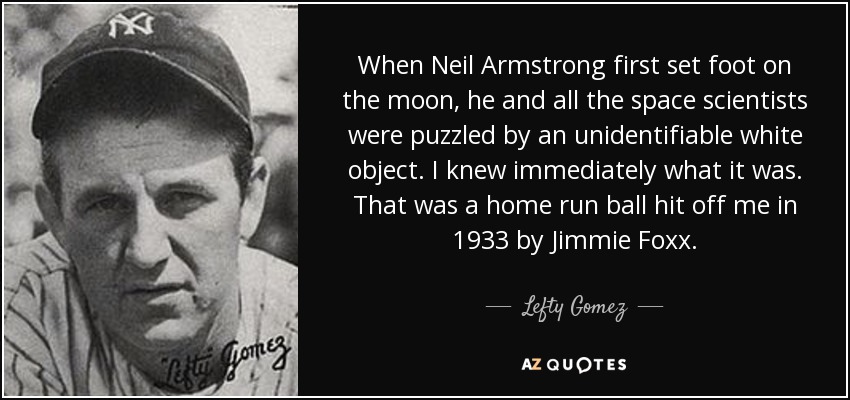
When Neil Armstrong first set foot on the moon, he and all the space scientists were puzzled by an unidentifiable white object. I knew immediately what it was. That was a home run ball hit off me in 1933 by Jimmie Foxx.
In private many scientists admit that science has no explanation for the beginning of life... Darwin never imagined the exquisitely profound complexity that exists even at the most basic levels of life.
Many people, including many important and well-respected scientists, just don't want there to be anything beyond nature. They don't want a supernatural being to affect nature.
It probably helps that my background is in the sciences and I can speak the scientists' language.
Science can proceed only if the scientist adopts an essentially theological worldview. ..even the most atheistic scientist accepts as an act of faith the existence of a law-like order in nature that is at least in part comprehensible to us.
People take it for granted that the physical world is both ordered and intelligible. The underlying order in nature - the laws of physics - are simply accepted as given, as brute facts. Nobody asks where they came from; at least not in polite company. However, even the most atheistic scientist accepts as an act of faith that the universe is not absurd, that there is a rational basis to physical existence manifested as law-like order in nature that is at least partly comprehensible to us. So science can proceed only if the scientist adopts an essentially theological worldview.
We are driven by the usual insatiable curiosity of the scientist, and our work is a delightful game.
I've often heard it said that there's a consensus of thousands of scientists on the global warming issue and that humans are causing a catastrophic change to the climate system. Well I am one scientist, and there are many that simply think that is not true.
The reward of the young scientist is the emotional th rill of being the first person in the history of the world to see something or to understand something. Nothing can compare with that experience The reward of the old scientist is the sense of having seen a vague sketch grow into a masterly landscape.
The work of science has nothing whatever to do with consensus. Consensus is the business of politics. Science, on the contrary, requires only one investigator who happens to be right, which means that he or she has results that are verifiable by reference to the real world. In science consensus is irrelevant. What is relevant is reproducible results. The greatest scientists in history are great precisely because they broke with the consensus.
I realized, "Oh my gosh! I'm having a stroke!" And the next thing my brain says to me is, Wow! This is so cool! How many brain scientists have the opportunity to study their own brain from the inside out?"
Any scientist who tells you they know that GMOs are safe and not to worry about it, is either ignorant of the history of science or is deliberately lying. Nobody knows what the long-term effect will be.
It can be very intense being an actor; it can be quite a small world. Then you speak to your friend who is a scientist and they have a completely different perspective.
Those without the gate frequently question the wisdom and right of the occultist to guard his knowledge by the imposition of oaths of secrecy. We are so accustomed to see the scientist give his beneficent discoveries freely to all mankind that we feel that humanity is wronged and defrauded if any knowledge be kept secret by its discoverers and not at once made available for all who desire to share in it. The knowledge is reserved in order that humanity may be protected from its abuse at the hands of the unscrupulous.
Isn’t every human being both a scientist and an artist; and in writing of human experience, isn’t there a good deal to be said for recognizing that fact and for using both methods?
There is not much that even the most socially responsible scientists can do as individuals, or even as a group, about the social consequences of their activities.
In my work, I am not attempting to predict the future. I am only pointing out what is possible with the intelligent application and humane use of science and technology. This does not call for scientists to manage society. What I suggest is applying the methods of science to the social system for the benefit of human kind and the environment.
We have to learn how scientists arrive at decisions. Once you use the scientific method, it doesn't mean that your decisions will be perfect. They'll be far more accurate than just opinions.
I think we will see better vaccines within the next 15 years, but I'm not a scientist and am focused on the short-term - what will happen in the interim.
I'm supposed to be a scientific person but I use intuition more than logic in making basic decisions.
I think that cognitive scientists would support the view that our visual system does not directly represent what is out there in the world and that our brain constructs a lot of the imagery that we believe we are seeing.
To say that you can 'have experience,' means, for one thing, that your past plays into and affects your present, and that it defines your capacity for future experience. As a social scientist, you have to control this rather elaborate interplay, to capture what you experience and sort it out; only in this way can you hope to use it to guide and test your reflection, and in the process shape yourself as an intellectual craftsman
Great numbers of children will be born who understand electronics and atomic power as well as other forms of energy. They will grow into scientists and engineers of a new age which has the power to destroy civilization unless we learn to live by spiritual laws.
My scientist friends have come up with things like 'principles of uncertainty' and dark holes. They're willing to live inside imagined hypotheses and theories. But many religious folks insist on answers that are always true. We love closure, resolution and clarity, while thinking that we are people of 'faith'! How strange that the very word 'faith' has come to mean its exact opposite.
Scientists care deeply about their place in that culture, and their contribution to it.
Follow AzQuotes on Facebook, Twitter and Google+. Every day we present the best quotes! Improve yourself, find your inspiration, share with friends
or simply: