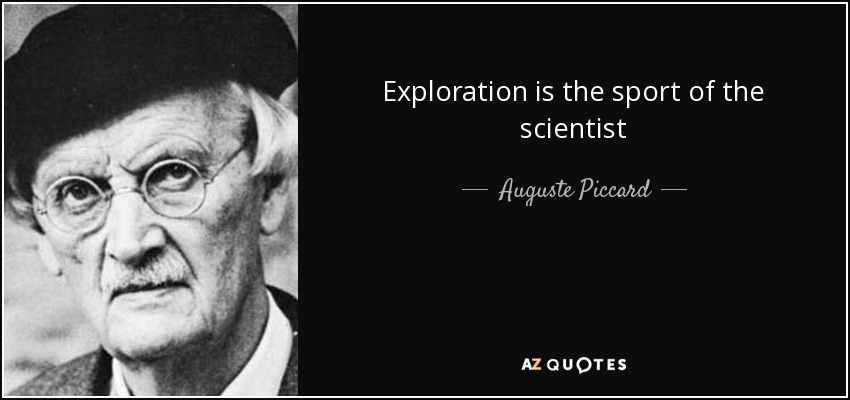
Exploration is the sport of the scientist
Whoever we are here, we might be princesses somewhere else. Or writers. Or scientists. Or presidents. Or whatever the hell we want to be that everyone else says we can't.
The State is not, as many political scientists would make it, an inanimate thing; it consists of people, human beings, each of whom operates under an inner compulsion to get the most out of life with the least expenditure of labor.
As a scientist I must be mindful of the past; all too often it has happened that matters of great value to science were overlooked because the new phenomenon did not fit the accepted scientific outlook of the time.
Take a brilliant, creative social scientist, without any respect for conventional wisdom and you get Ellen Langer. She is a fantastic storyteller, and Counterclockwise is a fascinating story about the unexpected ways in which our minds and bodies are connected.
It is not only visitors to the zoo who are fascinated but uneasy in the presence of chimpanzees; the same is true of scientists. The more they learn about these great apes, the deeper our identity crisis seems to become. The resemblance between humans and chimpanzees is not only external. If we look straight and deep into a chimpanzee’s eyes, an intelligent, self-assured personality looks back at us. If they are animals, what must we be?
When the wrong question is being asked, it usually turns out to be because the right question is too difficult. Scientists ask questions they can answer. That is, it is often the case that the operations of a science are not a consequence of the problematic of that science, but that the problematic is induced by the available means.
Scientists don't believe anything.Scientists test things.
The natural pattern of current astronomy is provided by the cryptic unity of nature itself (belief in which is the chief act of faith of the scientist).
The very foundation of science is to keep the door open to doubt. Precisely because we keep questioning everything, especially our own premises, we are always ready to improve our knowledge. Therefore a good scientist is never ‘certain’. Lack of certainty is precisely what makes conclusions more reliable than the conclusions of those who are certain: because the good scientist will be ready to shift to a different point of view if better elements of evidence, or novel arguments emerge. Therefore certainty is not only something of no use, but is in fact damaging, if we value reliability.
I wanted to be a scientist. I did a thesis on lions. But I realised photography can show things writing can't. Lions were my professor of photography.
The theist and the scientist are rival interpreters of nature, the one retreats as the other advances.
And I'm a stodgy old scientist who believes, naively, that there exists an external world, that there exist objective truths about that world, and that my job is to discover some of them.
And so, I was not a military test pilot, but as soon as NASA expressed an interest in flying scientists and people who were not military test pilots, that was an epiphany that just came like a stroke of lightning.
Well managed and healthy oceans are vital to the survival of small island states, such as the Maldives. This important book shows how scientists and governments can better protect the world's oceans.
You see, I am a very conventional scientist, really.
Scientists are really very conscious of the fact that they stand on the shoulders of an enormous tree of preceding workers and that their own contribution is not so enormous.
Sweden rejected fluoridation in the 1970s, and in this excellent book these three scientists have confirmed the wisdom of that decision. Our children have not suffered greater tooth decay, as World Health Organization figures attest, and in turn our citizens have not borne the other hazards fluoride may cause
I recognized that teaching and research institutions vitally depend on the involvement of active scientists also in management functions.
We think that it is the best scientists working in the frontier fields of science who are best able to judge what is good and what is bad - if any - in the application of their scientific research.
Elegance? It may seem odd to non-scientists, but there is an aesthetic in software as there is in every other area of intellectual endeavour. Truly great programmers are like great poets or great mathematicians - they can achieve in a few lines what lesser mortals can only approach in three volumes
A wise and well-informed humanist has taken the time to look lovingly and wonderingly at the living world around him, and to study the ways in which scientists have tried to analyze the world... THE BEST INTRODUCTION TO NATURAL HISTORY THAT HAS YET BEEN WRITTEN.
Unequal Democracy is the sort of book to which every political scientist should aspire--it is methodologically rigorous, conceptually serious, and above all, it addresses urgent concerns of our fellow citizens. As Bartels shows, much of what we think we know about the politics of economic inequality is dead wrong. Bartels's perplexing and often unexpected discoveries should help refocus the gathering public debate about inequality and what to do about it.
Scientists have no proof that life was not the result of an act of creation.
I'm a medical doctor and a biomedical scientist.
Follow AzQuotes on Facebook, Twitter and Google+. Every day we present the best quotes! Improve yourself, find your inspiration, share with friends
or simply: