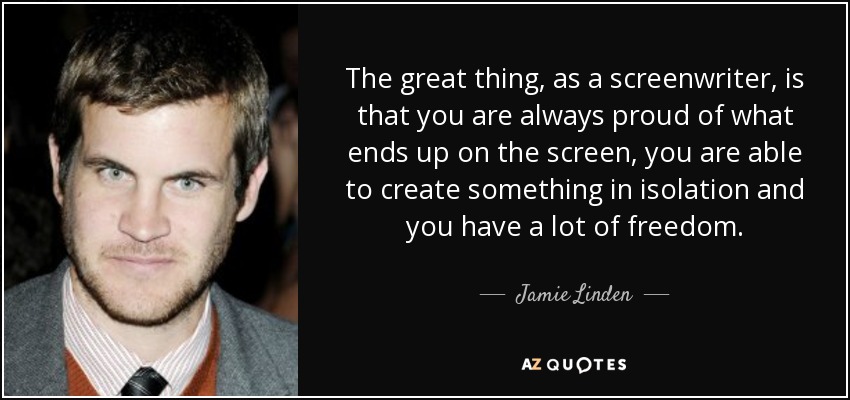
The great thing, as a screenwriter, is that you are always proud of what ends up on the screen, you are able to create something in isolation and you have a lot of freedom.
I have a lot of screenwriter friends and many of them have had an experience where they aren't even welcome on set during production.
Since signing with Universal, I have been working closely with Gary Ross, the director, producer and screenwriter. We have spent many hours on the phone, and I've been sending him information and items that have been useful to the writing process.
I was a novelist before I was a TV screenwriter. Actually, as a kid, I think I'd always wanted to be a writer, but never thought that I would be one.
I'm an affluent screenwriter and all that - I'm a known screenwriter, but I'm not in the fraternity of the very, very major people. I would say a guy like Ernie Lehman, William Goldman, and a few others are quite a cut above.
Fiction and screenwriting blend for me. I feel like being a TV writer/screenwriter has definitely made my fiction writing better, although I have less time to do it.
My mom was a screenwriter. I saw a lot of people who didn't seem very fulfilled creatively or otherwise by their roles in the motion picture industry.
I've always been a bit repelled by "Sunset Boulevard", which is wrong about almost everything it touches, whether it's fame, Hollywood, screenwriters, or old ladies. Sunset Boulevard would only make sense to me if it was about John Gilbert and the pool boy.
The thing about movies is if somebody has an idea that works, it's in, and I say that as a screenwriter as well as a director.
I think that scripts should be published, but they are published, really, because when you're a screenwriter, your stuff ends up in samizdat form on thousands and thousands of desks and shelves across the industry.
The two explorers are given fictional names. But as in real life, they travel to the Amazon roughly a generation apart, in the early-to-mid 20th century. In the film, they're both guided by Karamakate, as a young man early in the story and later as an old shaman. He and the outsiders share a desire for knowledge - self knowledge and an understanding of the world around them, says the film's co-screenwriter, Jacques Toulemonde.
From a writing point of view, you now have teams of screenwriters working with a director. What's lost in the process is the power of that one heart, brain, gut and soul that makes something an original piece of writing.
When I was a screenwriter, I was doing it for mercenary reasons.
I would say, and as I have said before, the series [Narcos] does not demonstrate real happenings but rather events that the screenwriters, in their own taste, believe depict the way we lived.
And I didn't grow up wanting to be a director. I grew up wanting to be a writer, so for me, that was always the goal - to be a novelist, not a screenwriter. And I think, again, if I didn't have the novels, maybe I'd be much more frustrated by not having directed yet.
If a novelist has created vivid characters, interesting relationships, settings the reader can easily imagine, and intriguing stories, a screenwriter has loads to work with. The challenge comes with deciding what to cut and what to keep.
A screenwriter heard me read from my novel 'The Wishbones' when it was still in progress and mentioned me to some producers in Hollywood. They called, and I told them I had a novel in my drawer about a high school election that goes haywire. They asked to take a look, and my life changed pretty dramatically as a result.
It's really hard as a screenwriter, you feel like you have a vision and then you turn it over to a director and you have to let it go.
About a year ago I got really exhausted from reading bad scripts and I know that I am a writer and that I have stories to tell, so I thought, 'Let's do this!' So I'm co-writing a screenplay now with another screenwriter and loving it. Absolutely loving it. And I would like to be the producer on the project and of course the lead is me.
The Iraq war is a huge subject and there have been many films about it. But it was when the private contractors started taking over and taking responsibilities from the regular army, which hides the war. You have these private armies of mercenaries acting with immunity for their actions, the worst of which was the Blackwater case where they killed 17 Iraqi civilians and the guys who did it just went home. We [screenwriter Paul Laverty and Loach] felt this deserved a story.
Though 'Moneyball' had the talents of screenwriters Steven Zaillian and Aaron Sorkin going for it, they weren't baseball insiders.
I've had a real lucky time working in Hollywood. I've talked to other screenwriters, and they're all kind of beaten down and their spirits are crushed, because they work on these screenplays and these projects, and then directors either take them and change everything, rewrite them and make them worse, or they film them and they're nothing like how they imagined it to be.
Graphic novels and comic books offer an easy foothold into that world, and screenwriters and studio execs gravitate toward those, because I think they can see it all right there. It's like, "Here's what the movie looks like."
I would encourage you as a screenwriter to trust your story and don't make notes for the actors or don't make notes for the reader.
Whenever I work on a film, I have three rules. Only three and I tell them to every screenwriter. I say let's retain the spirit and the intent of the overall story. Let's make it the best film that we possibly can.
Follow AzQuotes on Facebook, Twitter and Google+. Every day we present the best quotes! Improve yourself, find your inspiration, share with friends
or simply: