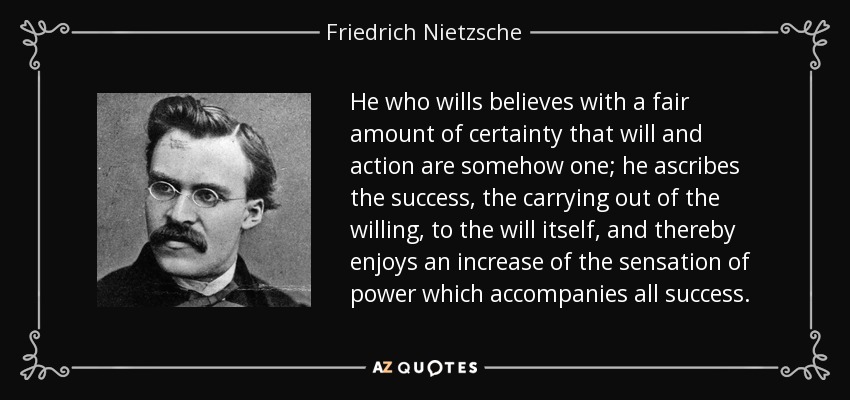
He who wills believes with a fair amount of certainty that will and action are somehow one; he ascribes the success, the carrying out of the willing, to the will itself, and thereby enjoys an increase of the sensation of power which accompanies all success.
Words are acoustical signs for concepts; concepts, however, are more or less definite image signs for often recurring and associated sensations, for groups of sensations. To understand one another, it is not enough that one use the same words; one also has to use the same words for the same species of inner experiences; in the end one has to have one's experiences in common.
There is a popular superstition that "realism" asserts itself in the cataloguing of a great number of material objects, in explaining mechanical processes, the methods of operating manufactories and trades, and in minutely and unsparingly describing physical sensations. But is not realism, more than it is anything else, an attitude of mind on the part of the writer toward his material, a vague indication of the sympathy and candour with which he accepts, rather than chooses, his theme?
Pornography and obscenity...work by specialism and fragmentation. They deal with a figure without a ground - situations in which the human factor is suppressed in favor of sensations and kicks.
As a child I was taught that to tell the truth was often painful. As an adult I have learned that not to tell the truth is more painful, and that the fear of telling the truth - whatever the truth may be - that fear is the most painful sensation of a moral life.
[Peake's books] are actual additions to life; they give, like certain rare dreams, sensations we never had before, and enlarge our conception of the range of possible experience.
Zen is really extraordinarily simple as long as one doesn't try to be cute about it or beat around the bush! Zen is simply the sensation and the clear understanding ... that there is behind the multiplicity of events and creatures in this universe simply one energy -- and it appears as you, and everything is it. The practice of Zen is to understand that one energy so as to "feel it in your bones.
Not bodies produce sensations, but element-complexes (sensation-complexes) constitute the bodies. When the physicist considers the bodies as the permanent reality, the 'elements' as the transient appearance, he does not realise that all 'bodies' are only mental symbols for element-complexes (sensation-complexes).
It is therefore, the interest of all, that every one, from birth, should be well educated, physically and mentally, that society may be improved in its character, - that everyone should be beneficially employed, physically and mentally, that the greatest amount of wealth may be created, and knowledge attained, - that everyone should be placed in the midst of those external circumstances that will produce the greatest number of pleasurable sensations, through the longest life, that man may be made truly intelligent, moral and happy, and be thus prepared to enter upon the coming Millennium.
Do not several sorts of Rays make Vibrations of several bignesses, which according to their bigness excite Sensations of several Colours, much after the manner that the Vibrations of the Air, according to their several bignesses excite Sensations of several Sounds? And particularly do not the most refrangible Rays excite the shortest Vibrations for making a Sensation of deep violet, the least refrangible the largest form making a Sensation of deep red, and several intermediate sorts of Rays, Vibrations of several intermediate bignesses to make Sensations of several intemediate Colours?
Images, memories, fragmentary shapes and forms all those sensations, visions, half-thoughts that appear and disappear in the wink of an eye, as one sets forth to meet.... The path also disappears as I think of it, as I say it.
It is not proper to project our feelings onto things or to attribute our own sensations and passions to them. Can it also be improper to see in them a guide, a way of life? To learn the art of remaining motionless amid the agitation of the whirlwind, to learn to remain still and to be as transparent as this fixed light amid the frantic branches this may be a program for life.
And yet, I wake up every day to a sensation of pervading disgust and annoyance. I probably ought to carry around some kind of thermometer or other instrument, to keep checking that I am not falling prey to premature curmudgeonhood.
It is very pleasant to scratch an itching ring-worm, but the sensation one gets afterwards is very painful and intolerable. In the same way the pleasures of this world are very attractive in the beginning, but their consequences are terrible to contemplate and hard to endure.
Oh, love is very much a physical thing.... I realize that it's very complicated, and I'm sure it can't be traced to individual neurons and hormones, but I think it's very much a physiological sensation that takes place in the brain.
Not the least of the hardships to which the dying are subject is the visitation of their loved ones. The poor darlings, God bless them, may feel every impulse to condole and console, but their primary sensation is nonetheless one of embarrassment in the presence of the unspeakable and a guilty gratitude that it is not yet their fate.
A bizarre sensation pervades a relationship of pretense. No truth seems true.
On Earth, much of the wrenching discomfort of emesis, apart from the sensation of nausea itself, is from the coordination of many muscles it takes to counter gravity.
It seems as though the goal of my work has always been to dissolve myself completely into the sensations of the surroundings in order to then integrate this into a coherent painterly form.
These are the sensations and feelings that are gradually blunted by education, staled by custom, rejected in favor of social conformity.
Thoughts are strange things. they have 'representational' powers: a thought typically represents the world as being one way or another. A sensation, by contrast, seems to just sit there.
When I discover something about the human genome, I experience a sense of awe at the mystery of life, and say to myself, 'Wow, only God knew before.' It is a profoundly beautiful and moving sensation, which helps me appreciate God and makes science even more rewarding for me.
As you are aware, no perceptions obtained by the senses are merely sensations impressed on our nervous systems. A peculiar intellectual activity is required to pass from a nervous sensation to the conception of an external object, which the sensation has aroused. The sensations of our nerves of sense are mere symbols indicating certain external objects, and it is usually only after considerable practice that we acquire the power of drawing correct conclusions from our sensations respecting the corresponding objects.
You have to seduce the reader, manipulate their mind and heart, listen to the music of language. I sometimes think of prose as music, in terms of its rhythms and dynamics, the way you compress and expand the attention of a reader over a sentence, the way the tempo pushes you towards an image or sensation. We want an intense experience, so that we can forget ourselves when we enter the world of the book. When you are reading, the physical object of the book should disappear from your hands.
The sensation of writing a book is the sensation of spinning, blinded by love and daring. It is the sensation of a stunt pilot's turning barrel rolls, or an inchworm's blind rearing from a stem in search of a route. At its worst, it feels like alligator wrestling, at the level of the sentence.
Follow AzQuotes on Facebook, Twitter and Google+. Every day we present the best quotes! Improve yourself, find your inspiration, share with friends
or simply: