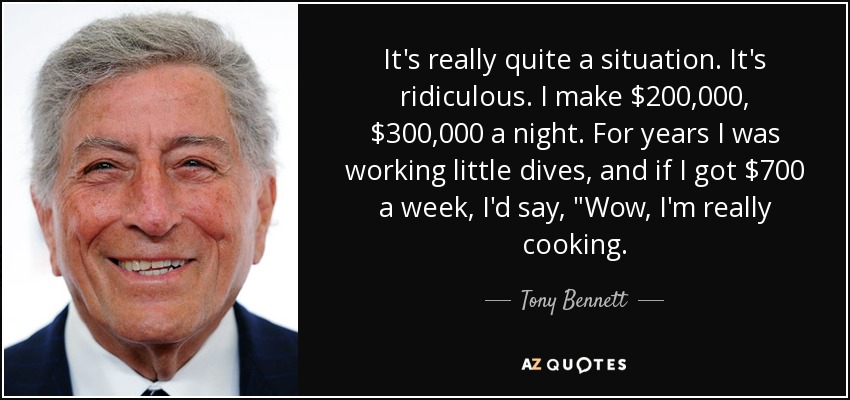
It's really quite a situation. It's ridiculous. I make $200,000, $300,000 a night. For years I was working little dives, and if I got $700 a week, I'd say, "Wow, I'm really cooking.
It came down to the obvious point that all the union cared about was the money and these other things certainly didn't matter enough. It's a tremendous situation that they have and it has become burdensome for the teams. Yes, we're asking for some relief going forward. I don't think that was unreasonable.
I'm the only one in my family who is deaf, and there are still conversations that go around me that I miss out on. And I ask what's going on, and I have to ask to be included. But I'm not going to be sad about it. I don't live in sad isolation. It's just a situation I'm used to.
A family's responses to crisis or to a new situation mirror those of a child. That is to say, the way a small child deals with a new challenge (for instance, learning to walk) has certain predictable stages: regression, anxiety, mastery, new energy, growth, and feedback for future achievement. These stages can also be seen in adults coping with new life events, whether positive or negative.
We are all in situations of our own choosing. Our thinking creates a pathway to success or failure. By disclaiming responsibility for our present, we crush the prospect of an incredible future that might have been ours.
Our chaotic economic situation has convinced so many of our young people that there is no room for them. They become uncertain andrestless and morbid; they grab at false promises, embrace false gods and judge things by treacherous values. Their insecurity makes them believe that tomorrow doesn't matter and the ineffectualness of their lives makes them deny the ideals which we of an older generation acknowledged.
Only through training will a person learn his own weaknesses... He who is aware of his weaknesses will remain master of himself in any situation.
Part of what makes a situation traumatic is not talking about it. Talking reduces trauma symptoms. When we don't talk about trauma, we remain emotionally illiterate. Our most powerful feelings go unnamed and unspoken.
We forgive, if we are wise, not for the other person, but for ourselves. We forgive, not to erase a wrong, but to relieve the residue of the wrong that is alive within us. We forgive because it is less painful than holding on to resentment. We forgive because without it we condemn ourselves to repeating endlessly the very trauma or situation that hurt us so. We forgive because ultimately it is the smartest action to take on our own behalf. We forgive because it restores to us a sense of inner balance.
Whereas children can learn from their interactions with their parents how to get along in one sort of social hierarchy--that of the family--it is from their interactions with peers that they can best learn how to survive among equals in a wide range of social situations.
One of my teachers used to call me Prince, because I always had a way of charming myself in and out of different situations.
When a person completely has nothing but negative interest in you and would like nothing more than to see you in the worst situation possible, then why would you consistently go toward that energy?
I've never written a song that's hopeless. I'm not a hopeless person. I'm crazily optimistic. I crazily see the good in people. I crazily see the way out of a terrible situation. I crazily try to be the diplomat. If there are two warring factions in my life, I want them to agree to disagree at the very least.
Seriously, I think what all the puzzling over parenthood I had to do to write [a novel] ROOM taught me is that children can thrive in a remarkable range of situations.
I think during the Cold War in America at least, there was a division; there was the Soviet government and there were the oppressed people, who were not represented by this government. That was a massive oversimplification of what the true situation was there. There were certainly many people who were completely and fully alienated from the government.
I love my situation as a spectator. The actors are only a little bit ahead of the audience. The audience discovers the episode when it's screened, but we actors only discover the episode when we get the script, two weeks ahead of shooting. Until then, we know nothing of the evolution of our characters.
As a woman, she [Penelope Cruz] obviously has changed as she has become an adult. But, as an actress, I actually might say that she has not changed that much. And she has something great, especially in comedy, and she hasn't been exploited as much as she could be in comedy, but particularly in that mix between comedy and drama. She's got a very special quality about her. You can place her in very extreme situations, especially very painful situations, in terms of how her character interprets it. And sometimes, the deeper and more human that pain is, the better she is at it.
Before babies, I worked very hard to make sure I understood my surroundings and figured out where I fit in the world, whether it was at work or whether it was in a social situation. And with kids, you just can't. The rule is you can't really do that because they dictate and they change so much so you just have to go with the flow more and be present and not have big expectations and be amused all the time.
I don't see perfection as far as a visual image of perfection. "Perfection" to me is, I walk away from a situation and say, "I did everything I could do right there. There was nothing more that I could do." Like, I worked as hard as I possibly could have. That's perfection.
When you look at the global situation, if America learned to be one of the many countries in the world and to find its way to cooperate with people and bring a global peace that could bring great prosperity to this globe, there is still a chance of that, and that's a big lesson from history. We are not paying attention to that.
I try to look at life carefully and reproduce life the way life is. It's a question of looking carefully at how it is. In life, you don't have total happiness. People always say that. But you don't have total sadness either, no matter what situation you are living in.
An actress reading a part for the first time tries many ways to say the same line before she settles into the one she believes suits the character and situation best. There's an aspect of the rehearsing actress about the girl on the verge of her teens. Playfully, she is starting to try out ways to be a grown-up person.
My historical reading of the situation is that these great monolithic empires developed, Rome, Turkey, and so forth, and they always break down when enough people, and it's always the young, the creative, and minority groups drop out and go back to a tribal form.
It would be a nice way to finish my career by remembering that I batted cleanup in the game in which my team won the World Series. But I now am convinced that I can still help, and if the right situation presented itself, I would have to think seriously about it.
To remain neutral in situations of injustice is to be complicit in that injustice.
Follow AzQuotes on Facebook, Twitter and Google+. Every day we present the best quotes! Improve yourself, find your inspiration, share with friends
or simply: