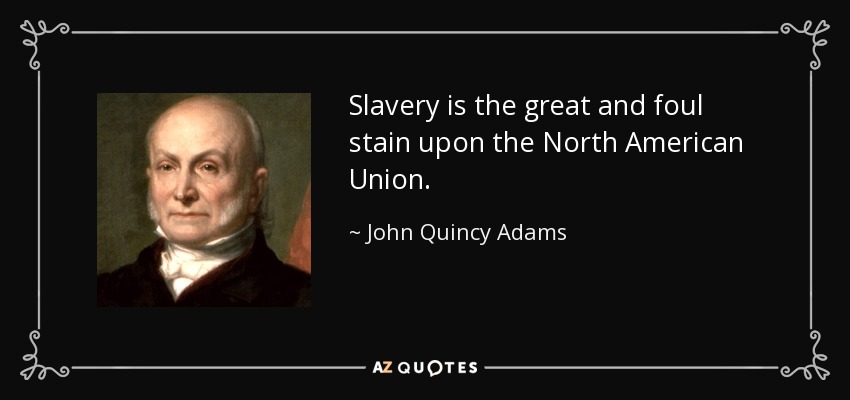
Slavery is the great and foul stain upon the North American Union.
Justice needs money; it always has . . . whether for abolition of slavery and early women's rights movements or the civil rights and environmental drives of our generation.
If a man really believes that God once upheld slavery; that he commanded soldiers to kill women and babes; that he believed in polygamy; that he persecuted for opinion's sake; that he will punish forever, and that he hates an unbeliever, the effect in my judgment will be bad. It always has been bad. This belief built the dungeons of the Inquisition. This belief made the Puritan murder the Quaker.
In all the ages the Roman Church has owned slaves, bought and sold slaves, authorized and encouraged her children to trade in them. . . . There were the texts; there was no mistaking their meaning; . . . she was doing in all this thing what the Bible had mapped out for her to do. So unassailable was her position that in all the centuries she had no word to say against human slavery.
It [slavery] has exercised absolute mastery over the American Church. . . . With the Bible in their hands, her priesthood have attempted to prove that slavery came down from God out of heaven. They have become slaveholders and dealers in human flesh.
Under any religion, the preestablished impersonal code transcends the right of the individual to explore, experience, and marvel at the mysteries of his own life and death. Religions introduce us not to God but to slavery. They deprive us of our freedom to explore our own souls and to discover the endless and wondrous possibilities presented to us by an infinite universe. And most often the method of religions is fear, not love. They demand blind obedience and often obedience to dreadful dogma.
Greed is permanent slavery
Mental slavery is mental death, and every man who has given up his intellectual freedom is the living coffin of his dead soul.
From my earliest recollection, I date the entertainment of a deep conviction that slavery would not always be able to hold me within its foul embrace; and in the darkest hours of my career in slavery, this living word of faith and spirit of hope departed not from me, but remained like ministering angels to cheer me through the gloom. This good spirit was from God, and to him I offer thanksgiving and praise.
I never was an Abolitionest, not even what could be called anti slavery, but I try to judge farely and honestly and it become patent to my mind early in the rebellion that the North and South could never live at peace with each other except as one nation, and that without Slavery.
My great and exceeding joy over these stupendous achievements, especially over the abolition of slavery (which had been the deepest desire and the great labor of my life), was slightly tinged with a feeling of sadness.
It was a glorious resurrection, from the tomb of slavery, to the heaven of slavery. My long-crushed spirit rose, cowardice departed, bold defiance took its place; and I now resolved that, however long I might remain a slave in form, the day had passed forever when I could be a slave in fact.
The mere word freedom is the only one that still excites me. I deem it capable of indefinitely sustaining the old human fanaticism. It doubtless satisfies my only legitimate aspiration. Among all the many misfortunes to which we are heir, it is only fair to admit that we are allowed the greatest degree of freedom of thought. It is up to us not to misuse it. To reduce the imagination to a state of slavery-even though it would mean the elimination of what is commonly called happiness-is to betray all sense of absolute justice within oneself.
Those who do not think that employment is systemic slavery are either blind or employed.
Marriage is not slavery. It is based on a love relationship deeply rooted in freedom. Each partner is free from the other and therefore free to love the other. Where there is control, or perception of control, there is not love. Love only exists where there is freedom.
Every time I embrace a black woman I’m embracing slavery, and when I put my arms around a white woman, well, I’m hugging freedom. The white man forbade me to have the white woman on pain of death... I will not be free until the day I can have a white woman in my bed.
Art is individualism, and individualism is a disturbing and disintegrating force. There lies its immense value. For what it seeks is to disturb monotony of type, slavery of custom, tyranny of habit, and the reduction of man to the level of a machine. It seeks to show new perspectives and other choices. It is a way to help expand and liberate the consciousness; our experiences, understandings, imaginings, options and thereby our lives.
The South was at the point where the scale was tipping against slavery. It was slowly dawning on the plantation owners that slave labor was not economic, besides being morally wrong. Slavery was destined to be abolished, whether for economic reasons or moral reasons matters not, but the international intriguers were not going to wait for voluntary abolition to rob them of their trump card.
There were 315,000 slave owners in the Union Army (with 200,000 in the Confederate Army) and the men who walked away from the Union Army were adamantly opposed to freeing slaves. We cite these facts and recorded statistics to point out that the principal cause of the war was not the issue of slavery.
The Civil War was started over economic issues, not slavery. The War was not popular in the North until the issue of slavery was added at a later time to turn it into a moral crusade.
Converting the war into an antislavery crusade was a brilliant move on Lincoln's part, and it resulted in a surge of voluntary recruits into the Union army. But this did not last. Northerners may have disapproved of slavery in the South but, once the bloodletting began in earnest, their willingness to die for that conviction began to wane. [...] Lincoln faced the embarrassing reality that he soon would have no army to carry on the crusade.
Many Southern Plantation owners were working towards the day when they could convert their investment to more profitable industrial production as had been done in the North, and others felt that freemen who were paid wages would be more efficient than slaves who had no incentive to work. For the present, however, they were stuck with the system they inherited. They felt that a complete and sudden abolition of slavery with no transition period would destroy their economy and leave many of the former slaves to starve - all of which actually happened in due course.
If Lincoln's primary goal in the War was not the abolition of slavery but simply to preserve the Union, the question arises: Why did the Union need preserving? Or, more pointedly, why did the Southern states want to secede?
[...] it is generally accepted that the Civil War was fought over the issue of slavery. That, at best, is a half-truth. Slavery was an issue, but the primary force for war was a clash between the economic interests of the North and the South. Even the issue of slavery itself was based on economics.
The Compromise of 1850 provided that the prohibition of slavery should be left up to the individual States, thus thwarting the Canaanites in their attempts to make this problem an excuse for federal intervention and a cause of war between the States.
Follow AzQuotes on Facebook, Twitter and Google+. Every day we present the best quotes! Improve yourself, find your inspiration, share with friends
or simply: