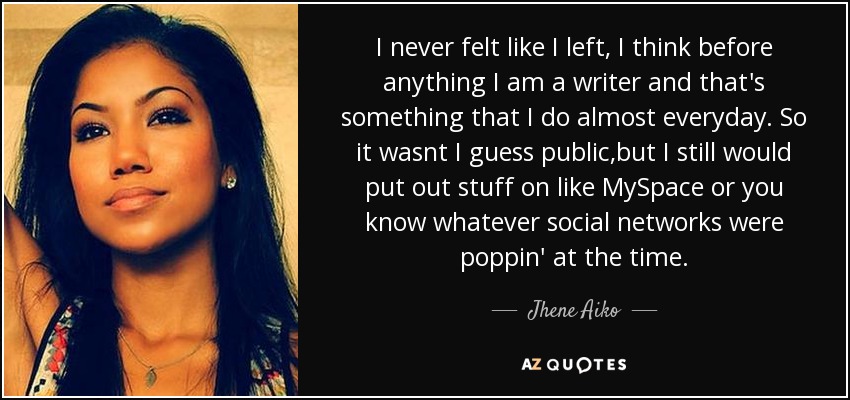
I never felt like I left, I think before anything I am a writer and that's something that I do almost everyday. So it wasnt I guess public,but I still would put out stuff on like MySpace or you know whatever social networks were poppin' at the time.
I started designing book jackets, which was great because I was good at it. And then from there I decided to become a freelance graphic designer and I needed to expand beyond book jackets, so I taught myself web design, and then in 1999 some friends of mine decided to start a company called Xanga.com, which was a very early kind of social network slash blogging community.
I don't think of Twitter as a social network. I think of it as a messaging system that has a lot of social components to it.
You curate information that you want to receive. It's a lot different because I'm not asking you if it's okay, I'm just saying I'm following your updates. That's why I don't think of Twitter as a social network.
Whatever social network that comes along, whether it be Twitter, Facebook, Instagram, Snapchat, whatever it is, I'll use it in a creative sense to push the vision and explore the possibilities of the relationship between humans and technology.
The stories leaders and others tell, few of which are true, are a lousy foundation on which to base any sort of science, and we know how to accomplish behavioral change and the importance of priming, informational saliency, and social networks. Producing inspiration and other good feelings doesn't last very long.
As writer pay declined and teacher pay also, we all started hanging out online. You could say online social networks cheapen our friendships or you could say we were cheapened by a plutocratic power grab and this is all we can afford.
There are three things, and it depends on the group that we're talking about, but there's history, there's culture, and then there's social networks. So, you know, historically black and white, they worship together until about the end of slavery, and people started moving out into separate churches. But it was because of discrimination and racism and such that blacks began to establish their own denominations and their own churches.
So we didn't get the denominations and the separate congregations really till about into Civil War time. What's happened then, of course, is now that we've had well over 100 years of this history to establish separate cultures, different ways of worshipping, and different ways of understanding theology so that when people try to come together makes it very difficult. And then, of course, social networks, you know, how do we find a place to worship?
We go where our family goes. We go where our friends are, and because our social networks are so segregated by race, we end up with what we have. We also find that, you know, if you're immigrants, you're not part of that history.
So it may be a language that separates you - again, social networks. But second-generation Asian and Hispanics, second, and third and fourth and so on, they are much more likely to be in integrated churches than are blacks or whites.
When you have a bad game the social network isn't exactly your best friend. People tend to go after you a little bit, but I don't let it bother me.
When you see what is happening with the social network, with Facebook, Twitter and co it is becoming obvious that the reputation of ourselves is becoming more and more important everyday. Image is becoming too much for me, and we are living in a virtual world and sometimes it is very easy to make mistakes. It is more difficult to take responsibility for our mistakes.
I'm going to do 'The Social Network Two: The Electric Boogaloo.' And I have a part in 'Beige Swan.' I'm going to be the lead, but I don't dance. I just do a lot of sitting down. It's too tiring to get up and dance around. That should be coming out in 20-never.
Your social networks may matter more than your genetic networks. But if your friends have healthy habits you are more likely to as well. So get healthy friends.
Respect for people is the cornerstone of communication and networking.
If you're not networking, you're not networking.
In China, the social network is a bit different. But I am active there too.
When you think of a social network, you have these two-way interactions: "Are you my friend? Yes? No? Yes?" Like LinkedIn, it's business oriented, but it's all about establishing connections. You connect to me through my other connections, and that sort of thing, and you sort of define who your friends are. Twitter doesn't have that.
Maybe we need to look upon technologies and social networks as things that come out of us, not things that lead us. We can be on top of these things instead of them bein' on top of us as human beings.
Being aware is a lot more than just reading a couple of news articles and talking about it on your preferred social network.
That definitely I feel is part of my generation: social networking, communication over the Internet, whether it's Skype or IRC or some form of text-based chat, text messaging.
Follow AzQuotes on Facebook, Twitter and Google+. Every day we present the best quotes! Improve yourself, find your inspiration, share with friends
or simply: