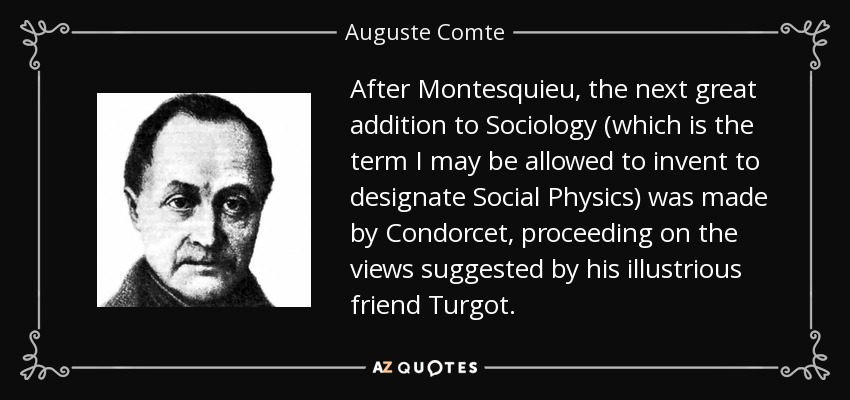
After Montesquieu, the next great addition to Sociology (which is the term I may be allowed to invent to designate Social Physics) was made by Condorcet, proceeding on the views suggested by his illustrious friend Turgot.
Biochemists and biologists who adhere blindly to the Darwinism theory search for results that will be in agreement with their theories and consequently orient their research in a given direction, whether it be in the field of ecology, ethology, sociology, demography (dynamics of populations), genetics (so-called evolutionary genetics), or paleontology. This intrusion of theories has unfortunate results: it deprives observations and experiments of their objectivity, makes them biased, and, moreover, creates false problems.
I have been accused of being ignorant of economics (although I am the founder and Chairman of the Board of a company which publishes seven professional economic newsletters), of being ignorant of sociology (although I am trained in sociology and was C. Wright Mills' research assistant at Columbia), of being unable to use statistics (although I earned my living as a professional statistician for five years) and of ignoring political factors (although all my graduate training was in political science).
A religious phenomenon will only be recognized as such if it is grasped at its own level, that is to say, if it is studied as something religious. To try to grasp the essence of such phenomenon by means of physiology, psychology, sociology, economics, linguistics, art or any other study is false; it misses the one unique and irreducible element in it - the element of the sacred.
I believe one should design for the advantage of the largest mass of people, first and always. That takes care of ideologies and sociologies.
Economic problems have no sharp edges. They shade off imperceptibly into politics, sociology, and ethics. Indeed, it is hardly an exaggeration to say that the ultimate answer to every economic problem lies in some other field.
My major preoccupation is the question, 'What is reality ?' Many of my stories and novels deal with psychotic states or drug-induced states by which I can present the concept of a multiverse rather than a universe. Music and sociology are themes in my novels, also radical political trends; in particular I've written about fascism and my fear of it.
Oral history is a research method. It is a way of conducting long, highly detailed interviews with people about their life experiences, often in multiple interview sessions. Oral history allows the person being interviewed to use their own language to talk about events in their life and the method is used by researchers in different fields like history, anthropology and sociology.
The first proponent of cortical memory networks on a major scale was neither a neuroscientist nor a computer scientist but .. a Viennes economist: Friedrich von Hayek (1899-1992). A man of exceptionally broad knowledge and profound insight into the operation of complex systems, Hayek applied such insight with remarkable success to economics (Nobel Prize, 1974), sociology, political science, jurisprudence, evolutionary theory, psychology, and brain science (Hayek, 1952).
You don't see Los Angeles erecting a museum dedicated to the birth place of the Crips and the Bloods and the Mexican Mafia, with a special guided bus tour highlighting the rise of the crack trade, yet you can hop on a bus in Chicago tomorrow to see the famous locales of murders. I have to imagine there's some wonderful academic book on the sociology of this out there.
I'm interested in power. I'm interested in the kind of polarities and equilibriums that take place within sexuality and philosophy and sociology. So in Versailles, in this type of setting, you have a place that is about absolute control, where everything has been thought about.
Yes, there's genetics. Yes, there are chromosomes. Yes, there's biology. Yes, there are environment, sociology, parenting, economics, class, and all of that. But there is something else, as well.
My dear, I used to think I was serving humanity . . . and I pleasured in the thought. Then I discovered that humanity does not want to be served; on the contrary it resents any attempt to serve it. So now I do what pleases myself.
There must be possible a fiction which, leaving sociology and case histories to the scientists, can arrive at the truth about the human condition, here and now, with all the bright magic of the fairy tale.
Follow AzQuotes on Facebook, Twitter and Google+. Every day we present the best quotes! Improve yourself, find your inspiration, share with friends
or simply: