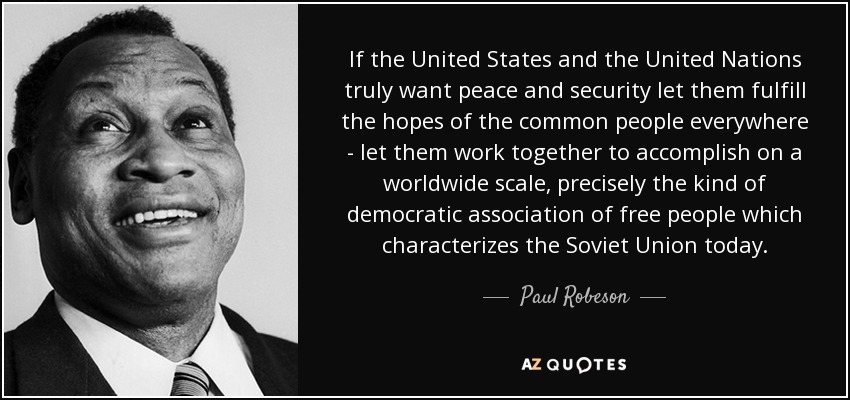
If the United States and the United Nations truly want peace and security let them fulfill the hopes of the common people everywhere - let them work together to accomplish on a worldwide scale, precisely the kind of democratic association of free people which characterizes the Soviet Union today.
I am truly happy that I am able to travel from time to time to the USSR the country I love above all. I always have been, I am now and will always be a loyal friend of the Soviet Union.
But I would like to think for a moment about a man who in the morning teaches his students that a false attribution of a Watteau drawing or an inaccurate transcription of a fourteenth-century epigraph is a sin against the spirit and in the afternoon or evening transmits to the agents of Soviet intelligence classified, perhaps vital information given to him in sworn trust by his countrymen and intimate colleagues. What are the sources of such scission? How does the spirit mask itself?
When I was a kid, I was like everyone else: afraid of getting nuked. We had drills in school - Sweden was very close to the Soviet Union. There was definitely a lot of tension.
I doubt whether the Revolution has, in essentials, changed Russia at all. Reading Gogol, or Dostoevsky for that matter, one realizes how completely the Soviet regime has fallen back on to, and perhaps invigorated, the old Russia. Certainly there is much more of Gogol and Dostoievsky in the regime than there is of Marx.
I must admit that the existence of Disneyland (which I know is real) proves that we are not living in Judaea in 50 AD. . . . Saint Paul would never go near Disneyland. Only children, tourists, and visiting Soviet high officials ever go to Disneyland. Saints do not.
If we have a thousand bamboo spears, there's nothing to worry about a war with the Soviet Union.
One of the greatest concerns that I had when I became President was the vast array of nuclear weapons in the arsenals of the United States and the Soviet Union and a few other countries, and also the great proliferation of conventional weapons, non-nuclear weapons, particularly as a tremendous burden on the economies of developing or very poor countries.
As a child I perceived violence as a sort of natural law. In the totalitarian Soviet Union, oppression held everything together. It was the sinister energy of our country.
Now all of us deplore this vast military spending. Yet, in the face of the Soviet attitude, we realize its necessity. Whatever the cost, America will keep itself secure. But in the process we must not, by our own hand, destroy or distort the American system. This we could do by useless overspending. I know one sure way to overspend. That is by overindulging sentimental attachments to outmoded military machines and concepts.
All important architecture of the last century was strongly influenced by political systems. Look at the Soviet system, with its constructivism and Stalinism, Weimer with its Modern style, Mussolini and, of course, the Nazis and Albert Speer's colossal structures. Today's architecture is subservient to the market and its terms. The market has supplanted ideology. Architecture has turned into a spectacle. It has to package itself and no longer has significance as anything but a landmark.
The Soviet experience was much worse than experts in the West had thought. That discovery had a tremendous impact both on the intellectual community and on the public at large.
I decided to go into politics because of our Soviet-style government.
I don't worry about superpower confrontation. You know, I lived through the Cold War days, and where everybody was worried about a Soviet Union armed to the teeth. I think we're going to get along fine with Russia, and I don't see them as internationally ambitious.
Soviet people are better off materially and richer spiritually.
We bow our heads in respect for those Soviet women who displayed exceptional courage in the severe time of war. Never before but during the days of the war the grandeur of spirit and the invincible will of our Soviet women, their selfless dedication, loyalty and affection to their Homeland, their boundless persistence in work and their heroism on the front manifested themselves with such strength.
I think that in this globalised world, the local is going to become more and more important - it is a paradox. You see it in Western Europe more and more. Eastern Europe is still coming out of the Soviet uniform cultural era, but this kind of separation and nationalism is very obvious now in Western Europe.
It is sometimes said that one of the casualties of the general suspicion and mistrust that permeated the old Soviet Union was that the distinction between truth and other motivations to believe tended to break down. Upon hearing a purported piece of information, the reaction was not 'Is this true?' but 'Why is this person saying this? - What machinations or manipulations are going on here?' The question of truth did not, as it were, have the social space in which it could breath.
I think his [Reagan's] policy toward the Soviet Union was more risky than most people realize, and it was risky because of the paranoia and fear among the isolated old guard in Moscow.
American democracy and the Soviet system may peacefully exist side by side and compete with each other. But one cannot evolve into the other.
The Soviet Union's propaganda clearly wishes to use public opinion in this country to get the West to reduce its own arms while doing nothing themselves. In this way they would gain nuclear superiority. This is simply not on.
I'm a historian by training and by conviction. And so the thing that has throughout informed my thinking about international relations is history. I think, for example, the reason that I was perhaps able to see sooner than some others that the Soviet Empire in Eastern Europe was decaying--if not disintegrating--was that I came to it through history and through Germany, rather than through Sovietology and through Moscow. And therefore the starting point was that no empire in history has lasted forever, and this one won't either.
Increasing the power of the state in response to the Soviet menace would not defeat socialism in Russia but bring it to the United States.
First of all, we have to understand what communism is. I mean, to me, real communism, the Soviet communism, is basically a mask for Bolshevism, which is a mask for Judaism.
This bill reminds me of the tactics of the former Soviet Union - and we know how successful that was.
Follow AzQuotes on Facebook, Twitter and Google+. Every day we present the best quotes! Improve yourself, find your inspiration, share with friends
or simply: