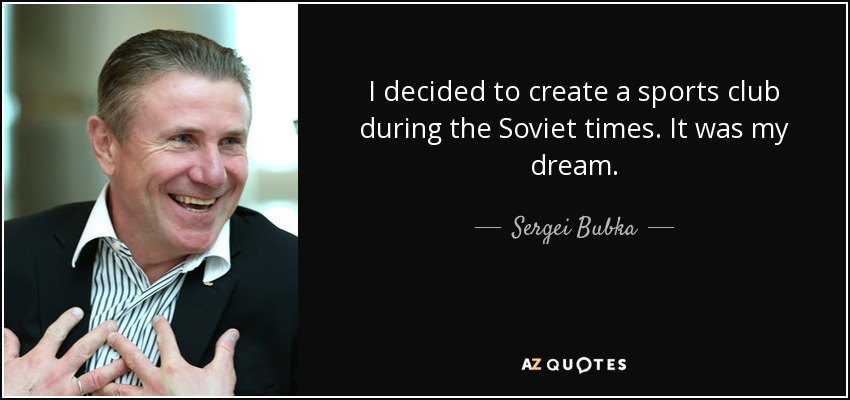
I decided to create a sports club during the Soviet times. It was my dream.
If I had to choose between life in the Soviet Union and life in the U. S. A. , I would certainly choose the Soviet Union.
Having lived in a collapsed empire before - I lived in Russia right after the Soviet Union collapsed - you can see a lot of the classic signs of an empire that's on its way out.
The Soviet Union's propaganda clearly wishes to use public opinion in this country to get the West to reduce its own arms while doing nothing themselves. In this way they would gain nuclear superiority. This is simply not on.
I'm a historian by training and by conviction. And so the thing that has throughout informed my thinking about international relations is history. I think, for example, the reason that I was perhaps able to see sooner than some others that the Soviet Empire in Eastern Europe was decaying--if not disintegrating--was that I came to it through history and through Germany, rather than through Sovietology and through Moscow. And therefore the starting point was that no empire in history has lasted forever, and this one won't either.
Increasing the power of the state in response to the Soviet menace would not defeat socialism in Russia but bring it to the United States.
First of all, we have to understand what communism is. I mean, to me, real communism, the Soviet communism, is basically a mask for Bolshevism, which is a mask for Judaism.
This bill reminds me of the tactics of the former Soviet Union - and we know how successful that was.
Before there was the Soviet Union that could inflame matters. Now you have states not as powerful as the Soviet Union, but states like Iraq, like Iran, and to some extent Syria, having made it possible for some of these groups to operate. So it is a very difficult situation.
Nothing in our lifetimes has been more heartening than when people of the former Soviet Union and Central Europe broke the grip of communism. We have aided their progress and I am proud of it.
I think his [Reagan's] policy toward the Soviet Union was more risky than most people realize, and it was risky because of the paranoia and fear among the isolated old guard in Moscow.
In light of 50 years of bondage of Eastern Europe, [invading the Soviet Union in 1948 to prevent it from acquiring nuclear weapons] was probably a reasonable thing to do.
How can there be democracy if the leadership in the United States and Britain don't uphold the values which my father's generation fought the Nazis, millions of people gave their lives against the Soviet Union's regime, didn't they? Because of what? Democracy. And what democracy meant. No torture, no camps, no detention forever or without trial, without charges. In solitary confinement. Those techniques which are not just alleged, they have actually been written about by the FBI. I don't think it's being far left - I hope that I'm wrong to consider that it's far left to uphold the rule of law.
And further, I tell you that the Jew is right, when he acts as he does - because we are too timid to be as German as the Jew is Jewish! ... It happened at the time of the [Bavarian] Soviet Republic: When the unleashed subhumans rambled murdering through the streets, the deputies hid behind a chimney in the Bavarian parliament.
The Soviet assumption that all other political life-forms and beliefs were inherently and immutably hostile was the simple and central cause of that Cold War.
I have a consistent rule: The American people should know as much about the Pentagon as the Soviet Union and China do, as much about General Motors as Ford does, and as much about City Bank as Chase Manhattan does.
We lived in a totalitarian system for more than 70 years, and our views are still under its influence. Many heads of state in the former Soviet republics believe that they must have total power.
When the whole discussion of "developing a national idea" hastily began in post-Soviet Russia, I tried to pour cold water on it with the objection that, after all the devastating losses we had experienced, it would be quite sufficient to have just one task: the preservation of a dying people.
It is painful to talk about it, but even with its 110,000 elite soldiers, the Soviet Union never managed to gain control over the entire Afghan territory.
I believe that renunciation of the Soviet Union was an expression of the free will of the Russian people.
When the Soviet Union was dissolved, most of us didn't even have the feeling that the country was falling apart. We thought we would continue with our lives as in the past, but as good neighbors.
Soviet-era nostalgia has strong support among the people. But not among the elite and, in my opinion, not with the president. We are not interested in keeping remnants of the communist era alive.
During the Cold War era, the issue was the containment of Soviet influence, and we tolerated many an authoritarian regime as long as they were useful to us in this respect.
You want to favor systems that benefit from error, disorder, variability and things like that. You want to favor these systems and unfortunately, when - there's something I call the Soviet Illusion. The more the government becomes intrusive, the more things have to follow a script, and it can't handle this kind of system.
When [Vladimir] Putin, a former lieutenant-colonel in the KGB, became Russia's president on December 31, 1999 - eight years after the failed coup attempt against (then Soviet leader Mikhail) Gorbachev, and eight years after the people had torn down the statue of Felix Dzerzhinsky, the hated founder of the KGB, in Moscow - it was admittedly a shock. Nevertheless, I decided to give Putin a chance. He seemed dynamic and capable of learning. But I had to bury my hopes after just a few months. He proved to be an autocrat - and, because the West let him do as he pleased, he became a dictator.
Follow AzQuotes on Facebook, Twitter and Google+. Every day we present the best quotes! Improve yourself, find your inspiration, share with friends
or simply: