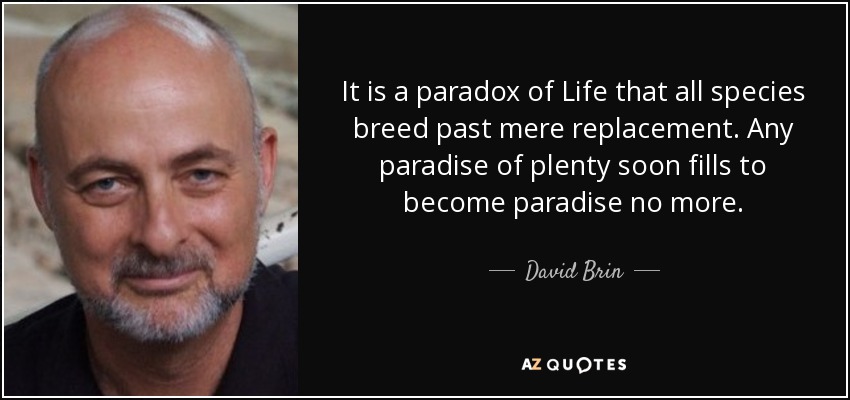
It is a paradox of Life that all species breed past mere replacement. Any paradise of plenty soon fills to become paradise no more.
How many people on Earth serve people? And how many people on Earth serve the Earth? The difference in the numbers must be enormous. It would reveal that the Earth is definitely not the primary concern of the human species. This might be fatal both to the Earth and to humanity. Please, leaders of the Earth and the nations, wake up to this potentially fatal disparity.
For as to the dispersing of Books, that Circumstance does perhaps as much harm as good: Since Nonsense flies with greater Celerity, and makes greater Impression than Reason; though indeed no particular species of Nonsense is so durable. But the several Forms of Nonsense never cease succeeding one another; and Men are always under the Dominion of some one or other, though nothing was ever equal in Absurdity and Wickedness to our present Patriotism.
The evolution of cultures appears to follow the pattern of the evolution of species. The many different forms of culture which arise correspond to the "mutations" of genetic theory. Some forms prove to be effective under prevailing circumstances and others not, and the perpetuation of the culture is determined accordingly.
We're an amazingly adaptive and resilient species. Once we put our mind to global warming, I have no doubt we'll figure a way through here that won't lead to utter calamity.
It amazes me to witness the masochism with which some journalists characterize their industry as a dying species. The future belongs to citizen journalism and blogs.
Overpopulation in the United States will become THE single greatest issue facing Americans in the 21st century. We either solve it proactively or nature will solve it brutally for us via water shortages, energy crisis, air pollution, gridlock, species extinction and worse.
Insect resistance to a pesticide was first reported in 1947 for the Housefly (Musca domestica) with respect to DDT. Since then resistance to one or more pesticides has been reported in at least 225 species of insects and other arthropods. The genetic variants required for resistance to the most diverse kinds of pesticides were apparently present in every one of the populations exposed to these man-made compounds.
Music can move us to the heights or depths of emotion. It can persuade us to buy something, or remind us of our first date. It can lift us out of depression when nothing else can. It can get us dancing to its beat. But the power of music goes much, much further. Indeed, music occupies more areas of our brain than language does-humans are a musical species.
Increasingly, we will be faced with a choice: whether to keep the oceans for wild fish or farmed fish. Farming domesticated species in close proximity with wild fish will mean that domesticated fish always win. Nobody in the world of policy appears to be asking what is best for society, wild fish or farmed fish. And what sort of farmed fish, anyway? Were this question to be asked, and answered honestly, we might find that our interests lay in prioritizing wild fish and making their ecosystems more productive by leaving them alone enough of the time.
The discovery informs about the origins and early evolution of arthropods, the most ubiquitous, species-rich, morphologically diverse and successful animal group on Earth.
Good teachers are an endangered species because they're giving up because of the tests and everything.
If evolution exists in every living species, likewise so too does devolution.
ONE THING I AM NEVER GOING TO DO WHEN I GROW UP Is fall in love, drop out of college, learn to subsist on water and air, have a species named after me, and ruin my life.
Diversity is a survival factor for the community itself. A community of a hundred million species can survive anything short of total global catastrophe. Within that hundred million will be thousands that could survive a global temperature drop of twenty degrees—which would be a lot more devastating than it sounds. Within that hundred million will be thousands that could survive a global temperature rise of twenty degrees. But a community of a hundred species or a thousand species has almost no survival value at all.
[A]ny species that exempts itself from the rules of competition ends up destroying the community in order to support its own expansion.
No one species shall make the life of the world its own.' … That's one expression of the law. Here's another: 'The world was not made for any one species.
Fortunately for me, I ran across some girls I could get along with so I could enjoy high school life okay, but it must be awful for kids who don't get along with anybody. We're different from our parents, a completely different species from our teachers. And kids who are one grade apart you are in a different world altogether. In other words, we're basically surrounded by enemies and have to make it on our own.
The air of caricature never fails to show itself in the products of reason applied relentlessly and without correction. The observation of clinical facts would seem to be a pursuit of the physician as harmless as it is indispensable. [But] it seemed irresistibly rational to certain minds that diseases should be as fully classifiable as are beetles and butterflies. This doctrine ... bore perhaps its richest fruit in the hands of Boissier de Sauvauges. In his Nosologia Methodica published in 1768 ... this Linnaeus of the bedside grouped diseases into ten classes, 295 genera, and 2400 species.
It has sometimes been said that the success of the Origin proved "that the subject was in the air," or "that men's minds were prepared for it." I do not think that this is strictly true, for I occasionally sounded not a few naturalists, and never happened to come across a single one who seemed to doubt about the permanence of species.
We are at a crossroads in human history. Never before has there been a moment so simultaneously perilous and promising. We are the first species to have taken evolution into our own hands.
Infectious disease is one of the few genuine adventures left in the world. The dragons are all dead and the lance grows rusty in the chimney corner. ... About the only sporting proposition that remains unimpaired by the relentless domestication of a once free-living human species is the war against those ferocious little fellow creatures, which lurk in dark corners and stalk us in the bodies of rats, mice and all kinds of domestic animals; which fly and crawl with the insects, and waylay us in our food and drink and even in our love
Upon this subject, the habits of our whole species fall into three great classes--useful labour, useless labour and idleness. Of these the first only is meritorious; and to it all the products of labour rightfully belong; but the two latter, while they exist, are heavy pensioners upon the first, robbing it of a large portion of it's just rights. The only remedy for this is to, as far as possible, drive useless labour and idleness out of existence.
I am principled against this kind of traffic in the human species . . . and to disperse the families I have an aversion.
The distribution of species on islands and continents throughout the world is exactly what you'd expect if evolution was a fact. The distribution of fossils in space and in time are exactly what you would expect if evolution were a fact. There are millions of facts all pointing in the same direction and no facts pointing in the wrong direction.
Follow AzQuotes on Facebook, Twitter and Google+. Every day we present the best quotes! Improve yourself, find your inspiration, share with friends
or simply: