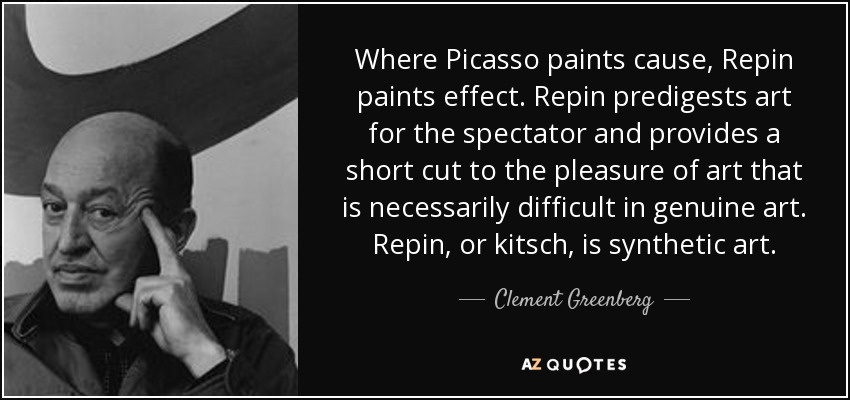
Where Picasso paints cause, Repin paints effect. Repin predigests art for the spectator and provides a short cut to the pleasure of art that is necessarily difficult in genuine art. Repin, or kitsch, is synthetic art.
Performance is always oriented towards a spectator, towards an imagined audience and I was thinking who is their imagined audience?
I think that there's some brainwashing going on with this idea that we don't have time to cook anymore. We have made cooking seem much more complicated than it is, and part of that comes from watching cooking shows on television-we've turned cooking into a spectator sport. ...My wife and I both work, and we can get a very nice dinner on the table in a half hour. It would not take any less time for us to drive to a fast-food outlet and order, sit down, and bus our table.
A work of art is said to be perfect in proportion as it does not remind the spectator of the process by which it was created.
Basketball is great; no one in Europe seems to believe just how close the spectators can sit to the players.
Why did God make tigers so good at catching prey, and at the same time make prey so good at getting away from tigers? You'd think that if God wanted one thing or the other to happen he'd have engineered it rather better. Maybe he enjoyed the spectator sport?
Film is the packaging of information in cans. Videotape is involved with the feeding back of process. Film rips information away from the situation for use elsewhere. Videotape can be fed back into a given situation and enrich experience. Film extends man as a spectator. Videotape extends man as a cybernator. Film imports information. Videotape implodes indigenous data.
The spectator and historian of [Belisarius's] exploits has observed, that amidst the perils of war, he was daring without rashness, prudent without fear, slow or rapid according to the exigencies of the moment; that in the deepest distress he was animated by real or apparent hope, but that he was modest and humble in the most prosperous fortune.
In the race of faith, stay focused upon Christ, not the other runners, nor the spectators.
We're not mere spectators, or a cosmic accident, or some sideshow, or the Greek chorus to the main event. The human experience IS the main event.
The contradiction in perspective was that it structured all images of reality to address a single spectator who, unlike God, could only be in one place at a time.
In my earlier paintings, I wanted the space between the picture plane and the spectator to be active. It was in that space, paradoxically, the painting 'took place.' Then, little by little, and to some extent deliberately, I made it go the other way, opening up an interior space... so that there was a layered, shallow depth.
To think that we are disconnected in some way serves the occupation whether it's through indifference or a distancing. It is a colonial approach of making you a subject and them the spectators. That is disturbing and counterproductive. And then suddenly they are surprised or find it alienating that the microcosmic effects of Palestine are happening in the U.S., France, and England, whether it's from the Islamic movements or immigration factors. Keeping a false purity of their countries will harm them eventually.
The history of mankind is a romance, a mask, a tragedy, constructed upon the principles of POETICAL JUSTICE; it is a noble or royal hunt, in which what is sport to the few is death to the many, and in which the spectators halloo and encourage the strong to set upon the weak, and cry havoc in the chase, though they do not share in the spoil.
An image means nothing. It is just a door, leading to the next door. It will never happens that we will find the truth we are looking for just in an image; it will happen behind the last door that the spectator discover the truth, because of his own efforts.
Like a researcher in his laboratory, I am the first spectator of the suggestions drawn from the materials. I unleash their expressive possibilities, even if I do not have a very clear idea of what I am going to do. As I go along with my work I formulate my thought, and from this struggle between what I want and the reality of the material - from this tension - is born an equilibrium.
I do feel for me that cinema has somehow ceased to be a spectator sport. I get tremendous excitement out of making it rather than watching it.
Implicit in the banking concept is the assumption of a dichotomy between human beings and the world: a person is merely in the world, not with the world or with others; the individual is spectator, not re-creator.
It is no small honour that God for our sake has so magnificently adorned the world, in order that we may not only be spectators of this beauteous theatre, but also enjoy the multiplied abundance and variety of good things which are presented to us in it.
The artist has some internal experience that produces a poem, a painting, a piece of music. Spectators submit themselves to the work, which generates an inner experience for them. But historically it's a very new, not to mention vulgar, idea that the spectator's experience should be identical to, or even have anything to do with, the artist's. That idea comes from an over-industrialized society which has learned to distrust magic.
The artist is a spectator, indifferent or impassioned, at the birth of his work, and observes the phases of its development.
At lucky moments this emanation could overwhelm the spectator in such a way, that because of all sorts of associations in his thinking, he could finally be taken to those areas which also had moved me so deeply and made me think I should draw the attention of others to it.
If we paint the phases of a riot, the crowd bustling with uplifted fists and the noisy onslaughts of cavalry are translated upon the canvas in sheaves of lines corresponding with all the conflicting forces, following the general laws of violence of the picture... These force-lines must encircle and involve the spectator so that he will in a manner be forced to struggle himself with the persons in the picture.
Ideally there is a type of continuum which flows from life through the artist's sensibility and his materials... the concreteness of the object and its own life , through the spectator, with his expectations, interpretations, back into life.
I believe that one of the most important properties of a work of art is an attempt to reconcile opposites, and in their fusion to achieve a 'wholeness' or 'oneness,' the experiencing of which should be revelatory - both for the artist and the spectator - something akin to the experience of enlightenment in terms of religion.
Follow AzQuotes on Facebook, Twitter and Google+. Every day we present the best quotes! Improve yourself, find your inspiration, share with friends
or simply: