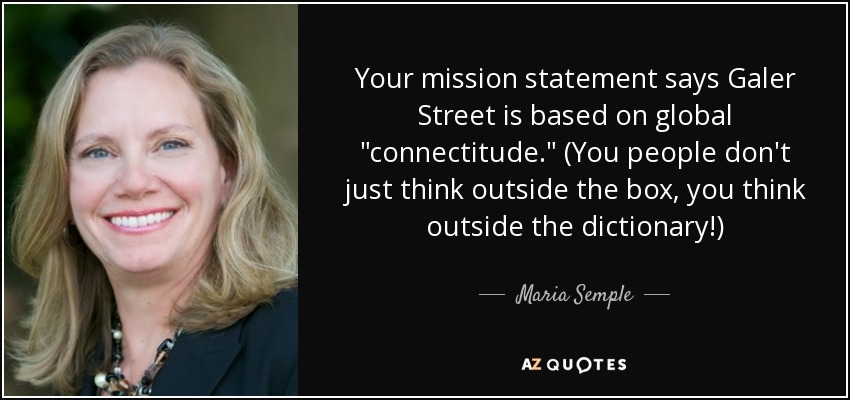
Your mission statement says Galer Street is based on global "connectitude." (You people don't just think outside the box, you think outside the dictionary!)
Adrian sifted through the bags and pulled out a slice of coconut cream. "If I were a dragon, this is what I'd go for." I didn't argue, mainly because that statement had no logical argument.
The criminal misuse of time was pointing out the mistakes. Catching them―noticing them―that was essential. If you did not in your own mind distinguish between useful and erroneous information, then you were not learning at all, you were merely replacing ignorance with false belief, which was no improvement. The part of the man's statement that was true, however, was about the uselessness of speaking up. If I know that the teacher is wrong, and say nothing, then I remain the only one who knows, and that gives me an advantage over those who believe the teacher.
That," he whispered, "is unthinkable." In Mosca’s experience, such statements generally meant that a thing was perfectly thinkable, but that the speaker did not want to think it.
There was nothing particularly intimate about the way they sat, but something about the scene made Gansey feel strange, like he’d heard an unpleasant statement and later forgotten everything about the words but the way they had made him feel.
Because there’s a clock attached to every beautiful woman. From the second she comes into her own, she begins to decline, because she begins to age. Aging is every beautiful woman’s kryptonite. And so, yes, it’s ridiculous and no, you don’t have much time and of course it’s not fair. Those three statements are the essence of beauty.
I watched as Humphrey Bogart’s character used beans as a metaphor for the relative unimportance in the wider world of his relationship with Ingrid Bergman’s character, and chose logic and decency ahead of his selfish emotional desires. The quandary and resulting decision made for an engrossing film. But this was not what people cried about. They were in love and could not be together. I repeated this statement to myself, trying to force an emotional reaction. I couldn’t. I didn’t care. I had enough problems of my own.
I hope we don't see no paparazzi today. Because I'm still getting acquainted with these jogging pants I threw on. Like, 'That's not my statement!'
Why (he wondered rhetorically) do people who have a position that's being attacked constantly state that they have a right to say it, as if the right itself-rather than the statement-has been challenged?
President Heber J. Grant often quoted the following statement, which is sometimes attributed to Ralph Waldo Emerson: “That which we persist in doing becomes easier for us to do-not that the nature of the thing is changed, but that our power to do is increased.'
For a contributing citizen to be released from the community was a final decision, a terrible punishment, an overwhelming statement of failure.
Certainly, I signed a statement that I killed two and a half million Jews. But I could just as well have said that it was five million Jews. There are certain methods by which any confession can be obtained, whether it is true or not.
We might not object to the statement that Lear deserved to suffer for his folly, selfishness and tyranny; but to assert that he deserved to suffer what he did suffer is to do violence not merely to language but to any healthy moral sense.
Here is my challenge. Name one ethical statement made, or one ethical action performed, by a believer that could not have been uttered or done by a nonbeliever. And here is my second challenge. Can any reader think of a wicked statement made, or an evil action performed, precisely because of religious faith? The second question is easy to answer, is it not? The first - I have been asking it for some time - awaits a convincing reply. By what right, then, do the faithful assume this irritating mantle of righteousness? They have as much to apologize for as to explain.
Truth is new, as well as old. It has new forms; and where you may find a new statement, an earnest statement, you may conclude that by the law of progress it is more likely to be a correct statement than that which has been repeated for ages by the lips of tradition.
We can't make any statements here. We can't talk about the internal politics of Paraguay.
Dr. Rice's record on Iraq gives me great concern. In her public statements she clearly overstated and exaggerated the intelligence concerning Iraq before the war in order to support the President's decision to initiate military action against Iraq
Those who confine God's love exclusively to the elect appear to me to take a narrow and contracted view of God's character and attributes....I have long come to the conclusion that men may be more systematic in their statements than the Bible, and may be led into grave error by idolatrous veneration of a system
The whole aim of Zen is not to make foolproof statements about experience, but to come to direct grips with reality without the mediation of logical verbalizing.
My films are intended as polemical statements against the American 'barrel down' cinema and its dis-empowerment of the spectator. They are an appeal for a cinema of insistent questions instead of false (because too quick) answers, for clarifying distance in place of violating closeness, for provocation and dialogue instead of consumption and consensus.
Certainly, my uni days involved some statements that I wouldn't make today.
Every cabinet minister gets a mission statement from the Prime Minister.
It’s making a statement about what life is, really. And I’m going to end the line with it.
For every grand and finely worded statement by the CEO, the brand is also defined by derisory consumer comments overheard in a hallway, or in a chat room on the Internet. Brands are sponges for content, for images, for fleeting feelings. They become psychological concepts held in the minds of the public, where they may stay forever. As such you can’t entirely control a brand. At best you can only guide and influence it.
The important thing, Jesus is saying (in Matthew 5:33-37), is to tell the truth and keep one's pledges without insisting that a certain form of words must be used if it is to be binding. No oath is necessary for the truthful person... Their word is so reliable that nothing more than a statement is needed from them.
Follow AzQuotes on Facebook, Twitter and Google+. Every day we present the best quotes! Improve yourself, find your inspiration, share with friends
or simply: