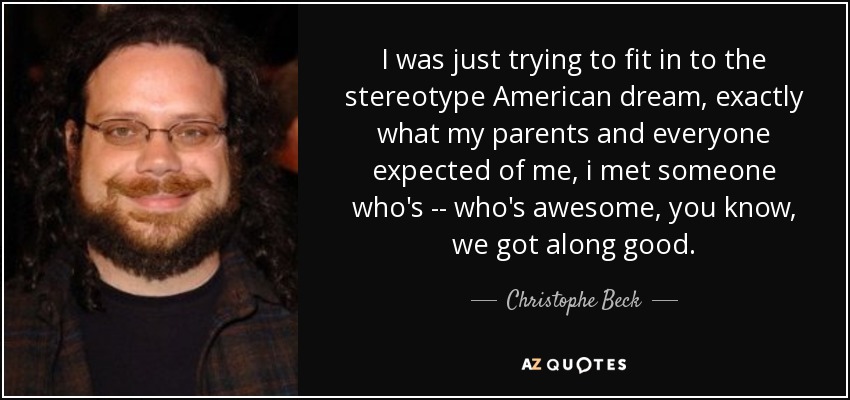
I was just trying to fit in to the stereotype American dream, exactly what my parents and everyone expected of me, i met someone who's -- who's awesome, you know, we got along good.
I think we start suffering as soon as we come out of the womb. I think that people tend to stereotype. When they think of suffering, they think of abuse - physical abuse, emotional abuse, poverty, that kind of thing. There's different levels of suffering. I don't think that it has to do with how much money you have - if you were raised in the ghetto or the Hamptons. For me it's more about perception: self-perception and how you perceive the world.
That so much of our experience, or the stereotype which passes for it should be dealt with by means of the short story is perhaps a symptom not unnoticeable elsewhere in the public domain of an unlovely cynicism about human character.
In comedy you sometimes have to look at the funny bone a little bit. So, that was the hardest part - was not offending. I'm not laughing at anybody. We're laughing together about who we are - and the funnier part of who we are. I'm (sure) not writing this and calling you a stereotype. I'm not doing that.
Emergence of Muslim communities in their own lands. They let in millions of people from a radically different culture and background. The Europeans have to ask themselves if all these people can be integrated. This has led to major problems. And...I do not stereotype all Muslims.
People hear me talk and they know my background and they immediately stereotype me as being a real, real country guy, and that's the right stereotype. But you also want people to know you're a little broader than that, too.
Just look at the history of cinema. The most reproduced male character is probably the hero and the most reproduced female character is probably the sex object. I think those stereotypes have been reproduced over and over again. It also changes our expectations when it comes to a situation like this in real life.
There's a stereotype that to be a strong black woman is to be strong about being black.
Millennials are an easy group to identify in terms of their appearance and are therefore highly subject to being stereotyped. When a negative stereotype about a group is relevant to performance on a specific task, it is referred to as "stereotype threat." Individuals who are highly identified with a particular group may experience increased susceptibility to stereotype threat.Understanding perceptions and why they may exist helps to explain and demystify tension and conflict that surfaces as a result of generational discord.
Today there are a huge number of think tanks working on poverty-related issues; there are books written on the topic; and university centers being created to study poverty. But, at the same time, the media has a terribly hard time with this issue; it's very hard to convince editors and publishers to devote resources to complex investigations of the lives of America's poor. And, as a result, too often poverty is portrayed in stereotypes, in sound bites, in a few pat images rather than in its full Technicolor complexity and diversity.
The reliance on stereotypes is in part the result of a structural problem within the media. Most newspapers have a business beat, with a number of highly trained journalists who know how to cover companies, trading, the markets and so on. But almost none have labor reporters anymore, and to my knowledge, none have full-time poverty-beat correspondents. And all of this helps to render invisible the lives and the life stories of tens of millions of Americans.
When the government is looking for a criminal in the crowd, it construes people in terms of culpability: innocence or guilt. When a corporation uses emotion recognition software to gauge your reaction to a carton of milk, it construes your body as a consumer. So there are these different modes of seeing what it is to be human, which have important implications for social classification, stereotyping, and racial profiling.
Some people think that Southern hip-hop doesn't have any depth. They think it's just noise, all about people having a good time in the club. And some of it doesn't have a lot of depth, it's true, but some does. I wanted to work against that stereotype. These are verses by Southern artists who are really wrestling with what it means to be here, young black men who are trying to figure out how to live in the South. So I wanted the epigraphs in my novels to reflect that.
I like the labels because I think they tell my story in a very concise way: gay, Latino. I think the responsibility that comes with accepting labels is that now I get a chance to break stereotypes. It gives me the opportunity to tell the unique stories of what those labels mean.
My being Indian is possibly the biggest thing that influences my stories. Not just in terms of settings - most of the settings in my stories are Indian - but also in terms of characters and plot. I think growing up in India grew my imagination in certain ways that would not have happened in any other place. I'm also fascinated by the idea of India, and writing stories allows me to explore this. As for thematic elements, they are probably pretty obvious in my stories. I also hope that my stories bust stereotypes at least to a modest extent.
Stereotypes, I want to say, have to be thought of not just as these invidious, bad things that we could get rid of, but as images that we cannot get rid of, that we have to live with.
Obviously invidious and prejudicial stereotypes need to be deconstructed and overcome, but it's not that they can be destroyed. I think that would be an illusion to think that we can somehow get rid of these basic search templates that allow us to sort out our social lives and to sort out the material world as well.
I see stereotypes as fundamental and inescapable and not as something that is... The kind of common view is "Oh, we shouldn't think in stereotypes," and I think the reality is we can't help but think in stereotypes.
Distinction between species and specimen is very much like the distinction between images and actual pictures, or, you know, objects that have a definite material identity. The classifications, the categories, the stereotypes, and the images are on one side, and the material pictures, statues, texts, and so forth are on the other.
There will always be people that will have assumptions about you, about my character, my personality, or that I might put on a show of being gay or something, or that I play up stereotypes or anything like that. It's always funny to me that those people are typically the people that know me the least.
I really appreciate crafts. I like cooking. I love food and drink. I love owning that through Instagram. Although that can be challenging at times because it doesn't fit people's stereotypes of a technical founder.
Speaking specifically about the memoir, I know that's a criticism that people can have about my work. When I look at the young men's lives, if they're reduced to the worst thing they've done, then it's easy for them to become a stereotype. I keep running into that with newspaper articles that are very short.
We apply the language that is comforting and comfortable and familiar in order to grasp that which confuses and scares us. That is the first step toward cliché and stereotype, as they're comforting devices. They reduce the confusing world to the already familiar. We're always smoothing out the bumps of actual living to turn it into narratable life.
There is a feminist proverb I learned from my mother: The personal is political. There's a powerful literary stereotype that men write about war and politics and public life, while women confine themselves to family and food and personal life.
I'm optimistic, though. Now, with the Arab Spring, I think that people in the region are beginning to overturn some of these clichés, and Western editors are starting to catch up. We're seeing some exceptions to the stereotypes, like Elizabeth Rubin's great piecein Newsweek, "The Feminists in the Middle of Tahrir Square." But an article like that shouldn't be the exception. It should be the rule.
Follow AzQuotes on Facebook, Twitter and Google+. Every day we present the best quotes! Improve yourself, find your inspiration, share with friends
or simply: