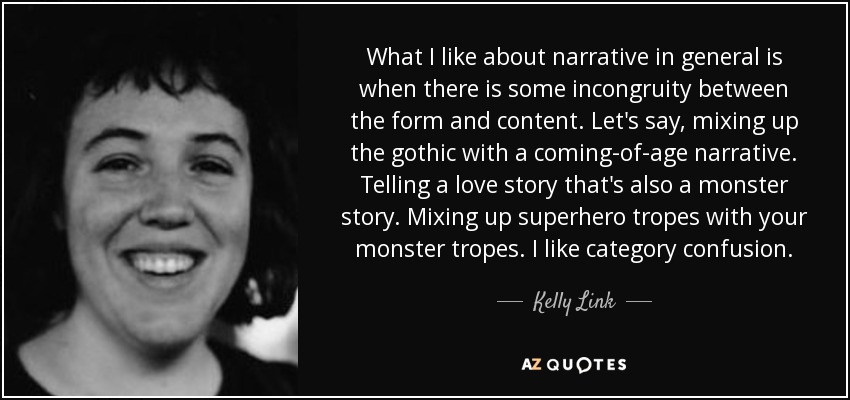
What I like about narrative in general is when there is some incongruity between the form and content. Let's say, mixing up the gothic with a coming-of-age narrative. Telling a love story that's also a monster story. Mixing up superhero tropes with your monster tropes. I like category confusion.
Whether or not this story has a happy ending depends, of course, on who is reading it. Whether you are a wolf or a girl.
Most of the things that I remember from childhood wouldn't make a particularly good story: rescuing worms during rainstorms, our schnauzer attacking a wheel of cheese when someone dropped it during dinner, my parents tricking us into riding Space Mountain at Disney World (we thought it was an educational people-mover kind of ride), playing Star Wars (I got to marry Harrison Ford and my sister married Luke Skywalker) in first and second grade. On the other hand, we always had lots of interesting babysitters--seminary students and friends of my parents--who told really good ghost stories.
There’s always been a need for horror fiction, though - ghost stories have been a staple of every human society since the beginning of recorded literature - and while commercially the field may have its ups and downs, it will never go away. Hell, look at the Bible: gods, devils, ghosts, witches, giants, resurrections. That’s one big horror story. And it’s the most popular book on the planet.
Live Free or Die Hard may work better for an audience that doesn't know much about the series is than it will for Die Hard die hards, who will be wondering who that impersonator is and what he did with the real John McClane. The original Die Hard came out of nowhere to blitz the 1988 summer box office. The fourth installment arrives with a weight of expectations that Atlas would have trouble shouldering and, when the dust settles in September, it's unlikely that Live Free or Die Hard will be one of this year's big success stories.
All true stories end in death.
Romance is all about making a story out of our love.
Hollywood no longer offers entertainment. Instead, activism has replaced acting, and sermons have supplanted stories. Instead of a good yarn, you get a yawn.
In terms of style, too, I think I've been working with a somewhat limited -- although intentionally limited -- set of tools. So I'm attempting to be a bit looser as I start stories off. To digress. To make interesting mistakes.
You can think of my films as cautionary tales, but you might even think of them as despairing tales, because at least in a cautionary tale, you have this idea that by listening to the story you can assure a better outcome. Whereas I'm not at all convinced that's the case. In fact, if anything, I'm convinced that it's the opposite.
Science has an uncomfortable way of pushing human beings from center stage. In our prescientific stories, humans began as the focal point of Nature, living on an Earth that was the center of the universe. As the origins of the Earth and of mankind were investigated more carefully, it became clear that Nature had other interests beyond people, and the Earth was less central than previously hoped. Humankind was just one branch of the great family of life, and the Earth is a smallish planet orbiting an unexceptional sun quite far out on one arm of a run-of-the-mill spiral galaxy.
Some artists, such as Jack Kirby, need no plot at all. I mean I'll just say to Jack, "Let's let the next villain be Dr. Doom" ... or I may not even say that. He may tell me. And then he goes home and does it. He's so good at plots, I'm sure he's a thousand times better than I. He just makes up the plots for these stories. All I do is a little editing ... I may tell him that he's gone too far in one direction or another. Of course, occasionally I'll give him a plot, but we're practically both the writers on the things.
Jack [Kirby] and Joe [Simon] wrote and drew the stories themselves in the beginning and I was just, like, the office boy. But after a while they had more writing than they could handle and I was the only guy around, so they said, "Hey Stan, you think you can write this?" When you're seventeen years old, what do you know? I said, "Sure, I can do it!" And that was it.
The Irish, as a race, have the oral tradition in their blood. A direct question to them is an anathema, but in other cases, a mere syllable of a hero's name will elicit whole chapters of stories.
The one place where I can relax is on the golf course with my teammates and buddies, assuming I'm hitting the golf ball well. If I'm not, well, that is another story.
The once rather old-fashioned science of paleontology finds itself in a maelstrom of excitement and controversy. Astrophysicists, atmospheric scientists, geochemists, geophysicists, and statisticians are all contributing to the extinction problem. And the general public is taking part through television talk shows, magazine cover stories, newspaper editorials, and even the occasional mention in gossip columns.
Any story worth telling relates to real life in some meaningful way. Scifi allows you to tell meaningful stories without seeming too preachy - it adds a metaphorical layer between the story and the real world. Scifi is dismissed as ungrounded fluff, but it's actually the opposite.
It seems far simpler to go ahead and say that the epic is a fantastic myth, that happens to be true of the material Universe, that other myths are true in terms of their cultural meaning, and that there's absolutely no problem with holding more than one story, just as there's no problem with viewing the sunset in terms of planetary rotation and spectra and nuclear fusions one moment and as visual splendor the next.
Interestingly, it's as though the gospel story of Jesus is the archetypal heroic journey, the embodiment of the very adventure that all people in every epoch have desired.
The writing of a novel or short story or poem or whatever should elevate the audience, not drag the writer down to some level beneath herself. And she - the author - should fight always to prevent that dragging down, especially when the only possible benefit of allowing it to happen is monetary.
Somewhere In Time is the story of a love which transcends time , What Dreams May Come is the story of a love which transcends death . ... I feel that they represent the best writing I have done in the novel form.
Without the Christian explanation of original sin, the seemingly silly story of Adam and Eve and the tree of the knowledge of good and evil, there was no explanation of conflict. At all.
I have been advised that you have decided to move forward with your story without my interview. This, despite the fact confirmed more than three weeks ago that I would make myself available on a date certain (6 July), after you spoke to other relevant Church personnel and toured Church facilities, and that I would provide information annihilating the credibility of your sources including the fundamental crimes against the Scientology religion that were the reasons for their removal from post.
The method of producing comics in Japan is very hectic, but it's also rewarding because it's possible to do both the story and art all by yourself. In this way, it's possibly to bring out one's individuality. If this idea appeals to you, I call on you to try drawing your own manga.
If a good editor will let me tell my story with the right artist, I'm happy.
Follow AzQuotes on Facebook, Twitter and Google+. Every day we present the best quotes! Improve yourself, find your inspiration, share with friends
or simply: