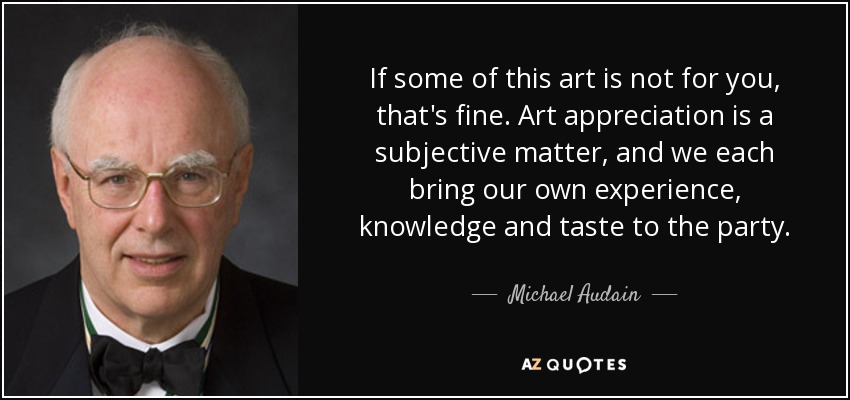
If some of this art is not for you, that's fine. Art appreciation is a subjective matter, and we each bring our own experience, knowledge and taste to the party.
[There] are cases where there is no dishonesty involved but where people are tricked into false results by a lack of understanding about what human beings can do to themselves in the way of being led astray by subjective effects, wishful thinking or threshold interactions. These are examples of pathological science. These are things that attracted a great deal of attention. Usually hundreds of papers have been published upon them. Sometimes they have lasted for fifteen or twenty years and then they gradually die away.
The only problem in art is to achieve a balance between the subjective and the objective.
Look at the paintings of Picasso. He is a great painter, but just a subjective artist. Looking at his paintings, you will start feeling sick, dizzy, something going berserk in your mind. You cannot go on looking at Picasso's painting long enough. You would like to get away, because the painting has not come from a silent being. It has come from a chaos. It is a by product of a nightmare. But ninety-nine percent art belongs to that category.
I am convinced that an important stage of human thought will have been reached when the physiological and the psychological, the objective and the subjective, are actually united, when the tormenting conflicts or contradictions between my consciousness and my body will have been factually resolved or discarded.
The subjective element in geological studies accounts for two characteristic types that can be distinguished among geologists. One considering geology as a creative art, the other regarding geology as an exact science.
In what I do for a living, trust and confidence are key. Inevitably, you can't make brave choices and do your best work, if you don't have those, because it's such a subjective art form, and you don't have eyes on yourself.
What I think is great about Pippin, specifically, and I wouldn't make this generalization about all musicals, is that it is about how we tell stories and the way stories are very subjective. How we tell some things and leave other things out in the way The Princess Bride is or The Wizard of Oz is, which both have a framing device.
Nothing has value in itself. The consumer confers value on it by seeking to acquire it. Hence, the value of a thing is never objective, but always subjective.
Change is always subjective. To talk of evil and misery is nonsense, because they do not exist outside. If I am immune from all anger, I never feel angry. If am immune from all hatred, I never feel hatred.
Don't take on things you don't believe in and that you yourself are not good at. Learn to say no. Effective leaders match the objective needs of their company with the subjective competencies. As a result, they get an enormous amount of things done fast.
I just pretty much love from 1966 to 1972, that's my time. I think everything that needs to be said was said within that time. That's just a subjective thing, as well.
My point is that meaning is always personal, changeable and subjective. There is no 'correct' interpretation of a photograph.
I guess I just look at talent as a very subjective thing. I mean, if you never tried playing an oboe, how do you know you're not the most talented oboe player ever? The point is that if you don't love it, then it doesn't matter.
Psychotherapy makes every problem a subjective, inner problem. And that's not where the problems come from. They come from the environment, the cities, the economy, the racism. They come from architecture, school systems, capitalism, exploitation. They come from many places that psychotherapy does not address. Psychotherapy theory turns it all on you: you are the one who is wrong.
Truth is such a subjective thing.
Well, "disgusting" doesn't refer to the books but to the subjective reaction of the person making the complaint. I don't think that anything is disgusting per se. These words "disgusting" and "filthy," etc., have prevented us from undertaking any scientific experimentation in sexual matters.
The real question should be: what makes a good political poem? The possible answers to that question are both obvious and yet still a little too subjective for anyone to ever fully agree on. What do I most wish to see in a political poet? Sublimated rebellion.
I'm a professional comic. Whether you think I'm funny or not, that's, again, subjective.
This word "redemption," what is it about this word? Is it tangible? Do you know when it has happened? Is it necessary in a drama? Does it make a character boring? Does everyone agree on a character being "redeemed?" Or is it a word that is so subjective and polarizing and insignificant in modern television? It is a word that has been given, quite possibly, far too much significance, when it is truly ambiguous and meaningless in a drama. I have personally grown to loathe that word in literature.
Mark Tobey fills his canvases with elliptical, calligraphic lines, beautiful whirls that seem at first glance to be completely abstract and to come from nowhere at all except his own subjective musing. But I shall never forget how struck I was, on visiting Tobey's studio one day, to see strewn around books on astronomy and photographs of the Milky Way. I knew then that Tobey experiences the movement of the stars and solar constellations as the external pole of his encounter.
It seems to me that dominant cinema seems to require an empathy or a sympathy between the film and the audience which is basically to do with the manipulation of the emotions and it seems to me again -- and this is a very subjective position -- that most cinema seems to trivialise the emotions, sentimentalising or romanticising them.
I couldn't portray a women in all her natural loveliness.. I haven't the skill. No one has. I must, therefore, create a new sort of beauty, the beauty that appears to me in terms of volume of line, of mass, of weight, and through that beauty interpret my subjective impression. Nature is mere a pretext for decorative composition, plus sentiment. It suggests emotion, and I translate that emotion into art. I want to express the absolute, not merely the factitious woman.
I personally think honestly disclosing rather than hiding ones subjective values makes for more honest and trustworthy journalism. But no journalism - from the most stylistically objective to the most brazenly opinionated - has any real value unless it is grounded in facts, evidence, and verifiable data.
The scientific attitude of mind involves a sweeping away of all other desires in the interests of the desire to know-it involves suppression of hopes and fears, loves and hates, and the whole subjective emotional life, until we become subdued to the material, able to see it frankly, without preconceptions, without bias, without any wish except to see it as it is, and without any belief that what it is must be determined by some relation, positive or negative, to what we should like it to be, or to what we can easily imagine it to be.
Follow AzQuotes on Facebook, Twitter and Google+. Every day we present the best quotes! Improve yourself, find your inspiration, share with friends
or simply: