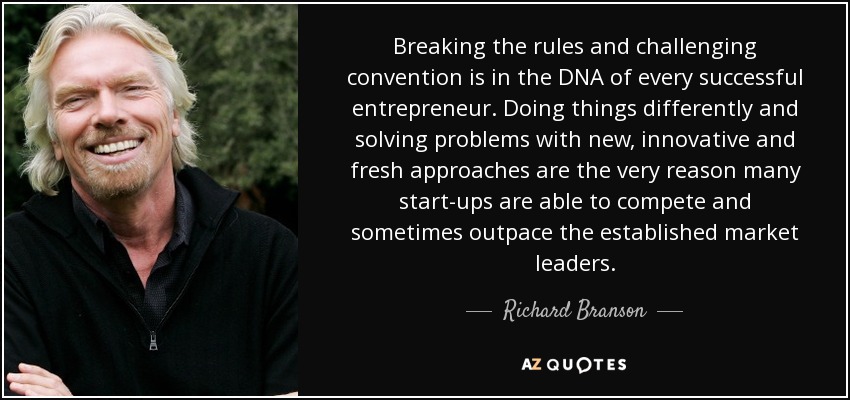
Breaking the rules and challenging convention is in the DNA of every successful entrepreneur. Doing things differently and solving problems with new, innovative and fresh approaches are the very reason many start-ups are able to compete and sometimes outpace the established market leaders.
The lesson here is very simple. But it is striking how often it is overlooked. We are so caught in the myths of the best and the brightest and the self-made that we think outliers spring naturally from the earth. We look at the young Bill Gates and marvel that our world allowed that thirteen-year-old to become a fabulously successful entrepreneur. But that's the wrong lesson. Our world only allowed one thirteen-year-old unlimited access to a time sharing terminal in 1968. If a million teenagers had been given the same opportunity, how many more Microsofts would we have today?
I'm convinced that about half of what separates the successful entrepreneurs from the non-successful ones is pure perseverance... Unless you have a lot of passion about this, you're not going to survive. You're going to give it up. So you've got to have an idea, or a problem or a wrong that you want to right that you're passionate about otherwise you're not going to have the perseverance to stick it through.
For a successful entrepreneur it can mean extreme wealth. But with extreme wealth comes extreme responsibility.
What does it take to be a successful entrepreneur? It takes willingness to learn, to be able to focus, to absorb information, and to always realize that business is a 24/7 job where someone is always out there to kick your ass.
One of the keys to thinking big is total focus. I think of it almost as a controlled neurosis, which is a quality I've noticed in many highly successful entrepreneurs.
If you're going to be a successful entrepreneur, you're going to have to be somebody who can tolerate a high rate of change, you have to be willing to put a lot more hours into it, you have to tolerate the fact that you're going to make more mistakes and have a culture that responds to that.
If you choose to become a smoker, you are an idiot, and you may lack the discipline and intelligence to be a successful entrepreneur.
What differentiates the success stories from the failures is that the successful entrepreneurs had the foresight, the ability, and the tools to discover which parts of their plans were working brilliantly and which were misguided, and adapt their strategies accordingly.
The skill sets it takes to be a successful entrepreneur, a successful marketer, or a relevant celebrity is a different skill set than you needed ten years ago, even though that was the skill set that mattered for decades.
Thinking big is only one part of being a successful entrepreneur.
The most important job of the entrepreneur begins before there is a business or employees. The job of an entrepreneur is to design a business that can grow, employ many people, add value to its customers, be a responsible corporate citizen, bring prosperity to all those that work on the business, be charitable, and eventually no longer need the entrepreneur. Before there is a business, a successful entrepreneur is designing this type of business in his or her mind's eye. According my rich dad, this is the job of a true entrepreneur.
Successful entrepreneurs judge correctly the need for change, then do something about it.
Successful entrepreneurs may hate hierarchies and structures and try to destroy them. They may garner the disapproval of MBAs for their creativity and wildness. But they have antennae in their heads. When they walk down the street anywhere in the world, they have their antennae out, evaluating how what they see can relate back to what they are doing. It might be packaging, a word, a poem, or even something in a completely different business.
Any successful entrepreneur knows that time is more valuable than money itself.
I see myself as a very successful entrepreneur. Maybe making films or else starting my own clothesline. I see myself as a corporate woman, sitting on the 16th floor of a swank office with a glass window that overlooks the Manhattan skyline.
Successful entrepreneurs don't wait for the perfect moment - they create it
We need to create an enterprise culture, a society where successful entrepreneurs are respected and admired, not treated with suspicion and disdain. And in which we see less envy of other peoples' achievements and mistrust of commerce, and a greater readiness to get out there and join in the process.
It is human nature, especially as we get older, to look for stability in our lives. But if you want to be a successful entrepreneur, you have to fight against that somewhat, as starting a business requires movement. You cannot stay still.
An incredibly high percentage of successful entrepreneurs are dyslexic. That's one of the little-known facts.
People ask me all the time, 'How can I become a successful entrepreneur?' And I have to be honest: It's one of my least favorite questions, because if you're waiting for someone else's advice to become an entrepreneur, chances are you're not one.
Most successful entrepreneurs share their knowledge as a way of giving back. They do not demand compensation. Those who do are usually trying to take advantage of you.
The world's most successful entrepreneurs play hard, but they work even harder.
Many people look at successful entrepreneurs and think it's easy to get where they are at, but it really isn't. Many entrepreneurs work 16-18 hour days and thus have been able to achieve their high levels of success.
Before there is a business, a successful entrepreneur is designing this type of business in his or her mind's eye. According to my rich dad, this is the job of a true entrepreneur.
Follow AzQuotes on Facebook, Twitter and Google+. Every day we present the best quotes! Improve yourself, find your inspiration, share with friends
or simply: