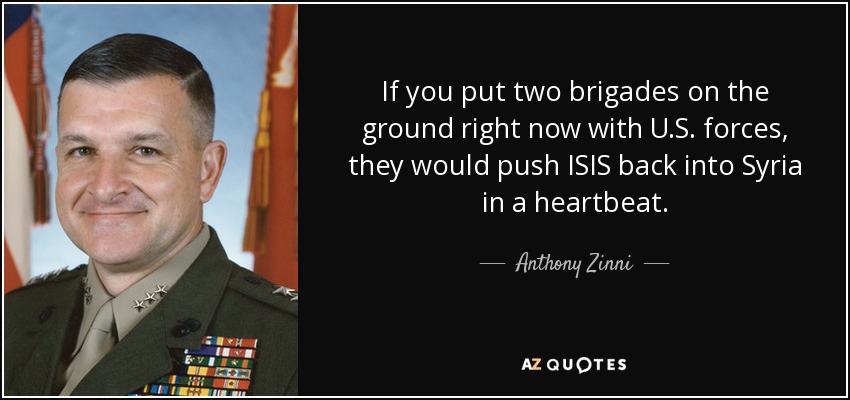
If you put two brigades on the ground right now with U.S. forces, they would push ISIS back into Syria in a heartbeat.
Isil poses a threat to the people of Iraq and Syria, and the broader Middle East - including American citizens, personnel and facilities. If left unchecked, these terrorists could pose a growing threat beyond that region, including to the United States.
In the fight against ISIL, we cannot rely on an Assad regime that terrorizes its people; a regime that will never regain the legitimacy it has lost. Instead, we must strengthen the opposition as the best counterweight to extremists like ISIL, while pursuing the political solution necessary to solve Syria's crisis once and for all.
The international community has to overcome its differences and find solutions to the conflicts of today in South Sudan, Syria, Central African Republic and elsewhere. Non-traditional donors need to step up alongside traditional donors. As many people are forcibly displaced today as the entire populations of medium-to-large countries such as Colombia or Spain, South Africa or South Korea.
The idea that Hezbollah is acting as an agent of Iran is very dubious. It's not accepted by specialists on Iran or specialists on Hezbollah. But it's the party line. Or sometimes you can put in Syria, i.e. "Syrian-supported Hezbollah," but since Syria is of less interest now you have to emphasize Iranian support.
It would seem to be the case that pressure on Iran to acquire nuclear weapons is almost totally driven by their need for a deterrent capability to avoid the fate of Iraq, Libya. The use of American military force in Syria thus sends exactly the opposite message as supposedly desired to the leadership in Tehran - and to others. North Korea has been dealt with diplomatically because it has the bomb and might use it if provoked.
While in the American academia the knowledge production on the Middle East in general and Syria in particular has been considerably transformed in recent years, the dissemination of these more updated views fails to reach the conventional educational system. For two main reasons: Politics can still subdue and censor views that are not endorsed ideologically, and academics have still not learned how to write openly, directly and, one should say, courageously about these issues.
So there are two separate tracks. One track is for the Syrian government and the opposition that is interested in a peaceful future of Syria to come together for national unity, for the political process. At the same time, it is a requirement for everybody to stop supporting the extremist groups, to stop allowing them safe passage, to stop allowing them to receive weapons, to stop allowing them to receive financial assistance, and to come together in actually fighting them.
People have been fed misinformation. The fact is that the fighting that is going on on the ground in Syria is with Al Qaeda, with Jabhat al Nusra, with Daesh. The pockets, small pockets, of other groups are usually surrounded by these various extremist groups. . . . Once they stop fighting, there is nothing for the Syrian government to hit other than the terrorist organizations.
Nobody thinks identically on Syria. But we share the same view with Russia that the future of the personalities in Syria will be determined by the people of Syria and not by people outside Syria.
The United States wanted to send its trained rebel groups to Syria to fight ISIS. Out of twenty-five hundred rebels they had trained, only seventy accepted to go to Syria to fight ISIS. Everybody else wanted to go to Syria to fight the government. So you've got to wake up and smell the coffee. . . . The rebel groups have not fired a shot against ISIS.
We try to coordinate regularly with Russia, as well as with others - except for the United States - on what is happening in the region. And we're open to discussing with everybody the situation in Syria, because we believe it's a common threat.
We have to remember examples of many artists of conscious rap who have been coopted by the Department of State of the United States to be cultural ambassadors in different parts of the world, like Syria, like other parts of the Middle East, including conscious Islamic-American rappers that are representing an international political agenda for the United States through cultures more affable for people of color in other parts of the world.
We need to increase our military spending. We need to deal with a no- fly zone in Syria, a safe zone.
Syria is bad enough, it's a pretty terrible atrocity. But there are much worse ones in the world. So for example, the worst atrocities in the past decade have been in the Congo, the Eastern Congo, where maybe 5 million people have been killed.
Credible reports came through that Syria had used chemical weapons. Whether it's true actually is still open to question, but it's very probably true. At that point, what was at stake was what is called credibility. So if you read the political actors, political leadership, foreign policy commentary, they constantly point out accurately that US credibility was at stake, and we have to maintain US credibility. So therefore something had to be done to show you can't violate our orders.
A bombing was planned [in Syria], which would probably make the situation worse, but would at least establish US credibility.
I think it was going to be hard to work with Russians on Syria. There is some potential overlap between the U.S. and Russia in that the Russians don't want to see the Syria situation unravel to a point where they have to escalate their own involvement. But at the moment, I don't see the U.S. and Russia on the same page in Syria. Russia seems much more interested in consolidating government control over liberated areas. It seems to me that the U.S. and Russia are proving they can disagree for independent reasons in any number of theaters.
For the West, they wanted to undermine the Syrian positions. For the petrodollar countries like Saudi Arabia, they're thinking undermining Syria will undermine Iran on sectarian basis.
[Peace in Syria] is [António Guterres] priority, and of course it's our priority, that's self-evident.
Peace in Syria is not only our priority; it's a Middle Eastern priority, and when the Middle East is stable, the rest of the world is stable, because the Middle East is the heart of the world geographically and geopolitically, and Syria is the heart of the Middle East geographically and geopolitically.
We are ready to cooperate in any way to achieve stability in Syria, of course taking into consideration the interest of the country, and the will of the Syrian people.
I would say I need two things: the first one is to be objective in every statement he could make regarding any conflict around the world, including Syria. The second one is not to turn Secretary-General office into a part or branch of the State Department of the United States.
My decision was, and the decision of the different institutions, and the decision of the different officials in Syria - I'm on top of them - was to have dialogue, to fight terrorists, and to reform as a response at the very beginning, response to the allegations, let's say, at that time, that they needed reform in Syria, we responded.
We are engaging in the diplomatic efforts that are required within Iraq among the Shia, the Sunni and the Kurd, among friends, like Egypt, and Turkey and Saudi Arabia, but also enemies like Iran and Syria. They have to have buy-in into that process.
Follow AzQuotes on Facebook, Twitter and Google+. Every day we present the best quotes! Improve yourself, find your inspiration, share with friends
or simply: