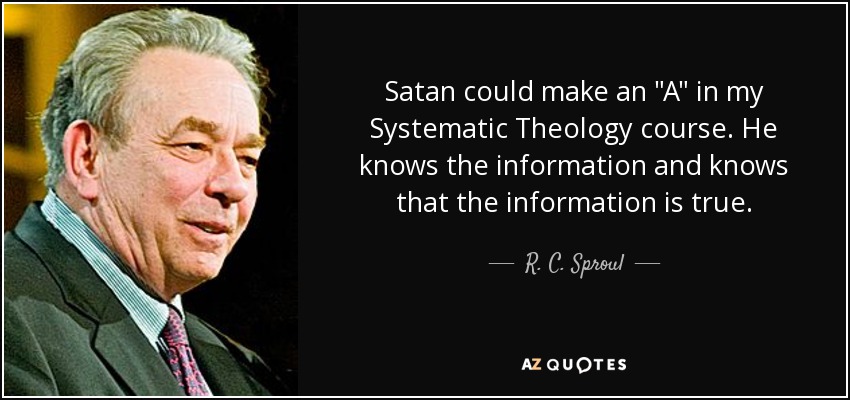
Satan could make an "A" in my Systematic Theology course. He knows the information and knows that the information is true.
Tell me your doctrine of the Fall and I will tell you the state of your theology.
Contemporary Christian proclamation is faced with the question whether, when it demands faith from men and women, it expects them to acknowledge this mythical world picture from the past. If this is impossible, it has to face the question whether the New Testament proclamation has a truth that is independent of the mythical world picture, in which case it would be the task of theology to demythologize the Christian proclamation.
The states of consciousness are all that psychology needs to do her work with. Metaphysics or theology may prove the Soul to exist; but for psychology the hypothesis of such a substantial principle of unity is superfluous.
Religion, therefore, as I now ask you arbitrarily to take it, shall mean for us the feelings, acts, and experiences of individual men in their solitude, so far as they apprehend themselves to stand in relation to whatever they may consider the divine. Since the relation may be either moral, physical, or ritual, it is evident that out of religion in the sense in which we take it, theologies, philosophies, and ecclesiastical organizations may secondarily grow.
I firmly believe that the method which sets theological theories against scientifically ascertained facts, is fatal to the current theology and injurious to the spirit of religion; and that the method which frankly recognizes the facts of life, and appreciates the spirit of the scientists whose patient and assiduous endeavor has brought those facts to light, will commend the spirit of religion to the new generation, and will benefit--not impair--theology as a science, by compelling its reconstruction.
Like all great theologies, Bill [O'Reilly]'s can be boiled down to one sentence: There must be a god, because I don't know how things work.
Philosophy finds itself to be no longer anything but the heir to a fabulous mystical theology, but missing a God and wiping the slate clean.
There is a notion that complete impartiality is the most fitting and indeed the normal disposition for true exegesis , because it guarantees complete absence of prejudice. For a short time, around 1910, this idea threatened to achieve almost a canonical status in Protestant theology. But now, we can quite calmly describe it as merely comical.
The third major characteristic of God - "infinitude" - is the catchall, the universal modifier of Christian theology. God is not merely a being; he is infinite being. God is not merely good; he is infinite goodness. God is not merely wise; he is infinite wisdom. And so on down the list. God is exaggeration run amuck.
The Book of Job and the 19th Psalm, which even the Church admits to be more ancient than the chronological order in which they stand in the book called the Bible, are theological orations conformable to the original system of theology.
I`m impressed that people out there in Pennsylvania, deer hunter country, have had it with these stupid wars, that they don`t go along with the neocon theology, they don`t go along with the big money people or the evangelicals that always seem to want to fight, especially in the Middle East.
I think the opportunity to deal with students and getting them properly oriented on science and theology and the relation between those is going to be important because science has been such an instrument used by the materialists to undermine the Christian faith and religious belief generally.
Like the Bible-a document that often contradicts itself and from which one can construct sharply different arguments-theology is the product of human hands and hearts.
Rationally considered, nothing can be more absurd than the baptism of infants under any circumstances. No statement, no matter by whom it may be said to have been uttered, can make that true which is radically false. If an innocent child, unconscious of good or evil, irresponsible to God and man, incapable of thought or action, is not already, in accordance with Christian theology, a member of Christ, then no vicarious promise or priestly ablution can make him one. For if this were so, a similar ceremony under devil worship could make him a member of Satan.
Christianity in our country is a lot like what the Ducksters profess. No longer doctrinaire or demanding, the mishmash of pop-religion practiced in churches across America is an extension of the therapeutic culture: festooned with feelings, mostly misdirected. Untempered by intelligent interpretation of scripture... American pop-theology: light on doctrine, heavy on hellfire and damnation.
Infinite possibility in all things is a certainty. That pretty much covers theology and philosophy for me.
Margaret Miles offers a stunning treatment of human experience, coaxing humans to leave dualisms behind and embrace our intelligent bodies. In a foundational text, she draws on the arts, philosophy and theology, and her experience as a hospice volunteer to explore concrete alternatives to privileging the rational mind. Her erudition, wisdom, and graceful writing are compelling proof of the intelligent body.
Science tells us what we can know but what we can know is little and if we forget how much we cannot know we become insensitive of many things of very great importance. Theology, on the other hand induces a dogmatic belief that we have knowledge where in fact we have ignorance and by doing so generates a kind of impertinent insolence towards the universe. Uncertainty in the presence of vivid hopes and fears is painful, but must be endured if we wish to live without the support of comforting fairy tales.
There is nothing more negative than the result of the critical study of the life of Jesus. The Jesus of Nazareth who came forward publicly as the Messiah, who preached the Kingdom of God, who founded the Kingdom of Heaven upon earth, and died to give his work its final consecration, never had any existence. He is a figure designed by rationalism, endowed with life by liberalism, and clothed by modern theology in an historical garb.
The antagonism between science and religion, about which we hear so much, appears to me to be purely factitiousfabricated, on the one hand, by short-sighted religious people who confound a certain branch of science, theology, with religion; and, on the other, by equally short-sighted scientific people who forget that science takes for its province only that which is susceptible of clear intellectual comprehension; and that, outside the boundaries of that province, they must be content with imagination, with hope, and with ignorance
Next to theology I give to music the highest place and honor. And we see how David and all the saints have wrought their godly thoughts into verse, rhyme, and song.
The more I read, the less I admire modern theology. the more I study the productions of the new schools of theological teachers, the more I marvel that men and women can be satisfied with such writings. There is a vagueness, a mistiness, a shallowness, an indistinctness, a superficiality, an aimlessness, a hollowness about the literature of the 'broader and kinder systems', as they are called, which to my mind stamps their origin on their face. They are of the earth, earthy.
To escape the power of the unknown, to prove to yourself that you don't believe in it, you accept its spells. Like an avowed atheist who sees the Devil at night, you reason: He certainly doesn't exist; this is therefore an illusion, perhaps a result of indigestion. But the Devil is sure that he exists, and believes in his upside-down theology. What, then, will frighten him? You make the sign of the cross, and he vanishes in a puff of brimstone.
There is superstition in science quite as much as there is superstition in theology, and it is all the more dangerous because those suffering from it are profoundly convinced that they are freeing themselves from all superstition.
Follow AzQuotes on Facebook, Twitter and Google+. Every day we present the best quotes! Improve yourself, find your inspiration, share with friends
or simply: