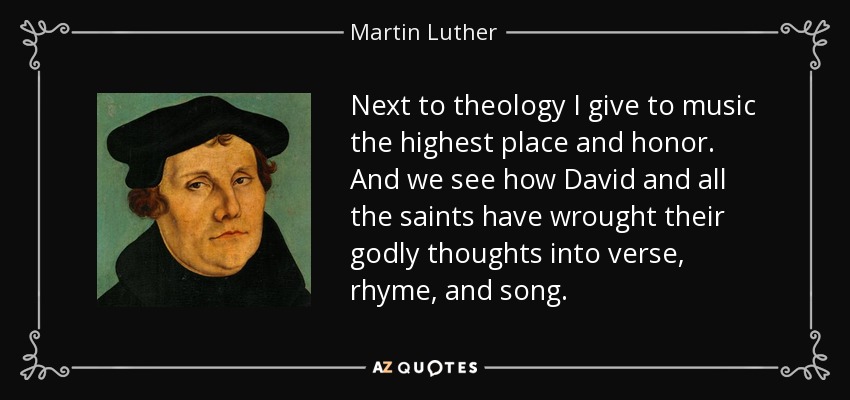
Next to theology I give to music the highest place and honor. And we see how David and all the saints have wrought their godly thoughts into verse, rhyme, and song.
The more I read, the less I admire modern theology. the more I study the productions of the new schools of theological teachers, the more I marvel that men and women can be satisfied with such writings. There is a vagueness, a mistiness, a shallowness, an indistinctness, a superficiality, an aimlessness, a hollowness about the literature of the 'broader and kinder systems', as they are called, which to my mind stamps their origin on their face. They are of the earth, earthy.
To escape the power of the unknown, to prove to yourself that you don't believe in it, you accept its spells. Like an avowed atheist who sees the Devil at night, you reason: He certainly doesn't exist; this is therefore an illusion, perhaps a result of indigestion. But the Devil is sure that he exists, and believes in his upside-down theology. What, then, will frighten him? You make the sign of the cross, and he vanishes in a puff of brimstone.
There is superstition in science quite as much as there is superstition in theology, and it is all the more dangerous because those suffering from it are profoundly convinced that they are freeing themselves from all superstition.
This whole Christian theology thing is that god came down to experience life through his son. Well, how's he experiencing life if he doesn't get laid? Give me a break. And why would he not get laid, as he created the apparatus in the first place?
The spirit of dogmatic theology poisons anything it touches.
Liberty's chief foe is theology.
Unlike music or poetry or painting, food rouses no response in passionate and emotional youth. Only when the surge of the blood is quieted does gastronomy come into its own with philosophy and theology and the sterner delights of the mind.
Even if nothing worse than wasted mental effort could be laid to the charge of theology, that alone ought to be sufficient to banish it from the earth, as one of the worst enemies of mankind.
Proclaim a theology of divine righteousness which demands justice, respect, tolerance, compassion, inclusiveness, trust in the ultimate efficacy of divine zeal, and the rigorous pursuit of peace in the midst of competing interests and faith claims.
The church has contributed nothing to civilization. It has progressed somewhat, and it has become a little more decent, in reflection of the movements of civilization that have taken place outside of the church and usually in the face of the strong opposition of the church. But the church has always resisted the process of civilization. It has struggled to the last ditch, by fair means and foul, to preserve as long as it could the vestiges of ancient and medieval theology, with all the puerile moralities and harsh customs and medieval styles of belief.
The sooner the doctrine of original sin disappears, the better it is for theology.
It's better to emphasize biblical theology, partly because there are fine Study Bibles already available that lean into systematic theology, and partly because biblical theology is particularly strong at helping readers see how the Bible hangs together in its own categories: that is, God in his infinite wisdom chose to give us his Word in the 66 canonical books, with all of their variations in theme, emphasis, vocabulary, literary form, and distinctive contributions across time.
I think a lot it was the theology, that the road to Jerusalem runs through Baghdad, that somehow if we broke apart the rejectionist states, like Iraq, then the whole Middle East would reconfigure itself into a more favorable environment for democracy and Israel and us.
I hope and believe my co-religionists understand and admit that I disclaim their theology in toto, and that by no twisting of language or darkening of its meanings can I be made to have any thing whatever in common with them about religious matters... they must take my word for it that there is nothing in common between their theology and my philosophy.
To discover the true principles of morality, men have no need of theology, of revelation, or of gods. They need but common sense. They have only to look within themselves, to reflect upon their own nature, to consult their obvious interests, to consider the object of society and of each of the members who compose it, and they will easily understand that virtue is an advantage, and that vice is an injury to beings of the species.
There is a broad distinction between religion and theology. The one is a natural, human experience common to all well-organized minds. The other is a system of speculations about the unseen and the unknowable, which the human mind has no power to grasp or explain, and these speculations vary with every sect, age, and type of civilization. No one knows any more of what lies beyond our sphere of action than thou and I, and we know nothing.
There is nothing more negative than the result of the critical study of the life of Jesus. The Jesus of Nazareth who came forward publicly as the Messiah, who preached the Kingdom of God, who founded the Kingdom of Heaven upon earth, and died to give his work its final consecration, never had any existence. He is a figure designed by rationalism, endowed with life by liberalism, and clothed by modern theology in an historical garb.
But the others, those who tried to bring Jesus to life at the call of love, found it a cruel task to be honest. The critical study of the life of Jesus has been for theology a school of honesty. The world had never seen before, and will never see again, a struggle for truth so full of pain and renunciation as that of which the Lives of Jesus of the last hundred years contain the cryptic record.
I went to Notre Dame. I don't know if that has any relevance, but maybe we all had a little too much philosophy and theology.
I was born in 1965. When I grew up in India, there was no expectation that a good Muslim woman wore the headscarf. But what happened when I came here to the U.S. and the emergence of the Saudi and Iranian theologies in the world is that the headscarf became the hijab and the hijab is now the idea that is synonymous with headscarf.
What it does remind us is that 'God' is not to be separated from the quest for the Kingdom of God and is not and cannot be the object of any detached 'scientific' contemplation. Heidegger's critique of onto-theology is also driving a wedge between speaking of God and the aims of science - not so as to get rid of God but rather to free God from a false objectification.
Barth's approach tears up any possibility of dialogue between faith and unfaith or between theology and other human sciences. Theology just says what it says on the basis of scripture, and that's that.
So we didn't get the denominations and the separate congregations really till about into Civil War time. What's happened then, of course, is now that we've had well over 100 years of this history to establish separate cultures, different ways of worshipping, and different ways of understanding theology so that when people try to come together makes it very difficult. And then, of course, social networks, you know, how do we find a place to worship?
What I see now is that even with the Islamists, who have been portraying themselves as the alternative to corruption and dictatorship and in defence of more transparency, there is one respect in which they have now changed completely. Since the beginning of the 1920's, Islamism was very close in positioning in some respects to 'liberation theology'. But that is no longer the case.
Follow AzQuotes on Facebook, Twitter and Google+. Every day we present the best quotes! Improve yourself, find your inspiration, share with friends
or simply: