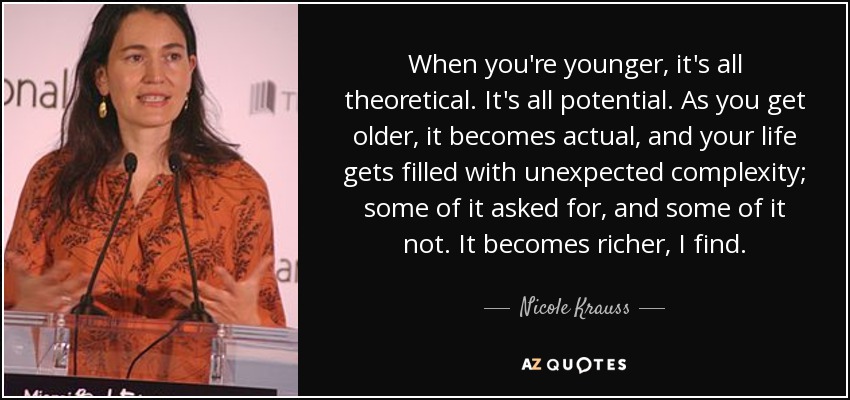
When you're younger, it's all theoretical. It's all potential. As you get older, it becomes actual, and your life gets filled with unexpected complexity; some of it asked for, and some of it not. It becomes richer, I find.
The classes of problems which are respectively known and not known to have good algorithms are of great theoretical interest. [...] I conjecture that there is no good algorithm for the traveling salesman problem. My reasons are the same as for any mathematical conjecture: (1) It is a legitimate mathematical possibility, and (2) I do not know.
When I was a college student at Yale, I was studying physics and mathematics and was absolutely intent on becoming a theoretical physicist.
Can the vast technology beneath our gaze be anything but a representation? Any optical artifact... The city panorama is a theoretical (ie visual) simulacrum: in short, a picture, of which the preconditions for feasibility are forgetfulness and a misunderstanding of processes.
The ultimate arbiter of truth is experiment, not the comfort one derives from one's a priori beliefs, nor the beauty or elegance one ascribes to one's theoretical models.
I see anarchism as the theoretical ideal to which we are all gradually evolving to a point where everybody can tell the truth to everybody else and nobody can get punished for it. That can only happen without hierarchy and without people having the authority to punish other people.
Clearly, one does not have to give up being an academic, retreat from rigorous research, or renounce the importance of specialization in order to address major social issues. I don't think you give up theoretical rigor by writing in a way that addresses major social concerns and is at the same time accessible to wider informed general audiences.
Thus, the weight of my criticism is directed against the inadequacy of the theoretical foundations of the laissez-faire doctrine upon which I was brought up and for many years I taught
The idea of buddha mind is not purely a concept or a theoretical, metaphysical idea. It is something extremely real that we can experience ourselves. In fact, it is the ego that feels that we have an ego. It is ego that tells us, My ego is bothering me. I feel very self-conscious about having to be me. I feel that I have a tremendous burden in me, and I wonder what the best way to get rid of it is. Yet all those expressions of restlessness that keep coming out of us are the expression of buddha nature: the expression of our unborn, unobstructed, and nondwelling nature.
Mine is an enthusiastic and dionysian pessimism, like a flame that sets my vital exuberance ablaze, that mocks at any theoretical, scientific or moral prison.
Knowledge has the form of a tree, and since metaphysics is the most fundamental one of the theoretical disciplines, it represents the roots of the tree.
I would be lying, however, if I claimed that I could always formulate worthwhile hypotheses on the basis of my theoretical framework. Sometimes there were no reflexive processes to be found; sometimes I failed to find them; and, what was the most painful of all, sometimes I got them wrong. One way or another, I often invested without a worthwhile hypothesis and my activities were not very different from a random walk.
I started out in nuclear physics. But after I became more sensitized to the environmental and health implications of the nuclear system - I was being trained to be the first women in the fast-breeder reactor in India (and was in it when it first went critical) - I didn't feel comfortable with it. So I went into theoretical physics.
I have confronted theoretical positions whose protagonists claim that what I take to be historically produced characteristics of what is specifically modern are in fact the timelessly necessary characteristics of all and any moral judgment, of all and any selfhood.
Our relationships as experimentalists with theoretical physicists should be like those with a beautiful woman - we should accept with gratitude any favours she offers, but we should not expect too much nor believe all that is said.
Is the purpose of theoretical physics to be no more than a cataloging of all the things that can happen when particles interact with each other and seperate? Or is it to be an understanding at a deeper level in which there are things that are not directly observable (as the underlying quantized fields are) but in terms of which we shall have a more fundamental understanding?
In an enterprise such as the building of the atomic bomb the difference between ideas, hopes, suggestions and theoretical calculations, and solid numbers based on measurement, is paramount. All the committees, the politicking and the plans would have come to naught if a few unpredictable nuclear cross sections had been different from what they are by a factor of two.
We do have tendency, now in biology especially to make up stories, to make theoretical biology a kind of game, in fact we have game theory in biology which is meant to use the theory of games to make predictions or explain things.
We've been following many forms of democratized ownership, starting with co-ops, land banks at the neighborhood level, municipal ownership and state ownership of banks - there's a whole series of these that attempt to fill the small-scale infrastructure that can build up to a larger theoretical vision.
The life of theoretical philosophy is the best and happiest a man can lead. Few men are capable of it and then only intermittently. For the rest there is a second-best way of life, that of moral virtue and practical wisdom.
Because of recent improvements in the accuracy of theoretical predictions based on large scale ab initio quantum mechanical calculations, meaningful comparisons between theoretical and experimental findings have become possible.
After some minor pieces of theoretical study that I worked on, a student in my statistical mechanics class brought to my attention a problem in polyelectrolytes.
Names and theoretical things don't occur to me. If they do, I'm not doing my real playing mode.
Carlsen came with a line that was not very theoretical, trying to challenge the World Champion to play chess. [...] But Anand proved that even this obscure line is something he has studied before, and it was Carlsen that was set back.
My relationship to the desecration of the earth was very theoretical and intellectual until I got sick. I could never watch anything about polar bears dying or the death of bees. There were certain things I knew I couldn't go near because they were too devastating. But I don't think until I got cancer did I get it in my body, what was happening to the earth. I finally went: "Oh! Earth! Organism!"
Follow AzQuotes on Facebook, Twitter and Google+. Every day we present the best quotes! Improve yourself, find your inspiration, share with friends
or simply: